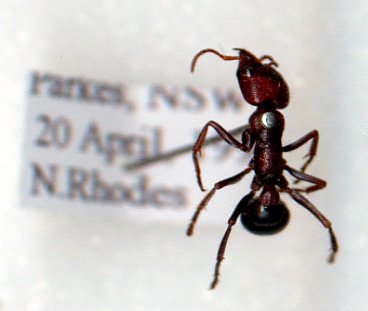
Meat Ant
Gravel Ant
 Click to enlarge image
© Australian Museum
Fast Facts
-
Classification
- Genus
- Iridomyrmex
- Species
- purpureus
- Subfamily
- Dolichoderinae
- Family
- Formicidae
- Super Family
- Vespoidea
- Suborder
- Apocrita
- Order
- Hymenoptera
- Class
- Insecta
- Subphylum
- Uniramia
- Phylum
- Arthopoda
- Kingdom
- Animalia
-
- Size Range
- 1 cm
Meat Ants are members of the genus Iridomyrmex, which is the most abundant, conspicuous and ecologically important group of ants in Australia.
Habitat
Meat Ants live in sandy/gravel soils in urban areas, forests and woodlands, and heath.
Distribution
Meat Ants are found throughout Australia.
Feeding and diet
Iridomyrmex species, including Meat Ants, are omnivores (eat plants and animals) and forage during the day while other species of ants in the area may be restricted to foraging at night.
Other behaviours and adaptations
Meat Ants, also known as Gravel Ants, build large nests underground and often place sand, gravel, pebbles or even bits of dead vegetation on the upper (mounded) surface of the nest. Large nests are common along some of Sydney's country roadsides and a single nest may contain 64,000 ants. Sometimes a number of nests will be part of one colony and can be spread over a wide area connected by numerous ant paths and trails. These super-nests are known to stretch up to 650 m.
They are aggressive towards intruders, attacking other invertebrates, which they may eat, and driving off much larger animals by sheer weight of numbers.
Border disputes may occur between rival colonies and are resolved by ritual fighting.
Meat Ants and other Iridomyrmex species are often involved in mutually beneficial (symbiotic) relationships with caterpillars of different butterflies. The caterpillars supply sugary fluids to the ants, which in turn protect the caterpillars from predators.
Communication
Workers of the colony are equipped with powerful jaws and communicate with each other using chemical cues.
Economic impacts
In rural Australia farmers may use these ants to remove animal carcasses from their land. A dead animal placed on a nest would be reduced to bones over a period of weeks.
Danger to humans
Members of the subfamily Dolichoderinae, which includes Meat Ants, lack a sting, but they are armed with defensive compounds produced by the anal gland - a structure unique to this subfamily. This is the source of the pungent, and often unpleasant odors produced by many species in this family when they are disturbed, crushed or otherwise annoyed. They also do bite repeatedly and aggressively defend their nests and territories.