Corpse fauna
Many kinds of organisms live by feeding on dead bodies.
On this page...
In the process, their activities result in the decomposition of the body and the recycling of nutrients.
The dominant groups of organisms involved in decomposition are bacteria, flies, beetles, mites and moths. Other animals, mainly parasitoid wasps, predatory beetles and predatory flies, feed on the animals that feed on the corpse.
A dead body is therefore an ecosystem of its own, in which different fauna arrive and depart from the corpse at different times. The arrival time and growth rates of insects inhabiting corpses are used by forensic scientists to determine the circumstances surrounding suspicious deaths.
Bacteria
There are many forms of bacteria, which gain their energy in a variety of ways.
Some bacteria are autotrophic, making their own food in a similar way to plants by splitting carbon dioxide using energy from the sun, or through the oxidation of elements such as nitrogen and sulphur.
Bacteria involved in the decomposition of animal bodies are heterotrophic, breaking down complex molecules into their constituent elements through respiration or fermentation (depending on whether they are aerobic or anaerobic bacteria). Bacteria are largely responsible for the recycling of carbon, nitrogen and sulphur into forms where they can be taken up by plants.
For example, heterotrophic bacteria like Bacillus decompose proteins, releasing ammonia, which is oxidised by other bacteria into nitrogen dioxide, and eventually into nitrate. Nitrate can be assimilated by plants as a source of nitrogen.

Intestinal Bacteria.
Image: D. Colgan© Australian Museum
Flies
The larvae of flies (maggots) are the most obvious and abundant fauna present on corpses in the early stages of decomposition.
House flies Muscidae and blowflies Calliphoridae are the first to arrive (pioneer flies). Flies in both these families lay eggs (although some blowflies 'lay' larvae). The recently hatched larvae, as well as their parents, initially feed on the fluids that exude from the body. Later they enter the body through natural openings or wounds, and eventually feed over the whole body as the tissues decay.
Different species of housefly and blowfly arrive at different times after death, and there can be considerable competition among flies for access to a corpse. Early arrivals, and flies which hatch faster, can gain a competitive advantage, although the flesh is easier to consume after it has undergone some decomposition. Flesh flies Sarcophagidae arrive slightly later than the other families, but they compensate for their late arrival by giving birth to larvae (maggots) rather than eggs. The succession of fauna that inhabit the corpse change its condition, making it suitable for succeeding fauna.
Juicy maggots provide an abundant food source for other animals, including other species of fly. The Blowfly, Chrysomya rufifacies, feeds on maggots of other flies as well as consuming decaying flesh. The larvae of Chrysomya are covered with protrusions called papillae, which serve as protection against the predatory attacks of other maggots.
When the corpse has dried out, two other groups of flies, the cheese flies Family Piophilidae and the coffin flies Family Phoridae join the beetles and mites in cleaning up the skeleton.

Adult blowflies use spongy mouth parts to soak up fluids exuded from the body. Electron micrograph.
Image: S. Lindsay© Australian Museum

Australian Sheep Blowfly, Lucilia cuprina.
Image: R. Major© Australian Museum
The Green-bottle, Lucilia cuprina, is a worldwide pest of sheep, imported to Australia from China. It is virtually identical to Lucilia sericata but occurs in drier areas. As well as laying in dead bodies and garbage tips, female Lucilia cuprina lay in parts of the fleeces of sheep that are contaminated with faeces and urine. The ammonia in urine is particularly attractive to the flies, and the young larvae can become established where the skin of the sheep has become irritated by the urine. These flies can then attack the living flesh of the sheep.
Lucilia cuprina is one of the first flies to lay its eggs in a corpse, and the larvae are of the smooth form.

Australian Sheep Blowfly, Lucilia cuprina.
Image: R. Major© Australian Museum
The Green-bottle, Lucilia sericata, was introduced to Australia from Europe, and although it is virtually identical to Lucilia cuprina it only rarely attacks live sheep. It is also more coastal in its distribution, occurring in moister climates. Like Lucilia cuprina, it is one of the first visitors to a corpse, and the larval stages are smooth.

Eastern Golden Haired Blowfly, Calliphora stygia - Corpse Fauna
Image: R. Major© Australian Museum
Calliphora stygia is a large brown blowfly that is common and annoying in houses, and features regularly in insecticide commercials. It is one of the earliest flies to visit a corpse and will also feed on living sheep provided that Lucilia cuprina has invaded the sheep's tissues first. Unlike Lucilia, this species of blowfly is present throughout the year, and is able to exploit corpses during the cold months.

A female Green Hairy Maggot Blowfly Chrysomya rufifacies, ready to lay eggs.
Image: R. Major© Australian Museum
Chrysomia rufifacies is a large, metallic green blowfly whose larvae are predaceous, feeding on the larvae of earlier-arriving flies. Adult females do not lay their eggs in a corpse until the body is partially decomposed and maggots are available as prey. The larvae of Chrysomia rufifacies have tough spiny skin, which gives them protection against other predators. The larvae pupate on the surface, rather than burrowing into the soil, and they are particularly vulnerable to parasitism by wasps.


House flies Family Muscidae

House flies Family Muscidae - House Fly, Musca domestica
Image: R Major© Australian Museum
Adult house flies usually have spongy mouthparts and feed on fluids such as human perspiration or solid food that can be liquefied by the secretion of fly-saliva upon it. The larvae of many species of house fly are compost and/or dung feeders, although they can also feed on carrion.
The true House Fly, Musca domestica, has been transported world-wide by humans and although the adults are commonly observed feeding on exuded fluid from a corpse, the larvae are usually dung feeders. Adults are most common at corpses in the early stages of decomposition when the corpse is moist.
Another type of House fly, Australophyra rostrata, is attracted to corpses in the later stages of decomposition, after maggots of blowflies have disappeared, but before the corpse is fully dry. The maggots feed on the carrion, but they sometimes also prey on smooth maggots.
Flesh flies - Family Sarcophagidae

Flesh fly - Family Sarcophagidae
Image: R. Major© Australian Museum
Flesh flies are stripey-backed or chequered flies, often with bright red eyes. They arrive at corpses slightly later than the pioneer blowflies, but the eggs hatch in the uterus of the female, before she lays them, with the result that the larvae are deposited directly on the body. This allows them to catch up on the blowflies, whose eggs take around 24 hours to hatch.
Adult flesh flies still sometimes find themselves in competition with blowflies, as they fight for the best laying sites. When several flies attempt to lay in the same site, flesh flies can often be observed using their legs to kick other flies that stray too close.
Flesh fly pupae can remain dormant for long periods. Maggots of some Sarcophaga species hibernate as pupae in autumn and do not emerge as adult flies until late spring. Flesh flies often emerge in people's houses after feeding on dead possums in their ceiling.
Flesh flies - Family Sarcophagidae

Flesh flies - Family Sarcophagidae Flesh flies are stripey-backed or chequered flies, often with bright red eyes. They arrive at corpses slightly later than the pioneer blowflies, but the eggs hatch in the uterus of the female, before she lays them, with the result that the larvae are deposited directly on the body. This allows them to catch up on the blowflies, whose eggs take around 24 hours to hatch.
Image: R Major© Australian Museum
Flesh flies are stripey-backed or chequered flies, often with bright red eyes. They arrive at corpses slightly later than the pioneer blowflies, but the eggs hatch in the uterus of the female, before she lays them, with the result that the larvae are deposited directly on the body. This allows them to catch up on the blowflies, whose eggs take around 24 hours to hatch.
Adult flesh flies still sometimes find themselves in competition with blowflies, as they fight for the best laying sites. When several flies attempt to lay in the same site, flesh flies can often be observed using their legs to kick other flies that stray too close.
Flesh fly pupae can remain dormant for long periods. Maggots of some Sarcophaga species hibernate as pupae in autumn and do not emerge as adult flies until late spring. Flesh flies often emerge in people's houses after feeding on dead possums in their ceiling.
Cheese flies - Family Piophilidae

Cheese flies - Family Piophilidae Cheese flies are attracted to the cheesy odour which emanates from a corpse during the later stages of decomposition, particularly when the body is undergoing butyric fermentation. They are also common pests of cheeses and hams. The Cheese Skipper, Piophila casei, has a worldwide distribution and is named after the behaviour of its maggots. When disturbed the larvae flex and release their bodies, skipping up to 15 cm into the air. Although arriving after the bulk of the body has been consumed by the pioneer flies, cheese flies can occur in large numbers - 4,363 flies emerged from pupae derived from a single sheep's head. Cheese Skippers have been found in coffins buried up to 3 m deep and in corpses up to 10 years old.
Image: G. Gowing© Australian Museum
Cheese flies are attracted to the cheesy odour which emanates from a corpse during the later stages of decomposition, particularly when the body is undergoing butyric fermentation. They are also common pests of cheeses and hams.
The Cheese Skipper, Piophila casei, has a worldwide distribution and is named after the behaviour of its maggots. When disturbed the larvae flex and release their bodies, skipping up to 15 cm into the air.
Although arriving after the bulk of the body has been consumed by the pioneer flies, cheese flies can occur in large numbers - 4,363 flies emerged from pupae derived from a single sheep's head.
Cheese Skippers have been found in coffins buried up to 3 m deep and in corpses up to 10 years old.
Beetles
The first beetles arrive at a corpse soon after the body begins to putrefy. In contrast to the flies, beetles have chewing mouthparts and can manage tougher foods than the semi-liquid material that fly larvae are so efficient at exploiting.
Three types of beetle make their living out of corpses. The early arrivals tend to be predatory adults that feed on fly larvae. Some of these species lay their eggs in the corpse, and the emerging larvae, which share their parents' powerful jaws, also feed on fly larvae. These species include the rove beetles (Staphylinidae), and hister beetles (Histeridae).
Late-arriving species tend to be specialist scavengers which feed on tougher parts like skin and tendons as the body dries out. The dominant late stage scavengers include the larvae of hide beetles (Dermestidae), and ham beetles (Cleridae).
Species such as the carrion beetles (Silphidae) are more variable in their diets. The adults are predatory, although they will eat some carrion, but their larvae are restricted to carrion on moist corpses.
Other families of beetles also eat carrion, for example, the carcass beetles (Trogidae), but they are minor players in the decomposition of corpses. In Australia, several dung beetles (Scarabaeini) are attracted to large carcasses, especially to the intestine of herbivorous mammals. These beetles have specialised, fluid-feeding mouthparts.
Beetles have a life cycle similar to the fly life cycle with egg, larval, pupal and adult stages. However, the number of instars (stage of development between moulting) in the larval stage varies between species from 2 up to 16, and the stages differ more from each other than the instars of fly larvae.

Close up of the mouth parts of a beetle
Image: S. Lindsay© Australian Museum
Rove beetles - Family Staphylinidae

Rove beetles - Family Staphylinidae Staphylinids are usually elongate beetles with small elytra (wing covers) and large jaws. Like other beetles inhabiting carrion, they have fast larval development with only three larval stages. Devil's Coach-horse Beetle, Creophilus erythrocephalus, is a common predator of carrion, and with its bright red head, is a very visible component of the fauna of corpses in Australia. Adults are early visitors to a corpse and they feed on larvae of all species of fly, including predatory fly larvae. They lay their eggs in the corpse, and the emerging larvae are also predators. Creophilus erythrocephalus has a long development time in the egg, so it is common during the later stages of decomposition. As well as consuming maggots, they can also tear open the pupal cases of flies, so there is sufficient food to sustain them at a corpse for long periods. Another rove beetle, Aleochara haemorrhoidalis feeds on eggs as well as young blowfly larvae.
Image: R. Major© Australian Museum
Staphylinids are usually elongate beetles with small elytra (wing covers) and large jaws. Like other beetles inhabiting carrion, they have fast larval development with only three larval stages.
Devil's Coach-horse Beetle, Creophilus erythrocephalus, is a common predator of carrion, and with its bright red head, is a very visible component of the fauna of corpses in Australia.
Adults are early visitors to a corpse and they feed on larvae of all species of fly, including predatory fly larvae. They lay their eggs in the corpse, and the emerging larvae are also predators. Creophilus erythrocephalus has a long development time in the egg, so it is common during the later stages of decomposition. As well as consuming maggots, they can also tear open the pupal cases of flies, so there is sufficient food to sustain them at a corpse for long periods.
Another rove beetle, Aleochara haemorrhoidalis feeds on eggs as well as young blowfly larvae.




Mites

Mite from the genus Macrocheles
Image: D. E. Walter© Australian Museum
Mites belong to the group Arachnida which includes spiders, ticks, mites, scorpions and harvestmen (i.e. they are not insects).
Many thousands of mites feed on a corpse over the full term of its exposure to the elements. Gamasid mites like Macrocheles are common in the early stages of decomposition, while tyroglyphid mites feed on dry skin in the later stages of decomposition.
Some mites and carrion beetles have developed lifestyles that benefit each other. For example beetles from the genus Necrophorus find the ammonia excretions of blowfly maggots toxic, making it impossible for them to inhabit a carcass dominated by maggots. However these beetles carry on their bodies a type of mite from the genus Poecilochirus which feeds on fly eggs. If the beetle and its cargo of mites arrive at the corpse before any fly eggs hatch into maggots, the mites keep the maggot population in check by eating the eggs allowing the beetles to safely occupy the corpse.
Moths
Some of the familiar clothes moths (Family Tineidae) feed on mammalian hair during their larval stages. Adult moths lay their eggs on a carcass after all the fly larvae have finished with it. On hatching, their larvae forage on any hair that remains. Tineid moths are therefore the final animals contributing to the decomposition of a carcass.

Moth Corpse Fauna - Scardia australasiella
Image: M. Bulbert© Australian Museum

Moth - Monopis argillacea
Image: M. Bulbert© Australian Museum
Parasitic wasps
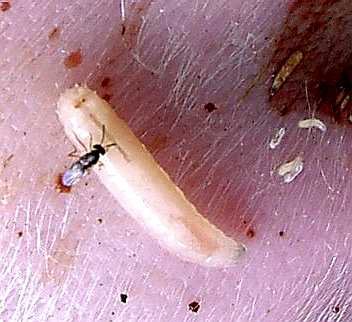
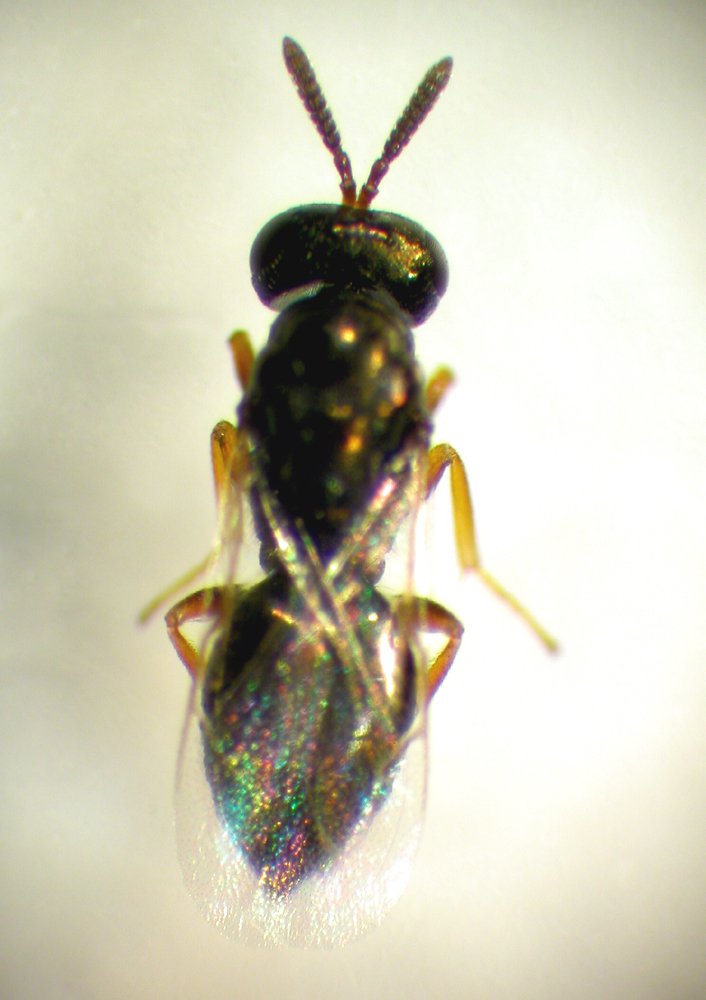
A number of families of wasp lay their eggs inside the larvae or pupae of flies, and are known as parasitoids. The wasp eggs hatch inside the maggot or fly pupa. The wasp larvae then feeds on the maggot or pupa, eventually killing it. The wasp larvae then pupate inside the maggot or fly pupa and emerge as adult wasps.
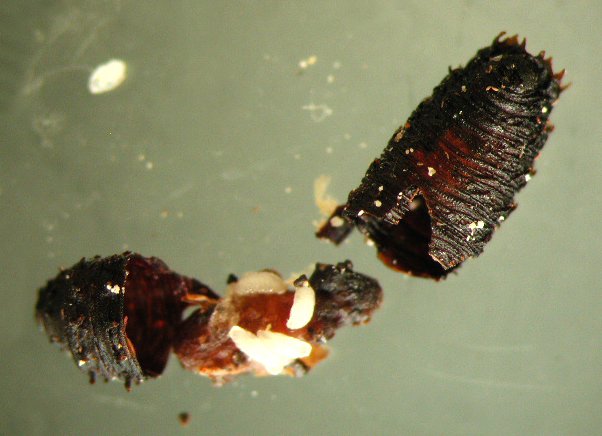
Wasps from the family Pteromalidae parasitise a variety of species but prefer the pupae of the predatory blowfly Chrysomya rufifacies. This is probably because this species pupates on the surface of the ground and is more accessible than the pupae of species that bury their pupae in the ground. One pupa is host to an average of 12 wasps.
Brachymeria calliphorae (Family Chalcidae) parasitises maggots rather than pupae, and only one wasp emerges from each maggot.
Only one wasp emerges from pupae parasitised by Hemilexomyia abrupta (Family Diapriidae) but this species appears to lay its eggs only in the pupae of the blowfly Calliphora stygia.