Animal Species:Daddy-long-legs Spider, Pholcus phalangioides

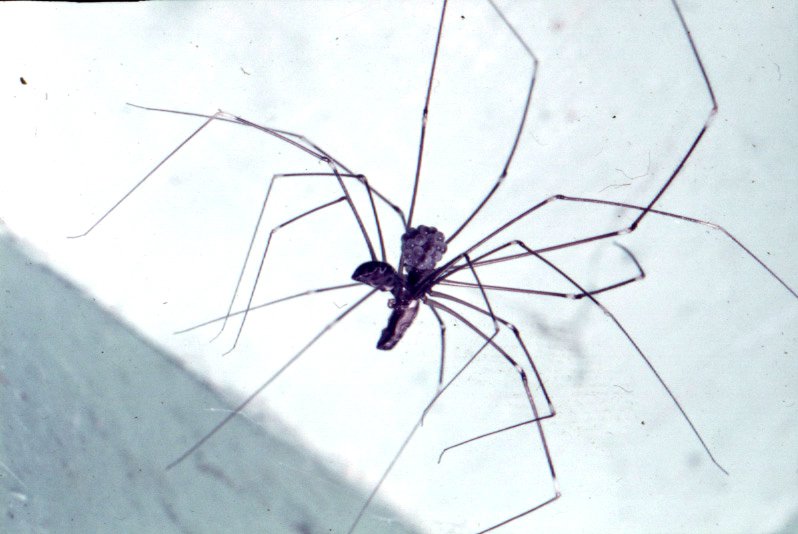
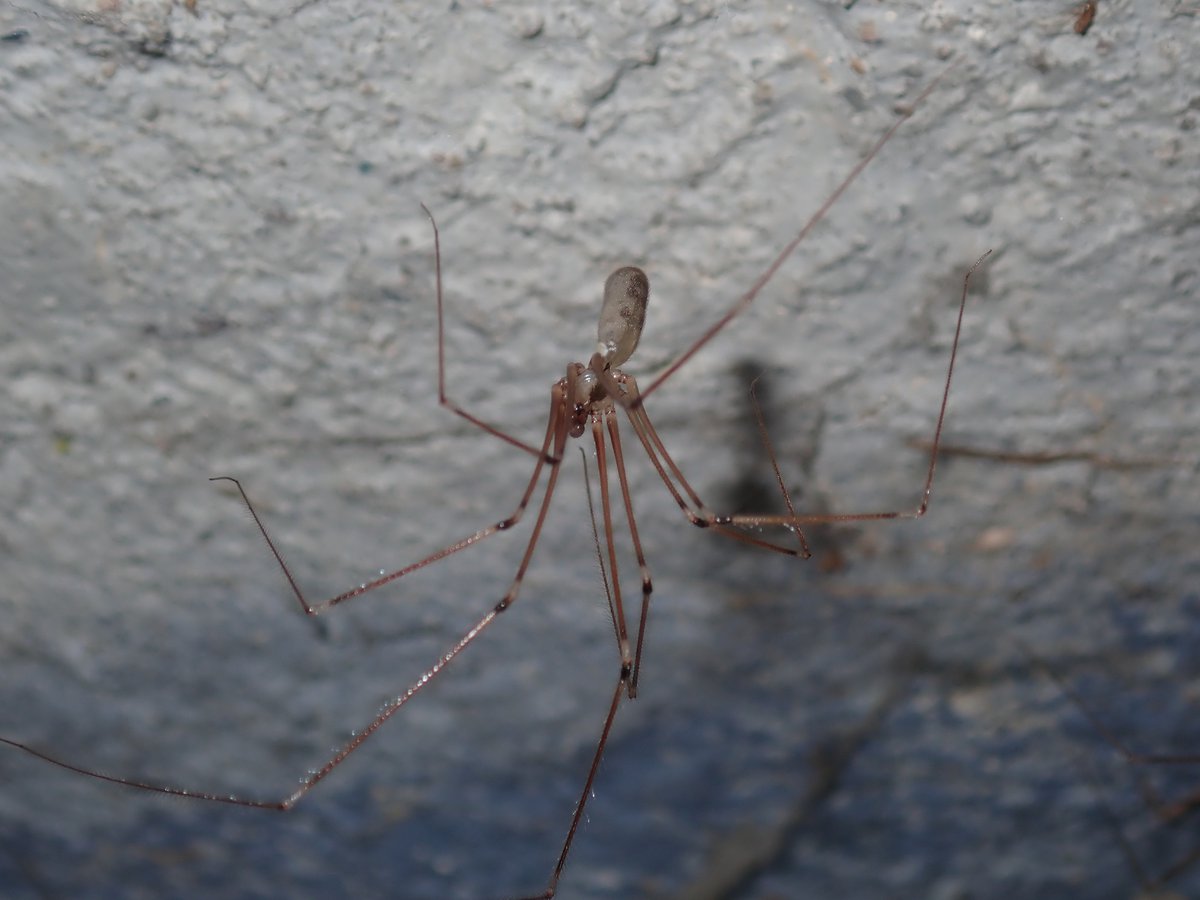
The cosmopolitan Daddy-long-legs Spider belongs to a group known as the tangle-web spiders.

Daddy-long-legs Spider

Daddy-long-legs Spider
R Mascord © Australian Museum

Help us improve our website and you could Win a Samsung Tablet

Number of species

12

Identification

Daddy-long-legs spiders are easily recognised by their extremely long, skinny legs and small body.  They are cream to pale brown.  Some species have darker markings on their legs and abdomen.

Size range

9 mm

Distribution

The Daddy-long-legs Spider, Pholcus phalangioides, is found throughout Australia. It is a cosmopolitan species that originates from Europe and was introduced accidently into Australia.

Habitat

Daddy-long-legs Spiders are found in most urban areas, in particular houses. They make a thin, tangled web in sheltered positions were they are unlikely to be disturbed, such as under furniture, behind doors, in the corner of the ceilings, in sheds, in garages and under decks. Its successful use of these human-made structures has made it one of the most common spiders in Australia.  If the Daddy-long-legs Spider is disturbed in the web it responds by setting up a a very fast, spinning motion, becoming a blur to anyone watching..

Habitat type

Terrestrial Habitat: peridomestic

What does this mean?

Feeding and Diet

The Daddy-long-legs Spider feeds on insects and other spiders.

Feeding Habits

arthropod-feeder, carnivorous, insectivorous, predator

What does this mean?

Life history mode

sedentary

What does this mean?

Danger to humans and first aid

There is a persistent belief that the Daddy-long-legs Spider has the most toxic venom of all spiders. However, there is no scientific evidence to back this up. The myth probably grew from observations that the Daddy-long-legs Spider will kill and eat a Redback Spider. However, the venom is not actually that potent, even for insects.

It had been thought that the fangs of this spider were incapable of piercing human skin. Recently, however, it was shown that the tiny fangs (about 0.25 mm) were actually capable of piercing human skin in a test done on the US television show, Mythbusters, but the stinging sensation produced was very short-lived. Most reputable sources, including the University of California, Riverside, still say that this species would never be considered as harmful to humans. However, in the unlikely event of a bite from this species, a positive identification of the spider by an expert should be made and medical attention sought if any reaction persists for more than a short time.

Classification

Species:
phalangioides
Genus:
Pholcus
Family:
Pholcidae
Order:
Araneae
Class:
Arachnida
Phylum:
Arthropoda
Kingdom:
Animalia

What does this mean?


Dr Mike Gray
Last Updated:

Tags spiders, araneae, arachnida, invertebrates, identification, classification,

12 comments

valyule - 9.03 PM, 29 March 2011
Today a daddy-long-legs captured a blowfly on my windowpane, and succeeded in tying it up into a little ball, although it was twice as big as the spider. The blowfly landed on its web, and buzzed like anything all through the procedure of being tied up. The spider used two legs to twirl the fly round and round, two legs to keep it connected to the fly, and the remainder of the legs to keep it standing. It twirled and twirled for about ten minutes, while the fly was gradually reduced to a small bundle. Then the spider zeroed in on it, and grasped it with its mandibles – whether to poison it or eat it I don’t know. I left it and came back two hours later. There was no sign of either the spider or the fly on the window-pane. Perhaps somewhere hidden on the frame
shantinga - 3.12 AM, 12 December 2010
hi @ jaymac, It sounds like what your describing is the white tailed spider im not sure if you are or not but i have a fair few white tails lurking around my home and i ahve killed some mean ones since living where i am. beacuse all white tails have a white tipped abdomen and white spots along there body and down there legs they also have a brownish body and are a long sorta spider
JayMac - 12.12 AM, 11 December 2010
I have recently found a group (4 in the one web at all times) of strange looking daddy long legs. They have a white tip on their tail and white spots on their legs. The largest was very aggressive before we killed it. They are definately part of the daddy long legs family i just don't know if they are very poisonous or not. Has anyone else ever seen anything like that?
belfoster - 8.11 PM, 07 November 2010
Hi, We have been infested with Redback spiders and are trying to find an effective control method, as their favorite places to hide are in my toddlers play equipment. How effective would Daddy Long-legs be in this?
Chris Hosking - 10.08 AM, 29 August 2010

Hi Darklldo,
 

It does sound like you have observed them mating. Within a few days you should see the female (whichever one that was) producing a bundle of eggs. A good online description of the reproduction of this genus is provided by this external website.

Enjoy!

Darklldo - 9.08 AM, 23 August 2010
Hello, I have a daddy long legs that lives next to my bathroom vanity basin. She/he has been there for about a month and does not appear to move or eat or anything. I have wondered if she had died, but if I blow gently on her she moves... so she is alive and well. She had a slightly larger visitor recently who usually lives behind the bathroom door, when he/she saw me he returned to his previous hiding place. Now I am brought to wonder if there could have been a mating = providing, of course, that they are compatible to mate.. Would love to know more.
Ondine Evans - 9.05 AM, 20 May 2010

Hi @KathBrad - we did some research and found some updated information on this species that accepts that its fangs may be able to pierce human skin and that the bite has an effect. We have amended our fact sheet accordingly, including links. Thankyou for alerting us to this.

KathBrad - 7.05 PM, 18 May 2010
Hi... I have been bitten by one of these Daddy Long Legs and so has my son. No confusion about the spider either. Little round body and thread-like long legs that are easily damaged. My own experience was when I had one on me and my mum said, 'Don't worry, they can't bite' and I watched as it lowered its body and bit. My faith in my mum was diminished after that... understandably. Then, more recently, my young son was bitten and he came up in a lump that made it look like his arm was broken. A severe allergic reaction. The bite marks became evident over a period. The skin had a greyness and I needed to give him antihistamines. So YES, they can bite and do pierce the skin.
Martyn Robinson - 10.04 AM, 21 April 2010

Hello Phillip,

Unfortunately very little work has been done on the web strength of individual species so I cannot tell you specifically how strong the silk of a Daddy-long-legs Spider  is. The silk strength will also vary greatly depending on whether the silk is moist or dried out, and also the type of purpose the spider produced it for (e.g framework silk doesn't need to be too stretchy and strong while prey catching silk does). One of the methods of determining the strength of a cord or line is the breaking length or the length it needs to be before it will snap under under its own accumulated weight when suspended from on end. According to 'The biology of Spiders' by R.F. Foelis (1996) spider silk has been calculated to need to be 80 km long before it would snap under its own weight!

Sincerely

Martyn Robinson

phillip.carr@integratedsecurity.com.au - 8.03 PM, 16 March 2010
Out of curiosity, what is the tensile strength and flexibility of webs spun by this type of spider?
Louise Carter - 9.07 AM, 13 July 2009
The species commonly found in houses in Australia, Pholcus phalangioides, is considered to be an introduced species. However, there are other species of Pholcus that are native to Australia.
xyris - 7.07 AM, 10 July 2009
Hello, Is the Daddy Long-legs spider considered an introduced spider to Australia?

Report misuse