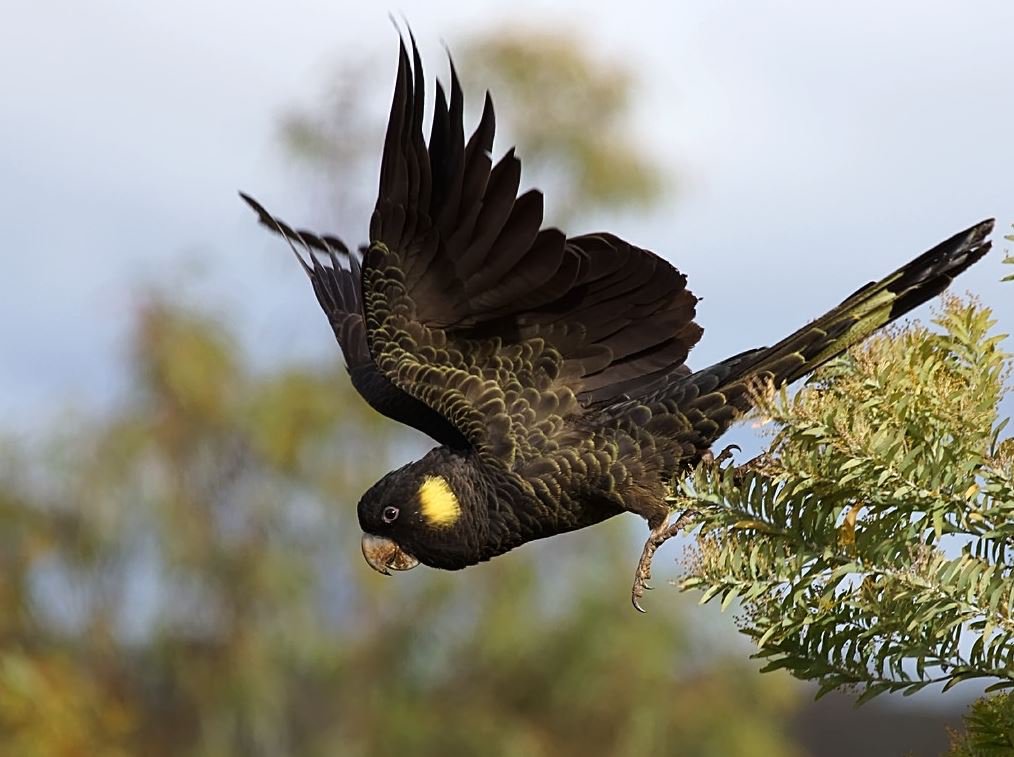
Animal Species:Yellow-tailed Black-Cockatoo
The Yellow-Tailed Black-Cockatoo is one of six species of Black-Cockatoo in Australia. In recent years it has been in rapid decline because of native habitat clearance, with a loss of food supply and nest sites.
Identification
The Yellow-tailed Black-Cockatoo is a large cockatoo. It is easily identified by its mostly black plumage, with most body feathers edged with yellow, not visible at a distance. It has a yellow cheek patch and yellow panels on the tail. The female has a larger yellow cheek patch, pale grey eye-ring (pink in males), white upper bill (grey-black in males) and black marks in the yellow tail panels. Young birds resemble the adult female, but young males have a smaller cheek patch.
Size range
55 cm to 65 cm
Similar Species
Short-billed Black-Cockatoo, Red-tailed Black-Cockatoo, Glossy Black-Cockatoo
Distribution
The Yellow-tailed Black-Cockatoo is found in south-eastern Australia, from Eyre Peninsula, South Australia to south and central eastern Queensland.
Habitat
The Yellow-tailed Black-Cockatoo inhabits a variety of habitat types, but favours eucalypt woodland and pine plantations. Small to large flocks can be seen in these areas, either perched or flying on slowly flapping wings.
Feeding and Diet
Yellow-tailed Black-Cockatoos feed in small to large flocks. Their favoured foods are wood-boring larvae and seeds of native and introduced trees and ground plants.
Communication
The contact call is a drawn-out, distinctive "kee-ow". They may screech if alarmed.
Mating and reproduction
Yellow-tailed Black-Cockatoos have a long breeding season, which varies throughout their range. Both sexes construct the nest, which is a large tree hollow, lined with wood chips. The female alone incubates the eggs, while the male supplies her with food. Usually only one chick survives, and this will stay in the care of its parents for about six months.
- Breeding season: Variable
- Clutch size: 2
- Time in nest: 168 days
Conservation Status (IUCN):
LEAST CONCERN (LC)
Classification
- Species:
- funereus
- Genus:
- Calyptorhynchus
- Family:
- Cacatuidae
- Order:
- Psittaciformes
- Class:
- Aves
References
- Crome, F. and Shields, J. 1992. Parrots and Pigeons of Australia. Angus and Robertson/National Photographic Index of Australian Wildlife, Sydney.
- Pizzey, G. and Knight, F. 1997. Field Guide to the Birds of Australia. Angus and Robertson, Sydney.
- Schodde, R. and Tideman, S.C. (eds) 1990. Reader's Digest Complete Book of Australian Birds (2nd Edition). Reader's Digest (Australia) Pty Ltd, Sydney.
- Forshaw, Joseph M. & Cooper, William T. 2002. Yellow-tailed Black-Cockatoo Calyptorhynchus funereus (Shaw). pp 57-70 in: Australian Parrots / Joseph M. Forshaw ; illustrated by William T. Cooper Alexander Editions, Robina, Queensland.
Ondine Evans
, Web Researcher/Editor
Last Updated:
Tags BIBY, yellow-tailed, black-cockatoo, cockatoos, parrots, birds,
11 comments
Brilliant, Thanks Jaynia!
Hi Jen, funny you should ask that question, we were just in the collection looking at a variety of specimens that fluoresce and/or reflect UV light!
Fluorescence happens when UV light strikes particular pigments in the feathers. Ultraviolet light is absorbed by the pigment, which re-emits the light at a different wavelength and causes a glowing effect. Many parrot species are known to have fluorescent patches, and it has been shown that they play an imporant role in mate selection and visual communication. However, a growing number of other avian taxa are being added to the list of glowing birds. Amongst the parrots, my personal favourite is the Australian King Parrot Alisterus scapularis. What looks like an unassuming light green strip along the wings in white light becomes an amazing glowing green strip under UV light. Budgerigars Melopsittacus undulatus are also quite wonderful; their little heads light up like beacons under UV light.
I am in the process of updating our ‘Glowing Parrots’ factsheet from the old website and will post it on the Bird website once it is finished. Watch this space!
Hey Jaynia,
I'm really interested to know more about which species fluoresce under ultr-violate light and the reasons why? Just so amazing!!!
Hi Soraya. The identification depends on which state you saw the birds in. If you are in the eastern states of Australia, then the birds were Yellow-tailed Black-Cockatoos. When the tail is folded, sometimes the black in the panel is not visible; also, some birds don't have a lot of black speckling. There is often a sharp distinction between the black and yellow. My guess is that this is most likely the species you saw.
If you are in the southern part of Western Australia, they would have been one of the white-tailed black cockatoos: either Baudin's Black-Cockatoo (Calyptorhynchus baudinii) or Carnaby's Black-Cockatoo (C. latirostris). The white-tailed black cockies have white cheek patches and (unsurprisingly) a white panel with little to no black in the tail. These may possibly be mistaken for pale yellow in certain circumstances. We are in the process of adding more fact sheets and images to the site, but unfortunately we don't have any white-tailed cocky images at this point. Try entering "white tailed black cockatoo" into a search engine to see some images of these lovely birds. Cheers, Jaynia
Hi Craig, it's always a treat to see these birds. Their range encompasses south-eastern Australia - from Queensland down into Tasmania - so they are certainly down your way. As with all native animals, they are protected by legislation specific to each state and territory. Further protection is extended to them in South Australia, where they are listed as Vulnerable. I'm curious to hear that you perceive their yellow parts as 'flouro green' - some species actually do fluoresce under ultra-violet light. Maybe your eyes work in the same way as birds (ha ha)?! Lucky you!
Sorry Dennis, I posted my last comment before it was finished! There are also Red-tailed Black-Cockatoos in your area, however, it isn't likely that they are what you saw if all your birds had yellow cheeks and yellow undertail panels. Cheers, Jaynia
Hi Dennis. Given your locality and description, it is most likely that the birds you saw are Yellow-tailed Black-Cockatoos. They only other black cockatoo in your area is the Glossy Black-Cockatoo, however as yours were large with yellow on the cheeks and under the tail, it is very unlikely that they were Glossies. Yellow-tailed Black-Cockatopos are large, very impressive birds and have a gorgeous call, unlike the harsh screech of a Sulphur-crested Cockatoo. You can check out their call on the Birds in Backyards site at http://www.birdsinbackyards.net/species/Calyptorhynchus-funereus. Yellow-tails forage for wood-boring insects by stripping bark and excavating holes in trees, hence the bits of falling branch you saw. They are also known to make a "grating" noise while they forage, which is probably the sound you heard. Best regards, Jaynia.