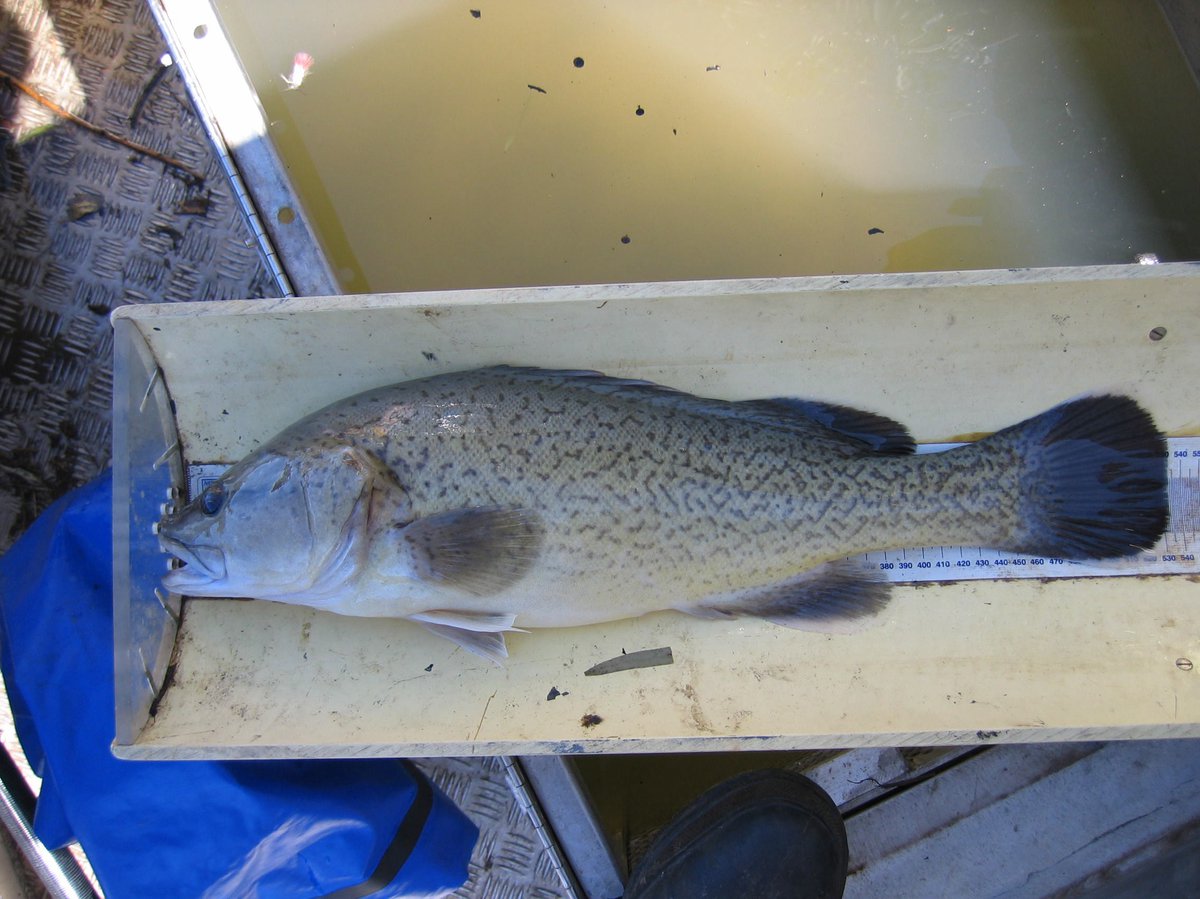
Trout Cod, Maccullochella macquariensis (Cuvier, 1829)
Blue Nose
 Click to enlarge image
© NSW Department of Primary Industries
Fast Facts
-
Classification
- Genus
- Maccullochella
- Species
- macquariensis
- Family
- Percichthyidae
- Order
- Perciformes
- Class
- Actinopterygii
- Subphylum
- Vertebrata
- Phylum
- Chordata
- Kingdom
- Animalia
-
- Size Range
- It grows to 85 cm in length and 16 kg in weight. Most fishes caught are less than 5 kg.
Introduction
The Trout Cod can be recognised by its overhanging upper jaw and the presence of a dusky horizontal stripe from the snout, through the eyes and onto the preoperculum. The species is endemic to Australia.
Identification
The Trout Cod is a large, deep-bodied species that has a big mouth and a straight head profile. It can be recognised by its overhanging upper jaw and the presence of a dusky horizontal stripe from the snout, through the eyes and onto the preoperculum.
In life, the fish is bluish grey or brown, with irregular spots and bars on the upper and lateral surfaces of the body as well as on the soft dorsal, anal and caudal fins. It is pale ventrally.
Habitat
It is usually found in rapidly flowing freshwater streams, often near snags or over rocky or gravel substrates. Larger fishes are found in deeper water.
Distribution
The species is endemic to Australia, occurring in scattered localities within the Murray-Darling system. Some fish have been translocated to coastal New South Wales.
The map below shows the Australian distribution of the species based on public sightings and specimens in Australian Museums. Source: Atlas of Living Australia.
Feeding and diet
Adult and juvenile fish eat other fishes, crustaceans, aquatic insects and molluscs. Larvae feed on zooplankton.
Economic impacts
The Trout Cod is now listed as a threatened species, largely due to habitat degradation. It originally occurred widely throughout the southern Murray-Darling River system of New South Wales, the Australian Capital Territory, Victoria and South Australia. This fish has been a popular angling species, but it can no longer be taken in New South Wales, the Australian Capital Territory and Victoria.
References
- Allen, G.R. 1991. Field Guide to The Freshwater Fishes of New Guinea. Christensen Research Institute. Pub. 9. Pp. 268.
- Allen, G.R., Midgley, S.H. & M. Allen. 2002. Field Guide to the Freshwater Fishes of Australia. Western Australian Museum. Pp. 394.
- Harris, J.H. & S.J. Rowland. in McDowall, R.M. 1996. Freshwater Fishes of South-Eastern Australia. Reed Books. Pp. 247.
- Merrick , J.R. & G.E. Schmida. 1984. Australian Freshwater Fishes. Biology and Management. John R. Merrick. Pp. 409.
- Morris , S.A. , Pollard, D.A., Gehrke, P.C. & J.J. Pogonoski. 2001. Threatened and Potentially Threatened Freshwater Fishes of Coastal New South Wales and the Murray-Darling Basin. Report to Fisheries Action Program and World Wide Fund for Nature. Project No. AA 0959.98. Pp. 177.