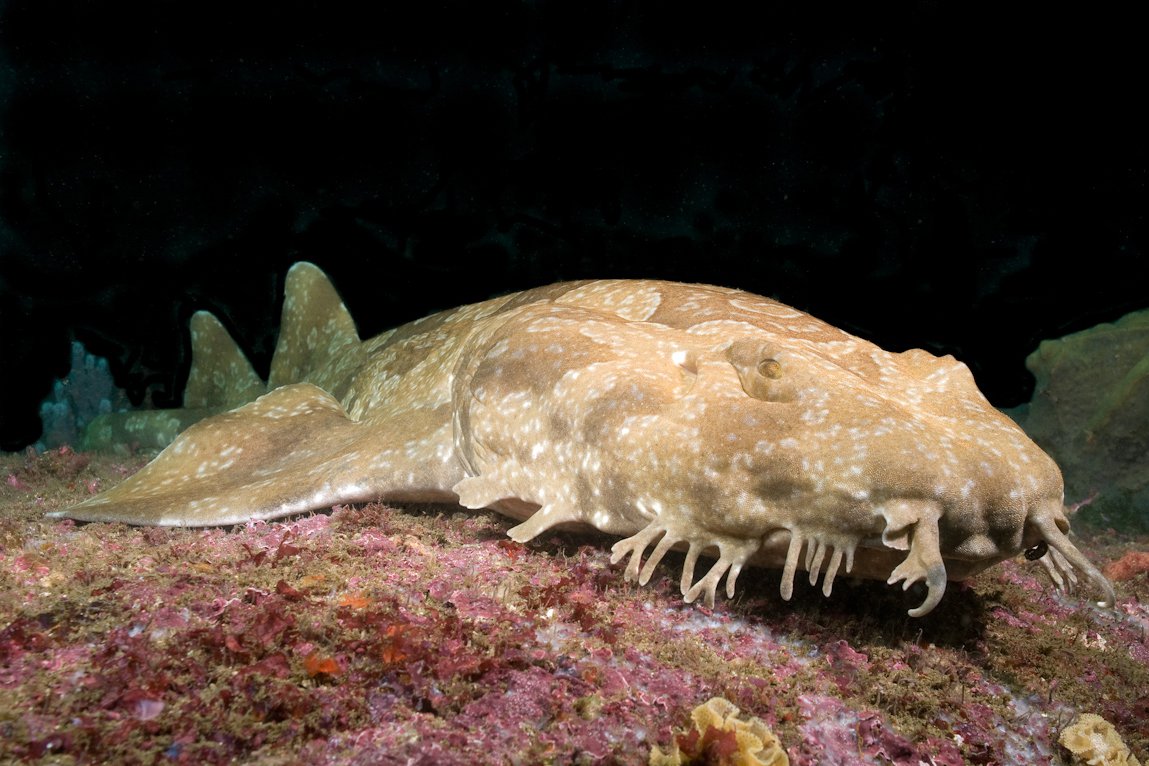
Spotted Wobbegong, Orectolobus maculatus (Bonnaterre, 1788)
Carpet Shark, Common Carpet Shark, Common Catshark, Tassel Shark, Wobbegong
 Click to enlarge image
© Erik Schlögl
Fast Facts
-
Classification
- Genus
- Orectolobus
- Species
- maculatus
- Family
- Orectolobidae
- Order
- Orectolobiformes
- Class
- Chondrichthyes
- Subphylum
- Vertebrata
- Phylum
- Chordata
- Kingdom
- Animalia
-
- Size Range
- It is about 20 cm in length when born and reaches a maximum size of about 3 m.
Introduction
The Spotted Wobbegong has a pattern of dark saddles, white o-shaped spots and white blotches. The species is widely distributed in subtropical and temperate Australian waters.
Identification
The Spotted Wobbegong can be recognised by the skin flaps around the snout margin and the distinctive colour pattern of dark saddles and white rings on a yellow to greenish-brown background.
The genus name Orectolobus comes from the Greek words orectos, meaning stretched out, and lobos meaning a rounded projection or protuberance. The genus name most likely refers to the barbels on the head. The species name maculatuscomes from the Latin word macula which means spot, and refers to the shark's spotted colouration. 'Wobbegong' is an Australian aboriginal word.
Habitat
Spotted Wobbegongs live in shallow coastal waters down to about 100 m depth. They often lie on sand or rocky reef bottoms and are frequently seen by divers.
Distribution
The species occurs along the southern coastline of Australia from southern Queensland to south-western Western Australia. It is possibly endemic to Australia. Records from Japan and the South China Sea are probably errors.
The map below shows the Australian distribution of the species based on public sightings and specimens in Australian Museums. Source: Atlas of Living Australia.
Feeding and diet
Feeding occurs mainly at night and includes prey items such as fishes, crayfish, crabs and octopuses.
References
- Brown, R.W. 1956. Composition of Scientific Words. R. W. Brown. Pp. 882.
- Kuiter, R.H. 1993. Coastal Fishes of South-Eastern Australia. Crawford House Press. Pp. 437.
- Kuiter, R.H. 1996. Guide to Sea Fishes of Australia. New Holland. Pp. 433.
- Last, P.R. & J.D. Stevens. 1994. Sharks and Rays of Australia. CSIRO. Pp. 513, Pl. 1-84.
- Stevens, J.D. in Gomon, M.F., J.C.M. Glover & R.H. Kuiter (Eds). 1994. The Fishes of Australia's South Coast. State Print, Adelaide. Pp. 992.
- Whitley, G.P. 1940. The fishes of Australia. Part I. The sharks, rays, devil-fish, and other primitive fishes of Australia and New Zealand. Royal Zoological Society N.S.W., Australian Zoological Handbook 1-280.