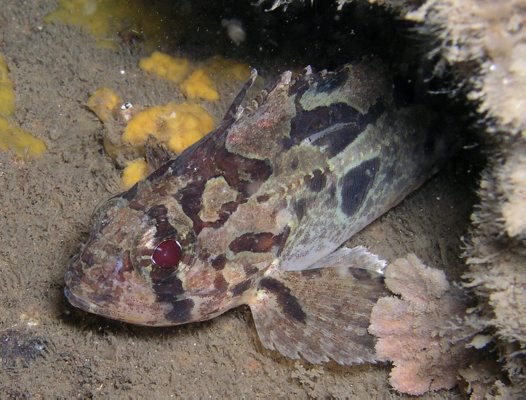
ANIMAL SPECIES:Soldier, Gymnapistes marmoratus (Cuvier, 1829)
The Soldier occurs mainly in temperate estuarine waters living amongst the seagrass. It is responsible for many stings received by people wading out into shallow waters.
Alternative Name/s
CobblerIdentification
The Soldier has a mottled colouration of brown to dark brown blotches above grading to paler below. The blotches are less distinct in larger fish. The 13 poisonous dorsal fin spines are each separated by incised membrane. There is a large retrorse (backward-pointing) spine on either side of the head below the eye.
The species differs from the similar-looking Fortescue, Centropogon australis by the absence of scales on its body. C. australis does have scaless. The Soldier also has a distinctive protruding lateral line, which is first visible posterior to the opercular margin and terminates on the caudal peduncle.
Size range
The species grows to 22 cm in length.Similar Species
The Soldier resembles the Fortescue. The Soldier is scaleless but the Fortescue has scales.Distribution
It is endemic to Australia. It occurs mainly in temperate estuarine waters from central New South Wales, around the south of the country and north to Perth, Western Australia.
Distribution by collection data
Biomaps map of Soldier specimens in the Australian Museum collection.
Habitat
Usually found inshore amongst seagrass.
Living with us
Danger to humans and first aid
The 13 poisonous dorsal fin spines are each separated by incised membrane. There is a large retrorse (backward-pointing) spine on either side of the head below the eye. Is responsible for many stings received by people wading out into shallow estuaries.
Classification
- Species:
- marmoratus
- Genus:
- Gymnapistes
- Family:
- Scorpaenidae
- Order:
- Scorpaeniformes
- Class:
- Actinopterygii
- Subphylum:
- Vertebrata
- Phylum:
- Chordata
- Kingdom:
- Animalia
References
- Edgar, G.J. 1997. Australian Marine Life: the plants and animals of temperate waters. Reed Books. Pp. 544.
- Poss, SG in Gomon, M.F., Glover, C.J.M. & R.H. Kuiter (Eds). 1994. The Fishes of Australia's South Coast. State Print, Adelaide. Pp. 992.
- Hutchins, B. & R. Swainston. 1986. Sea Fishes of Southern Australia. Complete Field Guide for Anglers and Divers. Swainston Publishing. Pp. 180.
- Kuiter, R.H. 1996. Guide to Sea Fishes of Australia. New Holland. Pp. 433.
- Kuiter, R.H. 2000. Coastal Fishes of South-eastern Australia. Gary Allen. Pp. 437.
Would you like to add a comment?
Sign up to add comments and find out more about the other benefits you can enjoy.
Would you like to add a tag?
Sign up to add tags and find out more about the other benefits you can enjoy.
Support us
Help us continue to provide quality research, education, community programs and exhibitions.
Online Shop
Featuring a selection of products relating to the collections.
Australian Museum Members
Join today to come to the Museum for free and enjoy many other benefits.
AMBS
Australian Museum Business Services - Ecological, archaeological and heritage consulting.
Museum as a Venue
We have many unique venues ideal for dinner, cocktails, weddings and conferences.


8 comments
Mark McGrouther
8.05 AM, 17 May 2010
Hi Tom, Our pleasure. Make sure you keep on the lookout for future fishy items of interest.
tomdavis
2.05 PM, 15 May 2010
Hi Mark & experts, Thanks for the help on the fish ID it is greatly appreciated. Tom
Mark McGrouther
11.05 AM, 07 May 2010
I just received an email from Dr Hiroyuki Motomura, a world authority on the scorpionfishes. He said, "Tom's image appears for me to be a Bullrout, Notesthes robusta. In overall appearance, coloration and head spine structure, this species is most likely".
"Regarding Sascha's identificaton of Centropogon australis, I have not observed large Centropogon australis, but I doubt whether the species develops the long snout and short spines on the head like the fish in Tom's image".
Mark McGrouther
1.05 PM, 04 May 2010
Thank you Sascha, I stand corrected! I have taken some of your comment and added it to the identification section above.
Sascha Schulz
12.05 PM, 04 May 2010
Hi Tom,
The fish in your photo is a large Centropogon australis, which is commonly known as a Fortescue. Gymnapistes marmoratus (Soldier) differs from the similar C. australis by the absence of scales on its body, which C. australis does posses. The scales are clearly visible in your lovely photo.
G. mamrmoratus also has a distinctive protruding lateral line (see photos on right of page), which is first visible posterior to the opercular margin, and terminates on the caudal peduncle.
Mark McGrouther
8.05 AM, 03 May 2010
Hi Tom, Great photo. Thank you for submitting it. The fish certainly looks like a Soldier to me but I'm not a scorpionfish expert. I will ask an expert to look at your photo. The Soldier is a temperate water fish that is 'officially' recorded only as far north as the Sydney region. What makes your fish particularly interesting is that if it is a Soldier, it was photographed well north of the distribution limit. Thanks again. I'll comment again soon.
tomdavis
3.05 PM, 01 May 2010
Hi I spotted this fish while doing a fish survey at Halifax Park in Nelson Bay, NSW. It looked like a very large Forteque, and I wondered if it might be a Cobbler? Are you able to identify the fish for me from the attached picture? Thanks, Tom Davis, Reef Life Survey Volunteer
Comment Attachment
Report misuse