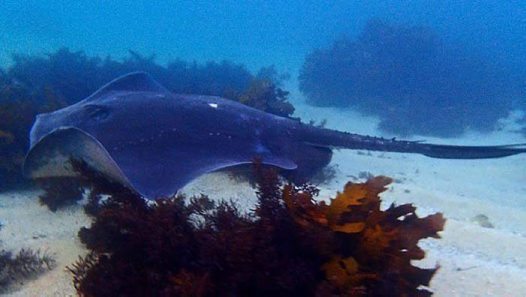
Smooth Stingray, Dasyatis brevicaudata (Hutton, 1875)
The species looks very similar to the Black Stingray. They are both dark above, pale below and have a whip-like tail. The Black Stingray lacks white spots but does have thorn-like denticles along the dorsal midline of the disc.
 Click to enlarge image
© Nick Dawkins
Fast Facts
-
Classification
- Genus
- Dasyatis
- Species
- brevicaudata
- Family
- Dasyatidae
- Order
- Myliobatiformes
- Class
- Chondrichthyes
- Subphylum
- Vertebrata
- Phylum
- Chordata
- Kingdom
- Animalia
-
- Size Range
- The Smooth Stingray is the largest of all Australian stingrays. It grows to 4.3 m in length, 2 m disc width and a weight of 350 kg.
Introduction
The Smooth Stingray is the largest of all Australian stingrays (Family Dasyatidae). It grows to 4.3 m in length, 2 m disc width and a weight of 350 kg. It usually has irregular rows of small white spots on the upper surface.
Identification
The Smooth Stingray usually has irregular rows of small white spots on the upper surface beside the head and no thorn-like denticles along the dorsal midline of the disc. It has a relatively short tail, less than 1.2 times the disc length. This gives the fish its species name, brevicaudata, which comes from the Latin brevis, meaning 'short', and cauda meaning 'tail'. View footage of an albino individual.
Habitat
It is a bottom-dwelling species which is recorded from temperate waters. It lives in coastal waters and estuaries from shallow water down to about 170 m.
Distribution
The Smooth Stingray occurs in Australia, New Zealand and South Africa. In Australia it is known from southern Queensland, around the south of the country and north to the central coast of Western Australia.
The map below shows the Australian distribution of the species based on public sightings and specimens in Australian Museums. Click on the map for detailed information. Source: Atlas of Living Australia.
Danger to humans
The Smooth Stingray is not aggressive and is often observed by divers. It usually has one venomous spine (the sting) halfway along the tail which is capable of inflicting severe or potentially fatal wounds. This species is sometimes observed raising its tail above its back like a scorpion.
References
- Brown, R.W. 1956. Composition of Scientific Words. R. W. Brown. Pp. 882.
- Last, P.R. in Gomon, M.F, C.J.M. Glover & R.H. Kuiter (Eds). 1994. The Fishes of Australia's South Coast. State Print, Adelaide. Pp. 992.
- Hutchins, B. & R. Swainston. 1986. Sea Fishes of Southern Australia. Complete Field Guide for Anglers and Divers. Swainston Publishing. Pp. 180.
- Kuiter, R.H. 1993. Coastal Fishes of South-Eastern Australia. Crawford House Press. Pp. 437.
- Last, P.R. & J.D. Stevens. 1994 Sharks and Rays of Australia. CSIRO. Pp. 513.