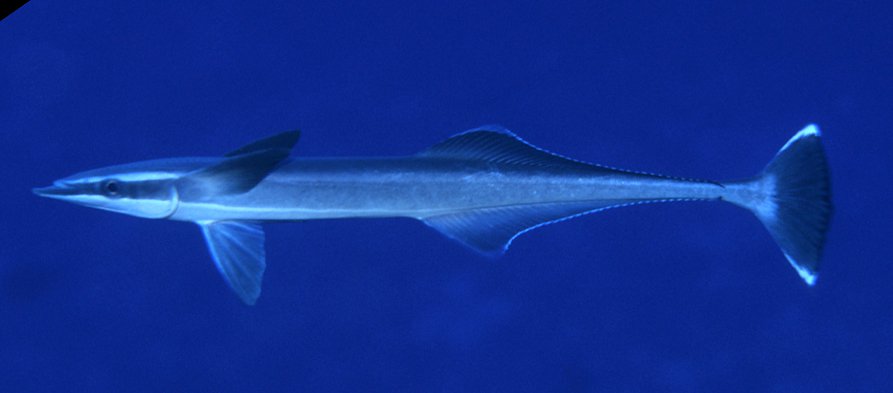
Sharksucker, Echeneis naucrates (Linnaeus, 1758)
 Click to enlarge image
© Erik Schlögl
Fast Facts
-
Classification
- Genus
- Echeneis
- Species
- naucrates
- Family
- Echeneidae
- Order
- Perciformes
- Class
- Actinopterygii
- Subphylum
- Vertebrata
- Phylum
- Chordata
- Kingdom
- Animalia
-
- Size Range
- The species grows to about 1 m in length.
Introduction
The Sharksucker has an oval-shaped sucking disc on the top of the head. It uses the disc to attach to the bodies of larger animals.
Identification
The Sharksucker is often white with distinct dark stripes, but large individuals may be entirely grey.
It has an elongate body, tiny embedded scales and an oval-shaped sucking disc. This disc, which is a highly modified dorsal fin, is positioned from the top of the head to the anterior part of the body.
The pectoral fins of the species are positioned high on the sides of the body while the dorsal and anal fins are long-based with elevated leading rays. The fish's lower jaw projects forward well beyond the upper jaw. The jaws, vomer and tongue have villiform teeth.
The family Echeneidae contains 8 species worldwide. Seven species in four genera (Echeneis, Phtherichthys, Remora and Remorina) have been recorded from Australian waters. The Sharksucker can be distinguished from other species by its slender body and large sucking disc that has 18 to 28 laminae (the cross 'flaps').

A Sharksucker attached to a Zebra Shark at a depth of 25m, North Stradbroke Island, Queensland, April 1996.
Image: Ian Shaw© Ian Shaw
Distribution
The Sharksucker has a widespread distribution in most tropical and some warm temperate marine waters. In Australia it is commonly seen from south-western Western Australia around the tropical north and south to the southern coast of New South Wales. It is infrequently observed in Victorian and Tasmanian waters.
The map below shows the Australian distribution of the species based on public sightings and specimens in Australian Museums. Source: Atlas of Living Australia.
Feeding and diet
When attached to a large predator, the Sharksucker eats food scraps from the feeding activity of its host. It is also known to eat parasites off the host's body. Ritter and Amin (see References, below) showed that the Sharksucker enter and clean the mouths of Lemon Sharks, Negaprion brevirostris, removing food trapped between the shark's teeth.
Other behaviours and adaptations
The Sharksucker uses the sucking disc to attach to larger fishes, most commonly sharks and rays. But it has been seen attached to boats, marine mammals and even divers. This species is also seen free-swimming.
References
- Allen, G.R. 1997. Marine Fishes of Tropical Australia and South-east Asia. Western Australian Museum. Pp. 292.
- Allen, G.R. & R. Swainston. 1988. The Marine Fishes of North-Western Australia. A Field Guide for Anglers and Divers. Western Australian Museum. Pp. 201.
- Glover, C.J.M. in Gomon, M.F, Glover, . & R.H. Kuiter (Eds). 1994. The Fishes of Australia's South Coast. State Print, Adelaide. Pp. 992.
- Hutchins, B. & R. Swainston. 1986. Sea Fishes of Southern Australia. Complete Field Guide for Anglers and Divers. Swainston Publishing. Pp. 180.
- Kuiter, R.H. 1996. Guide to Sea Fishes of Australia. New Holland. Pp. 433.
- Kuiter, R.H. 2000. Coastal Fishes of South-eastern Australia. Gary Allen. Pp. 437.
- Randall, J.E., Allen, G.R. & R.C. Steene. 1997. Fishes of the Great Barrier Reef and Coral Sea. Crawford House Press. Pp. 557.
- Ritter, E.K. & R.W. Amin, 2016. Mouth Cleaning of Lemon Sharks, Negapron brevirostris, by Sharksuckers, Echeneis naucrates. Copeia, 104 (3): 728-733.