

Ringtail Unicornfish, Naso annulatus (Quoy & Gaimard, 1825)
Short-horned Unicorn-fish, White-margin Unicorn
 Click to enlarge image
© Australian Museum
Fast Facts
-
Classification
- Genus
- Naso
- Species
- annulatus
- Family
- Acanthuridae
- Order
- Perciformes
- Class
- Actinopterygii
- Subphylum
- Vertebrata
- Phylum
- Chordata
- Kingdom
- Animalia
-
- Size Range
- The species grows to 1 m in length.
Introduction
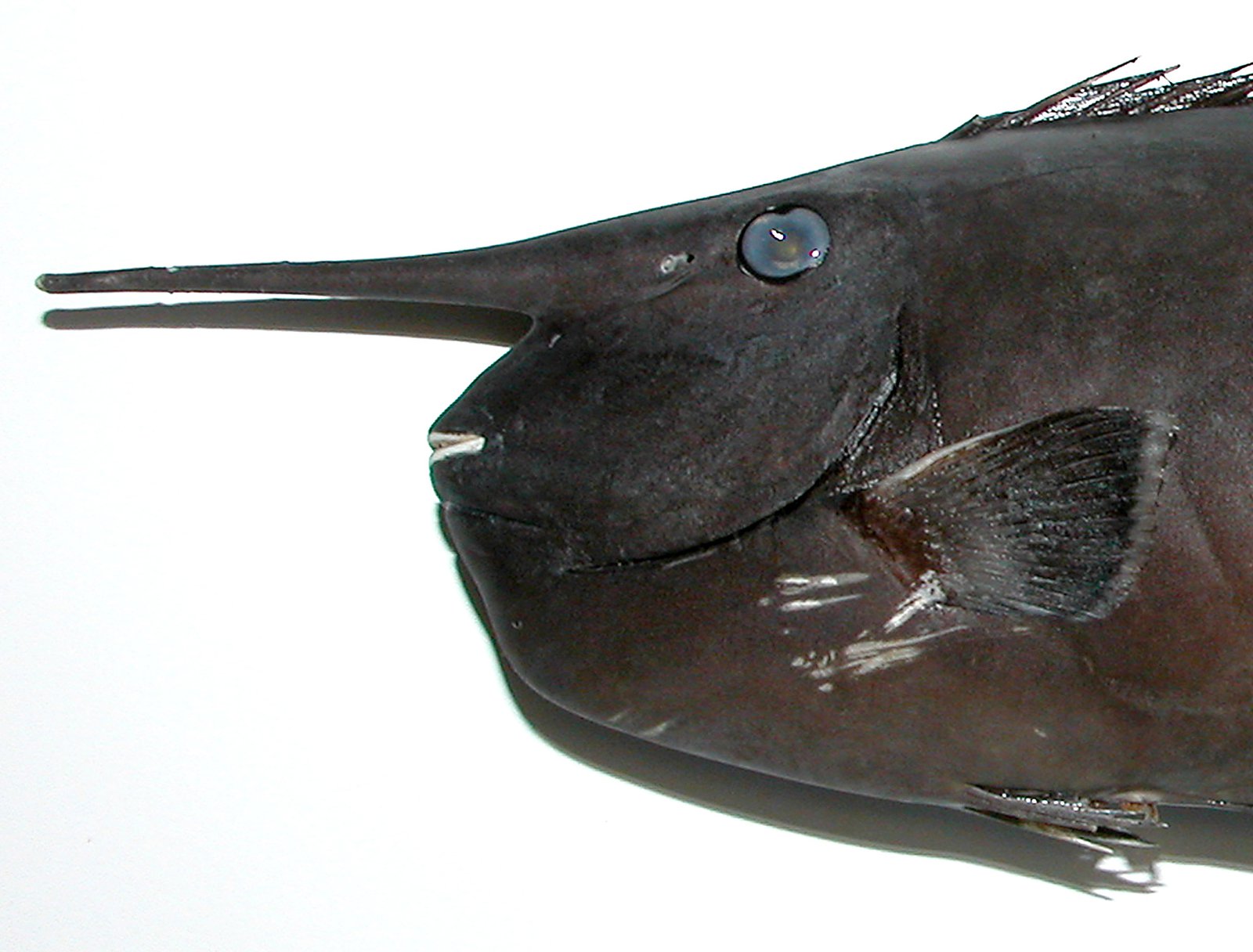
When the Ringtail Unicornfish is about 20 cm in length a long horn develops from a bump anterior to the eye. The species occurs in tropical marine waters of the Indo-Pacific.
Identification
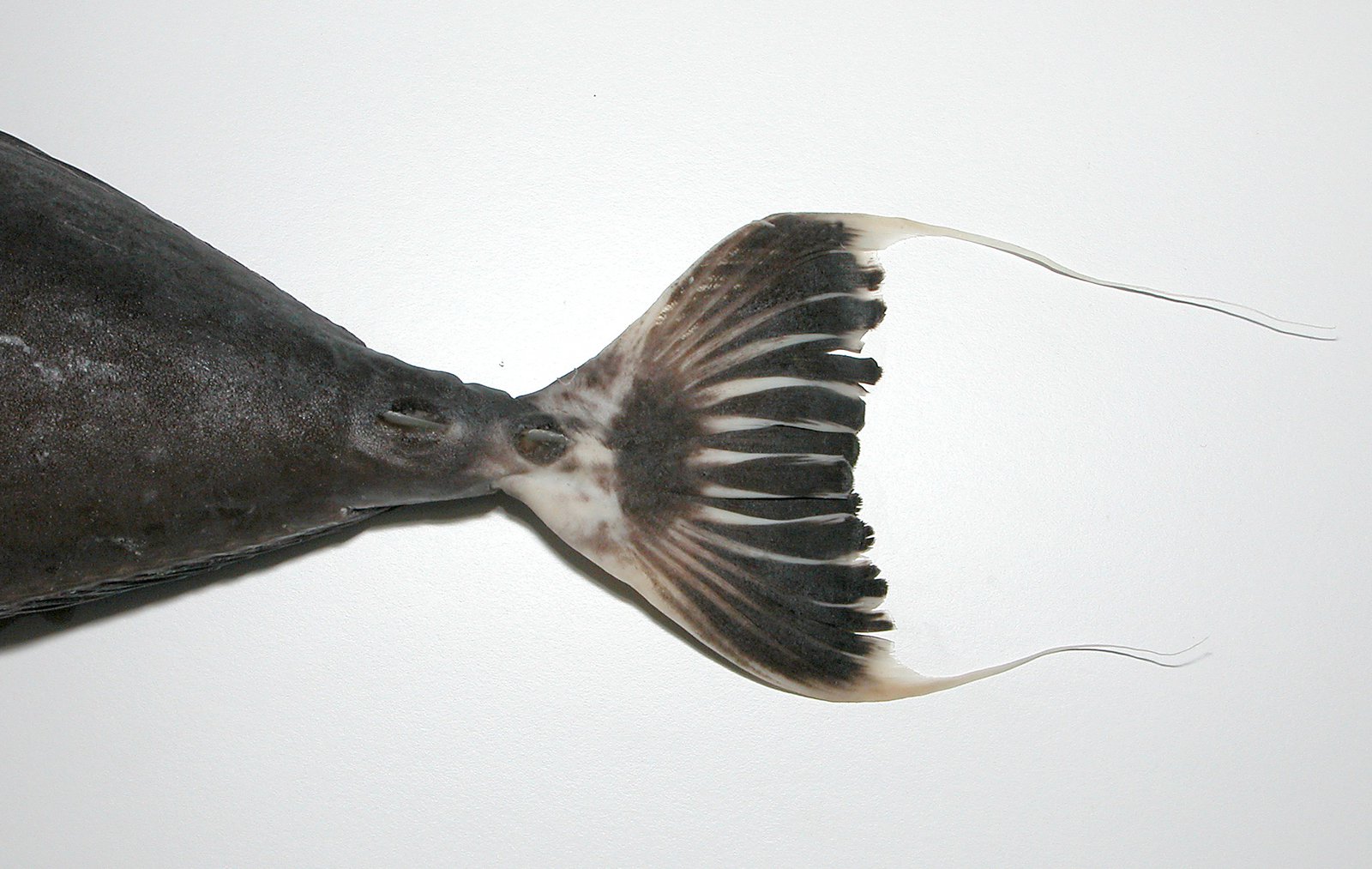
The body of the Ringtail Unicornfish tapers to a narrow caudal peduncle. There are two scutes on the caudal peduncle, each bearing a strong keel. When fish are about 20 cm in length a long horn develops from a bump anterior to the eye. The horn of mature fish can be as long as the head. The species is brown to grey or blackish. Juveniles often have a white ring around the caudal peduncle. The caudal fin margin and membranes of adults are white.

Habitat
Juveniles can be found on reefs around shallow lagoons. Adults are usually seen in small schools at depths over 20 m on reef dropoffs.
Distribution
It occurs in tropical marine waters of the Indo-Pacific. In Australia this species is known from the offshore islands of north-western Western Australia, the entire length of the Great Barrier Reef, Queensland and Lord Howe Island.
The map below shows the Australian distribution of the species based on public sightings and specimens in Australian Museums. Click on the map for detailed information. Source: Atlas of Living Australia.
References
- Allen, G.R. 1997. Marine Fishes of Tropical Australia and South-east Asia. Western Australian Museum. Pp. 292.
- Hoese, D.F., Bray, D.J., Paxton, J.R. & G.R. Allen. 2006. Fishes. In Beesley, P.L. & A. Wells. (eds) Zoological Catalogue of Australia. Volume 35. ABRS & CSIRO Publishing: Australia. parts 1-3, pages 1-2178.
- Kuiter, R.H. & H. Debelius. 2001. Surgeonfishes, Rabbitfishes and their relatives. A Comprehensive Guide to Acanthuroidei. TMC Publishing. Pp. 208.
- Myers, R.F. 1999. Micronesian Reef Fishes. Coral Graphics. Pp. 330.
- Randall, J.E., Allen, G.R. & R.C. Steene. 1997. Fishes of the Great Barrier Reef and Coral Sea. Crawford House Press. Pp. 557.

