Animal Species:Redback Spider, Latrodectus hasselti
Redback Spiders are found throughout Australia and are common in disturbed and urban areas.
Alternative Name/s
Red-back Spider
Identification
Redback spiders (Latrodectus hasselti) belong to the Family Theridiidae, which is found worldwide. The notorious Black Widow Spider (Latrodectus sp) of the United States is a close relative of the Redback Spider, and only differs in appearance by the absence of a red dorsal stripe. Other species of Latrodectus occur in Africa, New Zealand (the Katipo), the Pacific Islands, Europe and North and South America.
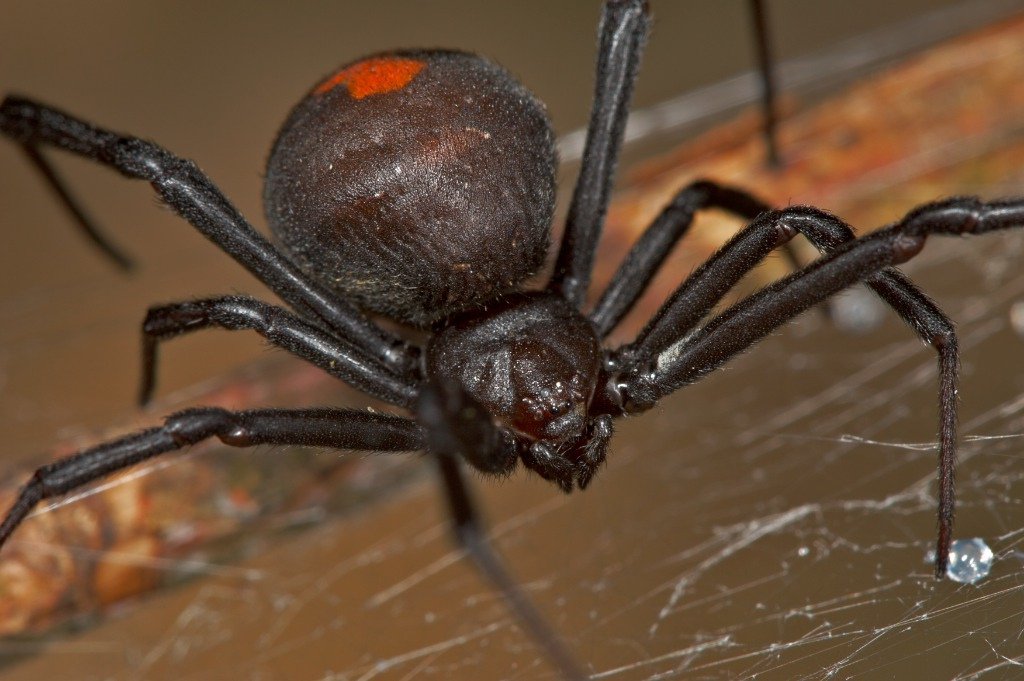
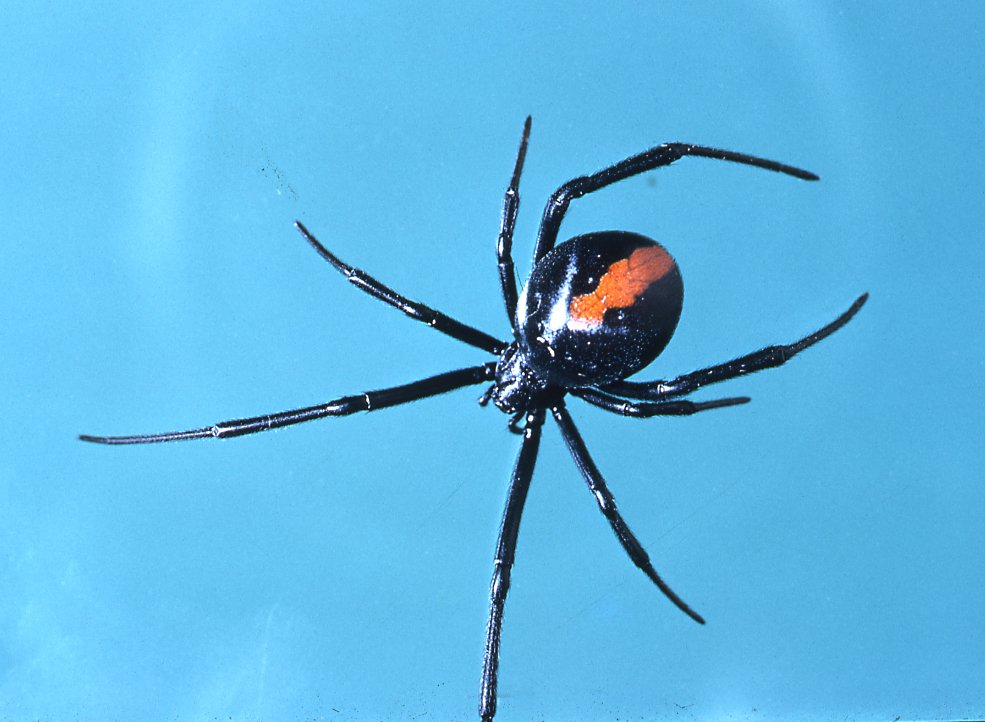
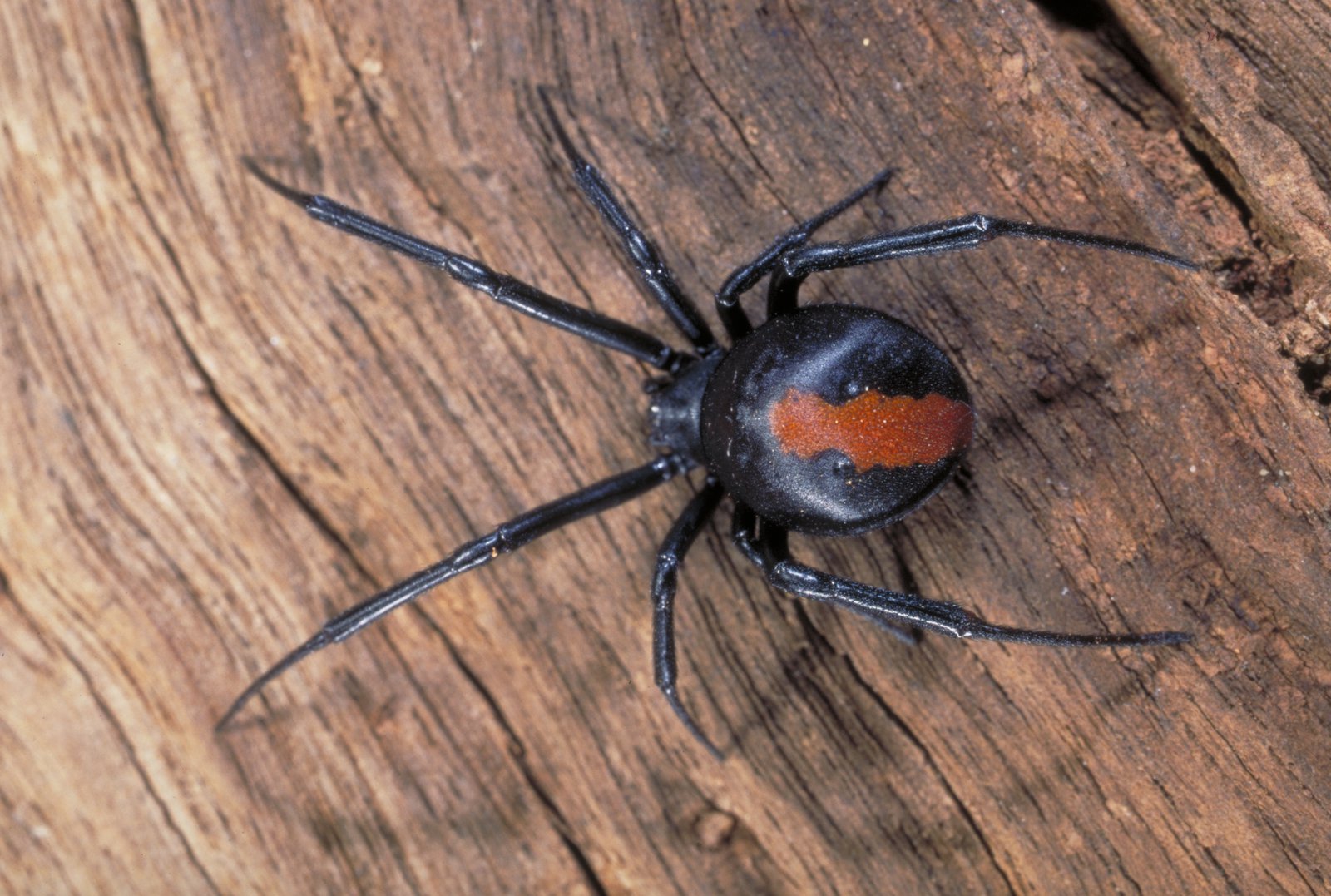
Female Redback Spiders are black (occasionally brownish) with an obvious orange to red longitudinal stripe on the upper abdomen, with the red stripe sometimes being broken, and an "hourglass" shaped red/orange spot on the underside of the abdomen. Juveniles have additional white markings on the abdomen. Females have a body about the size of a large pea and slender legs.
The males' red markings are often less distinct. The body is light brown with white markings on the upper side of the abdomen, and a pale hour-glass marking on the underside.
Size range
1 cm (female); 3 mm - 4 mm (male)
Similar Species
Grey House Spider, Cupboard Spider
Distribution
They are found Australia-wide and will live almost anywhere as long as there is adequate food, a sheltered web site and warm enough for breeding. They are especially common in disturbed and urban areas, in association with human habitation.
Habitat
Webs consist of a tangled, funnel-like upper retreat area from which vertical, sticky catching threads run to ground attachments. The Redback Spider favours proximity to human habitation, with webs being built in dry, sheltered sites, such as among rocks, in logs, shrubs, junk-piles, sheds, or toilets. Redback Spiders are less common in winter months.
Habitat type
Terrestrial Habitat: peridomestic, pest
Feeding and Diet
Insects are the usual prey of Redback Spiders, but they are capable of capturing quite large animals, such as male trapdoor spiders, king crickets and small lizards, if they become entangled in the web. Prey-stealing is also common, with large females taking stored food items from others' webs.
Feeding Habits
arthropod-feeder, carnivorous, insectivorous, predator
Life history mode
sedentary
Life cycle
Once the female has mated, she can store sperm and use it over a period of up to two years to lay several batches of eggs. She spends much time producing up to ten round egg sacs (1cm diameter), which are white, weathering to brown over time. Each egg sac contains approximately 250 eggs and only one to three weeks need to pass before more eggs can be laid. These sacs are suspended within the web. Sometimes small ichneumonid wasps parasitise them, puncturing each sac with tiny holes. The young spiderlings hatch in two to four weeks. Spiderlings are cannibalistic and will eat unhatched eggs and other spiderlings. The spiderlings disperse by ballooning to another suitable nest site on long silk threads that are caught by air currents.
Females mature on average in about four months. The smaller male matures on average in about 90 days. Females may live for two to three years, whereas males only live for about six or seven months.
Mating and reproduction
Male Redback Spiders do not produce a web, but may be found on the fringe of a female's web, especially during the summer mating season. The male has to make overtures to the female to discover whether she is ready to mate, which can prove fatal if she mistakes him for prey. It has been found that in order to occupy the female's attention during mating, the male spider offers her his abdomen by standing on his head and 'somersaulting' his abdomen towards her mouthparts. The female begins to squirt digestive juices onto the male's abdomen while the first palp is inserted. If he is not too weak, he will manage to withdraw, and then insert the second palp. She will continue to 'digest' his abdomen. Most males do not survive this process, which seems to be unique to Latrodectus hasselti.
Predators, Parasites and Diseases
Daddy-long-legs Spiders and White-tailed Spiders are known to catch and kill Redback Spiders.
Evolutionary Relationships
It was once thought that the Redback Spider, Latrodectus hasselti, was a sub species of the Black Widow Spider but it is now known to be a distinct species.
It has also been suggested by some workers that the Redback may not be native to Australia but have been introduced since European settlement, although it's not clear where they originated.
Recent research on the DNA sequences of all recognized Latrodectus species indicates that the Redback is a distinct species, most closely related to the New Zealand Katipo, and probably an Australian native.
Redbacks have most likely become much more common since European settlers started providing them with lots of the kinds of places they like to make webs in.
Danger to humans and first aid
Redback bites occur frequently, particularly over the summer months. More than 250 cases receive antivenom each year, with several milder envenomations probably going unreported. Only the female bite is dangerous. They can cause serious illness and have caused deaths. However, since Redback Spiders rarely leave their webs, humans are not likely to be bitten unless a body part such as a hand is put directly into the web, and because of their small jaws many bites are ineffective. The venom acts directly on the nerves, resulting in release and subsequent depletion of neurotransmitters.
Common early symptoms are pain (which can become severe), sweating (always including local sweating at bite site), muscular weakness, nausea and vomiting. Antivenom is available. No deaths have occurred since its introduction.
Apply an ice pack to the bitten area to relieve pain. Do not apply a pressure bandage (venom movement is slow and pressure worsens pain). Collect the spider for positive identification. Seek medical attention.
Classification
- Species:
- hasselti
- Genus:
- Latrodectus
- Family:
- Theridiidae
- Order:
- Araneae
- Class:
- Arachnida
- Phylum:
- Arthropoda
- Kingdom:
- Animalia
References
- Simon-Brunet, S. 1994. The Silken Web: a natural history of Australian Spiders. Reed Books.
- Preston-Mafham, R. 1991. The Book of Spiders and Scorpions. Quarto Publishing.
- Pyers, G. 1999. Australian Animals: Spiders. Heinemann Library.
- Forster, L. 1995. The behavioural ecology of Latrodectus hasselti (Thorell), the Australian Redback Spider (Araneae: Theridiidae): a review. Records of the Western Australian Museum Supplement No. 52: 13-24.
- York Main, B. 1976. Spiders. The Australian Naturalist Library, Collins, Sydney.
- Garb, J. E., A. Gonzalez, & R. G. Gillespie (2004). The black widow spider genus Latrodectus (Araneae: Theridiidae): phylogeny, biogeography, and invasion history. Molecular Phylogenetics and Evolution. 31, 1127-1142.
Last Updated:
Tags spiders, red-back, black widow, dangerous, araneae, arachnida, invertebrates, identification, classification, venomous,
75 comments
@kiwigirl12 The spider in your pic is not a Redback and is not dangerous. From what we can tell it is in the same family as Redbacks (Theridiidae) but can not give you a definte id without looking at the spider.
@anncast527 - Unfortunately I can't tell very much from the picture you attached. As you live in the US for more information you should contact the American Arachnological Society http://www.americanarachnology.org and hopefully they will be able to answer your questions.
@skywalka - Thanks for sending in a pic. No this isn't a juvenile red back, from what we can tell from the image it is a Steatoda species. A lot of people commonly mistake these spiders as Red Backs. Check out the the fact sheet for Steatoda's http://www.australianmuseum.net.au/Cupboard-Spider
@teff & @felixnoir - Its sounds like the spiders you are describing are 'brown house spiders' or 'cupboard spiders' (Family: Theridiidae, Genus: Steatoda). But its hard to give a definate answer without having a specimen or a good image. Brown house spiders are definately not a sub-species of Red Backs.
@jpnorton - its difficult to tell from your pic but the spider looks to be a type of Garden Orb. Have a look at the Garden Orb fact sheet to get some more information. These spiders have various colour combinations.
@kel - Male redback spiders are actually pretty small in comparision to the females, unless you were looking for them specifically you wouldn't notice them in the females web.
hello Erna, Are you writing from northern Australia? Your spider looks like a large species of pholcid (daddy long legs) called Artema atlanta. They are a harmless introduced species that occurs in many warm climates. As for the colour of the redbacks in your yard - an adult female Redback spider can be black with a red stripe, through to brown with an orange stripe (the stripe is on the top surface of the absomen), and they always have a distinctive orange/red "hourglass" patch on the underside. In Australia there are relatives of redback spiders called Steatoda (sometimes called cupboard spiders) and some species of those can look rather similar but usually without any stripe and without the underside marking. Young female redback spiders and males have less red and black and lots of white. As females get towards maturity they gradually lose the white. All stages have the red mark on the underside but it is sometimes pale and with white around it in small specimens so harder to see.
Dear all - thankyou for all of your comments detailing your experiences with suspected or verified Redback Spider bites. While we value your feedback, we are not a medical institution and cannot comment on or endorse any form of treatment. We can only advise on the biology of these spiders and/or help with identification of specimens. Please seek professional medical aid and advice on bites and reactions.
@mrbear - glad our information helped you to get some perspective on spiders. While the Redback Spider is classed as a dangerous spider, you can easily take precautions to avoid them and/or remove them safely when you find their webs. However, there is no surefire way to keep spiders out of the house - in fact, excluding spiders may be detrimental. Spiders are a great form of natural pest control, catching flies, mosquitoes, cockroaches et.c. plus spraying your house with pesticides is probably not great for your own health!
@blueback - please see my comment below regarding identifying spiders - we really need an image to be able to help you, but it wouldn't be a Redback :)
@whitetiger - without seeing a photo it is hard to tell you what your spider is, but it would not be a cross-species of any kind. Have a look at some of our Australian Spider images to see if your spider more closely resembles any other species there. If you can get a photo, send it as an attachment to our Search and Discover information and enquiry service for an ID.
Hi Nerida,
Your spider appears to be a species of Orb Weaver, possibly a Neoscona sp. These are not closely related to Redbacks and are not regarded as dangerous. It is not a spider you would normally find in the house so may have been carried in on a plant or perhaps clothes that were hung out to dry.
HI Ricko - all the information we have about Redback Spiders suggest that the female spiders have a body (i.e. the abdomen or back part with the stripe) about the size of a large pea - around 1cm across. We have heard nothing to suggest that they are much bigger. A photo attachment to a comment would be helpful, with something in the photo for scale (eg a ruler, a coin etc). This would be the best way for us to see if these spiders are particularly or unusually large.
@Travis253: your spider is most likely a juvenile Redback Spider. I can't say what the effects of a juvenile versus an adult would be, but treat with caution and perhaps clear the 'accessible' area of webs et.c.
@JCR: nice photo of a Red and Black Spider. These spiders belong to the Family Nicodamidae and are not considered dangerous spiders, although they can possibly cause some pain or swelling at the bite site. They are often confused with Redback Spiders but, as you can see, the coloration is quite different on closer inspection.
Hello Barb,
Yes, the colour of a Red-back Spiders stripe is quite variable and can range from a pale cream through to a bright nailpolish red. Males and many young females often have white markings as well. However, there are also a number of very similar shaped spiders which can have these markings but are NOT Red-backs. Various species of the 'cupboard' and flowerpot' spiders (Genus Steatoda) can have white markings - and in some cases even red markings, or no markings at all. We often get enquiries about these 'red-back spiders only without a red back' at the museum. They are not considered dangerous but as with all spider bites and insect stings if you feel unwell afterwards seek medical advice as people can have different reactions to venoms. It you want to be sure of the identity of your spider please send in an image (j'peg and not too large please)
S
M
Hello Cossie,
It may have been an unusually marked Red-back Spider - but then again it may have been another species of spider (there are several spiders with a very similar shape and pattern). Is it possible to photograph the specimen and send in an image to this e'mail or to sand@austmus.gov.au? We can identify or confirm identities much better from a photo than from a description.
Thanks in advance
S
M
Hello Gazza & Josh,
Gazza- male Redbacks are considered harmless as they are so tiny their fangs would have difficulty piercing skin anyway. However, as you found a male the chances that there are females nearby is pretty high. You might want to remove them from inside your house but what you decide to do with them then is up to you. If they don't bother you or your neighbors then you can just ignore them. They are as good at insect control as any other similar spider.
Josh - I don't think you can get antivenom for home use as it should be administered by someone in the medical profession and stored carefully before use. It should be realised that for MOST people the treatment for Redback bites is simply an ice-pack to reduce the swelling and pain. However as Ondine says treat all bites as potentially serious particularly if children or people with allergies to insect stings are concerned, until told otherwise by a doctor.
The other important thing to note is that bites are rare compared to most other accidents and you have to be very unlucky to be bitten. Redbacks are very common in many areas and people have lived alongside them with mostly few problems for all of Australia's human history. Death by lightning strike is 19 times more likely than death from spider bite and no-one has died from spider bite in Australia since 1980. Certainly take care, warn children what not to do, and remove any Redbacks from areas where they might cause problems (e.g. inside the house) but dangers from spiders are very exaggerated.
Sincerely
Martyn Robinson
Hi countryaustraliaa - A Redback Spider bite is a serious prospect for anyone. However, it is a fact that people with compromised immunity, children and the elderly may be even more susceptible to toxic spider and other bites. In ANY case, treat all suspected venomous bites as potentially dangerous and seek medical attention immediately. Our page on Spider bites and venoms has more information about how venoms work and also first aid for bites. Note that Pressure immoblisation is NOT recommended for Redback bites as it actually increases pain. However, if you have not caught, or definitely identified, the spider (or other animal) responsible, you must treat any bite as possibly dangerous until proven otherwise.
Tasdevil, you have raised an interesting point of discussion. I have contacted our Arachnology section, which has provided me with some information and a reference to a research paper, both of which I have added to the main page above. See Evolutionary Relationships (and the reference is the last one listed). An interesting line of thought!
Hello Nicky,
Ondine's suggestion is a good one but if you're nervous of spiders you might want to get someone else to do this. Alternately you could spray the inside of your letterbox with either Citronella or Eucalyptus oils. This will drive the spider out and the residual odour will prevent others from taking up residence.
'magpies' your roof spiders may well be Red-backs but check that they DO actually have red backs as there's some very similar spiders which lack this marking. They aren't colonial but an area where there is a lot of food will often attract quite a few and allow them to survive in close proximity to one another. As to the roof being a suitable site - it's certainly possible but they are usually closer to ground level.
S
M
Hi Nicky. Redback Spiders are not particularly jumpy, so you could probably stick a feather duster or small brush in there, swirl it around to get the web and spider, then extract it all and dispose of it away from the letterbox. Wear thick gloves if you are a bit concerned about it getting on you!