

Prickly Dogfish, Oxynotus bruniensis (Ogilby, 1893)
Rough Shark
 Click to enlarge image
© Australian Museum
Fast Facts
-
Classification
- Genus
- Oxynotus
- Species
- bruniensis
- Family
- Oxynotidae
- Order
- Squaliformes
- Class
- Chondrichthyes
- Subphylum
- Vertebrata
- Phylum
- Chordata
- Kingdom
- Animalia
-
- Size Range
- The Prickly Dogfish grows to 72cm in length.
Introduction
The Prickly Dogfish has a hump-backed body which has a flat lower surface and very rough skin. In Australia, the species occurs the central New South Wales coast to the Great Australian Bight, including Tasmania.
What do Prickly Dogfish look like?
3D interactive model of a Prickly Dogfish
3D model made by cdmstudio.com.au
Identification
The Prickly Dogfish has a hump-backed body with a flat lower surface. The body is nearly triangular in cross-section. The species has prominent abdominal ridges, two sail-like dorsal fins which are each preceded by a spine, and lacks an anal fin.
It is brown to grey in colour, although the dorsal fins and posterior margins of the pectorals and pelvics are often translucent to white. The skin of the Prickly Dogfish is very rough, giving rise to the common name. The denticles (modified scales) are incredibly rough and are elongate with a blade like cusp.
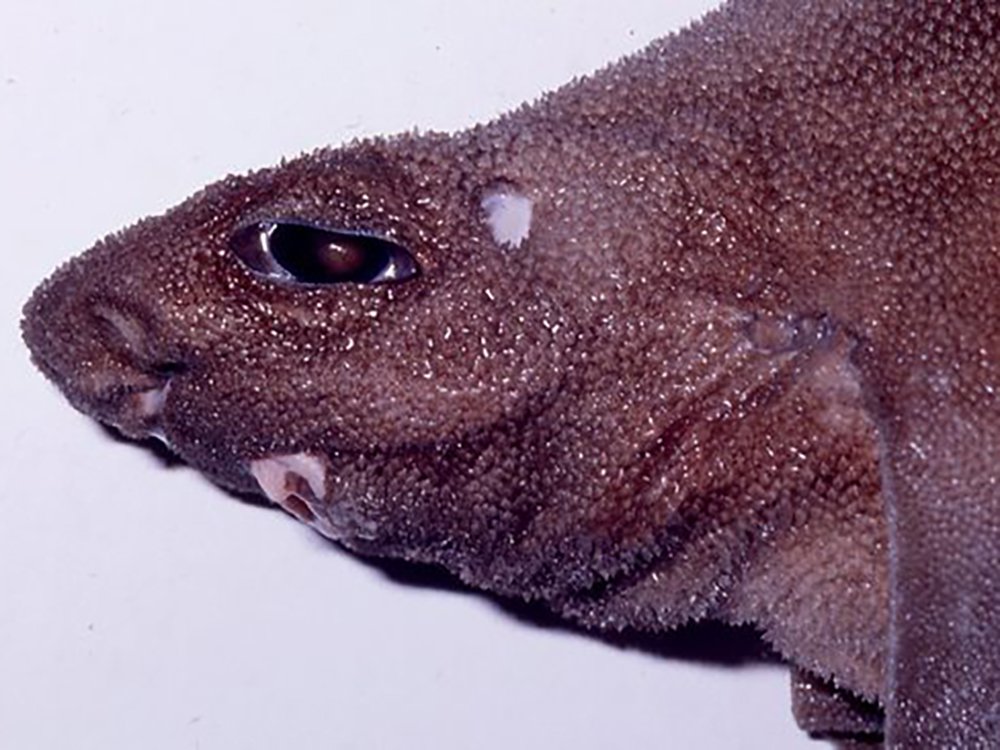
The head of a Prickly Dogfish caught north-east of Tuross, New South Wales, 18 July 1999.
Image: Carl Bento© Australian Museum
Where do Prickly Dogfish live?
Habitat
The Prickly Dogfish occurs in deepwater temperate marine waters on outer continental and insular shelves and upper slopes from from 45 m to 1067 m. They are most commonly found between 350-650 m.

A Prickly Dogfish caught during the NORFANZ expedition, May 2003.
Image: Kerryn Parkinson© NORFANZ Founding Parties
Distribution
In Australia, the Prickly Dogfish is widespread from Southern Queensland to west of the Great Australian Bight. It is also found in the Tasman Sea and throughout New Zealand.
Worldwide, there are five species in the Family Oxynotidae. Only one species is known from Australia.
The map below shows the Australian distribution of the species based on public sightings and specimens in Australian Museums. Source: Atlas of Living Australia.
What do Prickly Dogfish eat and how do they mate?
Feeding and diet
The Prickly Dogfish has short, snout, lanceolate (spear or lance-shaped) teeth in the upper jaw, and blade-like teeth in the lower jaw. This arrangement of teeth and the fleshy lipped mouth bears some resemblance to the Cookiecutter Shark.
They are carnivorous and feed exclusively on egg capsules of Chimaeras (Ghost Sharks). Finucci (2016) stated "DNA sequences has revealed that O. bruniensis preys on the egg cases of holocephalans, including the Pacific spookfish (Rhinochimaera pacifica) and the brown chimaera (Chimaera carophila), besides the longnose chimaera (H. raleighana)."
Sharks online publication
Delve into the world of Sharks and explore the digital publication with videos and extra content from the exhibition. Hear from First Nations peoples, scientists and conservationists as they share their stories about these ancient survivors.
Explore nowReproduction
Prickly Dogfish are born at approximately 24 cm and males mature at ~55cm TL while females mature at ~64 cm TL. They are aplacental viviparious (give birth to live young that develop from eggs in the female) and produce ~8 pups per litter.

© Australian Museum
How have Prickly Dogfish adapted?
Behaviours and adaptations
Fishes which swim in open water are often spindle-shaped (fusiform, meaning tapering to both ends). This is the most energy efficient body shape for pelagic fishes.
For fishes that live on or near the bottom, a spindle-shaped body is less energy efficient (Pridmore & Barwick, 1993). These fishes (the Prickly Dogfish included) often have cambered (humped) body shapes. They are often taken as by catch in trawls.
References
- Bray, D.J. 2017, Oxynotus bruniensis in Fishes of Australia, accessed 05 Aug 2022, https://fishesofaustralia.net.au/home/species/2016
- Compagno, L.J.V. 1984. FAO species catalogue. Vol. 4, Sharks of the World. An annotated and illustrated catalogue of shark species known to date. Part 1 - Hexanchiformes to Lamniformes: viii, 1-250.
- Ebert, D.A., Fowler, S., Compagno, L., 2016. Sharks of the World, Wild Nature Press, pages 1-528Finucci, B. 2016. Shark eat Shark World in Student Focus. OCS Newsletter. May 2016. Pp. 11-12.
- Glover, C.J.M. in Gomon, M.F., C.J.M. Glover & R.H. Kuiter (Eds). 1994. The Fishes of Australia's South Coast. State Print, Adelaide. Pp. 992.
- Last, P.R. & J.D. Stevens. 1994. Sharks and Rays of Australia. CSIRO. Pp. 513, Pl. 1-84.
- Pridmore, P.A. & R.E. Barwick, 1993. Post-cranial morphologies of the Late Devonian dipnoans Griphognathus and Chirodipterus and locomotor implications. Mem. Ass. Australas. Palaeontols. 15: 161-182 ISSN 0810-8889.

