Site navigation
-
Wildlife of Sydney
- Wildlife of Sydney
- Habitats of Sydney
- Crustaceans
- Lace corals and sea mats
- Jellyfish, anemones and corals
- Frogs
- Frogs: Class Amphibia
- Bleating Tree Frog
- Brown Toadlet
- Common Eastern Froglet
- Dainty Tree Frog
- Eastern Dwarf Tree Frog
- Eastern Pobblebonk Frog
- Giant Barred Frog
- Giant Burrowing Frog
- Green and Golden Bell Frog
- Green Tree Frog
- Haswell's Froglet
- Jervis Bay Tree Frog
- Leaf Green Tree Frog
- Lesueur's Frog
- Peron's Tree Frog
- Red-crowned Toadlet
- Red-eyed Tree Frog
- Rocket Frog
- Sandpaper Frog
- Striped Marsh Frog
- Spotted Marsh Frog
- Tusked Frog
- Tyler's Toadlet
- Verreaux's Tree Frog
- Insects
- Ant-raiding Ant
- Bull ants
- Funnel Ant
- Golden-spined Ant
- Green-head Ant
- Meat Ant
- Spider Ant
- Sugar Ant
- Common Blue-banded Bee
- Common Wasp-mimic Bee
- Cuckoo bees
- Feathery Leioproctus Bee
- Honey Bee
- Leafcutter Bee
- Masked bees
- Nomia bees
- Peacock Carpenter Bee
- Reed bees
- Stingless Bee
- White-banded bees
- Braconid wasps
- Cuckoo wasps
- Diapriid wasps
- European Wasp
- Fig wasps
- Flower wasps
- Hatchet wasps
- Ichneumonid wasps
- Mud-dauber Wasp
- Paper wasps
- Potter wasps
- Sand wasps
- Spider wasps
- Velvet ants
- Steel-blue sawflies
- Australian Carpet Beetle
- Beach rove beetles
- Bess Beetle
- Blue Mountains Firefly
- Bombardier Beetle
- Christmas Beetle
- Click beetles
- Darkling Beetle
- Feather-winged beetles
- Flat African Dung Beetle
- Jewel Beetle
- Lesser Grain Borer
- Long-nosed Lycid Beetle
- Orchid Beetle
- Paropsine Beetle
- Plague Soldier Beetle
- Powder Post Borer
- Pumpkin Beetle
- Punctate Flower Chafer Beetle
- Transverse Ladybird
- Three-punctured Diving Beetle
- Whirligig Beetle
- Bronze Orange Bug
- Cotton Harlequin Bug
- Crusader Bug
- Feather-legged Assassin Bug
- Floury Baker
- Giant Water Bug
- Greengrocer
- Green Vegetable Bug
- Termite Assassin Bug
- Australian Painted Lady
- Blue Triangle Butterfly
- Cabbage White Butterfly
- Caper White Butterfly
- Common Brown Butterfly
- Common Imperial Blue Butterfly
- Common Grass Blue
- Bronze Flat Butterfly
- Macleay's Swallowtail
- Meadow Argus Butterfly
- Orange Palm Dart
- Orchard Butterfly
- Wanderer Butterfly
- Yellow Admiral
- Emperor Gum Moth
- Giant Wood Moth
- Grapevine Moth
- Privet Hawk Moth
- Scribbly Gum Moth
- White-stemmed Gum Moth
- Fiery Skimmer
- Mountain Tigertail dragonfly
- Pygmy Shutwing
- South-eastern Petaltail
- Sydney Hawk Dragonfly
- Waterfall Redspot
- Balsam Beast
- Black Field Cricket
- Blackish Meadow Katydid
- Common Garden Katydid
- Common Macrotona Grasshopper
- Common Pyrgomorph
- Illawarra Raspy Cricket
- Mole Cricket
- Sydney Gum Leaf Katydid
- Flat Cockroach
- German Cockroach
- Native Cockroaches
- False Garden Mantid
- Purple-winged Mantid
- Australian Sheep Blowfly
- Biting midges
- Crane flies
- House Fly
- Hover flies
- March flies
- Mosquitoes
- Robber flies
- Vinegar Fly
- Reptiles
- Birds
- Spiders
- What are spiders?
- Bird-dropping spiders
- Black House and Grey House Spiders
- Daddy-long-legs Spider
- Flower Spiders
- Garden Orb Weaving Spiders
- Golden Orb Weaving Spiders
- Ground spiders
- Huntsman Spiders
- Jumping spiders
- Magnificent Spider
- Net-casting Spiders
- Redback Spider
- Sac Spiders
- Silver Orb Weaving Spiders
- Spotted Ground Spiders
- Sydney Funnel-web Spider
- Trapdoor Spiders
- Wolf Spiders
- Centipedes and millipedes
- Sea squirts and cunjevoi
- Sea stars, sea urchins and other echinoderms
- Mammals
- Mammals: Mammalia
- Australian Fur Seal
- Black Rat
- Bottlenose Dolphin
- Bush Rat
- Common Bentwing Bat
- Common Brushtail Possum
- Common Ringtail Possum
- Feathertail Glider
- Grey-headed Flying-fox
- House Mouse
- Humpback Whale
- Koala
- Long-nosed Bandicoot
- Short-beaked Echidna
- Southern Brown Bandicoot
- Southern Right Whale
- Spotted-tailed Quoll
- Sugar Glider
- Swamp Wallaby
- Water-rat
- Freshwater fish
- Sharks and rays
- Common Stingaree, Trygonoptera testacea Müller & Henle, 1841
- Eastern Shovelnose Ray, Aptychotrema rostrata (Shaw & Nodder, 1794)
- Greynurse Shark, Carcharias taurus Rafinesque, 1810
- Port Jackson Shark, Heterodontus portusjacksoni (Meyer, 1793)
- Spotted Wobbegong, Orectolobus maculatus (Bonnaterre, 1788)
- White Shark, Carcharodon carcharias (Linnaeus, 1758)
- Marine fishes
- Australian Mado, Atypichthys strigatus Günther, 1860
- Bigbelly Seahorse, Hippocampus abdominalis Lesson, 1827
- Black-tipped Bullseye at South Solitary Island
- Eastern Blue Devil, Paraplesiops bleekeri
- Eastern Blue Groper, Achoerodus viridis (Steindachner, 1866)
- Eastern Frogfish, Batrachomoeus dubius (White, 1790)
- Eastern Wirrah, Acanthistius ocellatus (Günther, 1859)
- Fanbelly Leatherjacket, Monacanthus chinensis (Isbeck, 1765)
- Fortescue, Centropogon australis (White, 1790)
- John Dory, Zeus faber Linnaeus, 1758
- Luderick, Girella tricuspidata (Quoy & Gaimard, 1824)
- Mulloway, Argyrosomus japonicus (Temminck & Schlegel, 1844)
- Old Wife, Enoplosus armatus (White, 1790)
- Peppered Sole, Aseraggodes sp
- Pineapplefish, Cleidopus gloriamaris De Vis, 1882
- Red Indian Fish, Pataecus fronto Richardson, 1844
- Red Morwong, Cheilodactylus fuscus (Castelnau, 1879)
- Red Rockcod, Scorpaena cardinalis Richardson, 1842
- Sand Whiting, Sillago ciliata Cuvier, 1829
- Sergeant Baker, Hime purpurissatus Richardson, 1843
- Silver Biddy, Gerres subfasciatus (Cuvier, 1830)
- Snapper, Pagrus auratus
- Sydney Cardinalfish, Apogon limenus (Randall & Hoese, 1988)
- Trumpetfish, Aulostomus chinensis (Linnaeus, 1766)
- Weedy Seadragon, Phyllopteryx taeniolatus (Lacépède, 1804)
- White's Seahorse, Hippocampus whitei Bleeker, 1855
- Molluscs
- Overview of molluscs - Phylum Mollusca
- Non-marine Molluscs
- Blacklip Abalone
- Black Nerites
- Blue-lined Octopus
- Blue mussels
- Cart-rut Shell
- Common Pipi
- Common Sydney Octopus
- Elephant Snail
- Garden Snail
- Giant Cuttlefish
- Ischnochiton australis
- Leopard Slug
- Limpets
- Little Blue Periwinkle
- Red Triangle Slug
- Sea Hare
- Squid
- Sydney Cockle
- Sydney Mud Whelk
- Sydney Rock Whelk
- Turban Snail
- Violet Snail
- Zebra Snail
- Sponges
- About the Museum
- What's on
- Visiting the Australian Museum
ANIMAL SPECIES:Peppered Sole, Aseraggodes sp
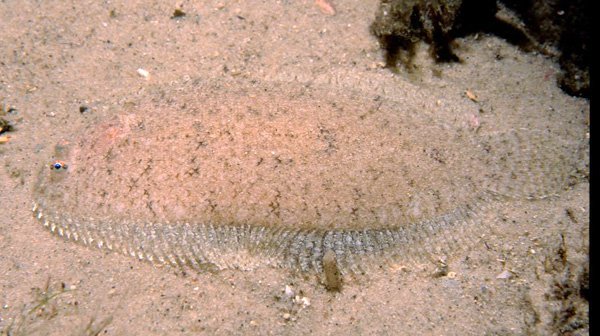
The Peppered Sole can be recognised by its very flat body (typical of the Family Soleidae) and elevated eyes on the right side of the body. It lacks pectoral fins and has papillae in front of the mouth. It is usually sandy coloured, speckled with light and dark spots.
Identification
The Peppered Sole can be recognised by its very flat body (typical of the Family Soleidae) and elevated eyes on the right side of the body. It lacks pectoral fins and has papillae in front of the mouth. It is usually sandy coloured, speckled with light and dark spots.
Size range
It grows to about 10 cm in length.Distribution
The species occurs in New South Wales.
Habitat
The Peppered Sole lives on sandy and silty bottoms in coastal bays, to depths of about 15 m.
Behaviour and adaptations
Life cycle
Like all flatfishes, the Peppered Sole passes through a planktonic stage, during which, the eyes are positioned on either side of the head. As the fish develops, one eye moves across the head, so both eyes end up on the same side. Some flatfishes, such as the Peppered Sole, have eyes that end up on the right side of the head. Another family of flatfishes, the Bothidae, contains the Left-eyed Flounders, in which the fishes have their eyes on the left side of the head.
Classification
- Genus:
- Aseraggodes
- Family:
- Soleidae
- Class:
- Actinopterygii
- Subphylum:
- Vertebrata
- Phylum:
- Chordata
- Kingdom:
- Animalia
References
- Edgar, G.J. 1997. Australian Marine Life: the plants and animals of temperate waters. Reed Books. Pp. 544.
- Kuiter, R.H. 1993. Coastal Fishes of South-Eastern Australia. Crawford House Press. Pp. 437.
- Kuiter, R.H. 1996. Guide to Sea Fishes of Australia. New Holland. Pp. 433.
Last Updated: 1 June 2009
Would you like to add a comment?
Sign up to add comments and find out more about the other benefits you can enjoy.
Would you like to add a tag?
Sign up to add tags and find out more about the other benefits you can enjoy.
what's on
19 Mar 10 – 20 Mar 10
Come and spend a Night at the Australian Museum and feel like you are sleeping over in your very own backyard.
Australian Museum, entry via William Street
Support us
Help us continue to provide quality research, education, community programs and exhibitions.
Online Shop
Featuring a selection of products relating to the collections.
Australian Museum Members
Join today to come to the Museum for free and enjoy many other benefits.
AMBS
Australian Museum Business Services - Ecological, archaeological and heritage consulting.
Museum as a Venue
We have many unique venues ideal for dinner, cocktails, weddings and conferences.
news
Michael Harvey
21 January 2010
The winner of this year's Wildlife Photographer of the Year competition has been stripped of his prize, after a review of the award by the judging panel.
Catherine Cooper
09 February 2010
The Australian Museum’s recent exhibition Climate change: our future, your choice has received an award from Museums and Galleries NSW.
what's new
- Eye-stripe Triggerfish, Sufflamen chrysopterum (Bloch & Schneider, 1801)
- Bilobed pectoral fin of a Blackspotted Gurnard Perch
- Blackspotted Gurnard Perch
- Blackspotted Gurnard Perch, Neosebastes nigropunctatus McCulloch, 1915
- Royal visitor examines Australian Museum collections
- Bone Detective - Stages 3 - Student Activities
- Fascinating Fossils Stage 5 - Student Activities
- Evolution, survival and extinction - Stage 6 - Student Activities
- Erecting Malangan Poles
- Scenes from Swarga (the afterlife): Balinese Painting E74161
what's popular
- Australian Museum Ornithology Collection
- Australian Museum Palaeontology Collection
- Palorchestes: A tale of misidentification
- Australian Museum Mineralogy Collection
- Frogs: Class Amphibia
- Mammals: Mammalia
- Moths, butterflies and skippers: Order Lepidoptera
- Spotted Wobbegong, Orectolobus maculatus (Bonnaterre, 1788)
- Chitons - Class Polyplacophora
- Intertidal habitats
recent comments
“Thank you Ondine, what a great website!”
“
Hi Will, Thank you for your kind offer of an image of the species. I will add a factsheet...”
Common Toadfish, Tetractenos hamiltoni (Gray & Richardson, 1843)
“
Hi Will, Sure. As stated in my previous post re Spotted Wobbegong, just email the images...”
Estuary Catfish, Cnidoglanis macrocephalus (Valenciennes, 1840)