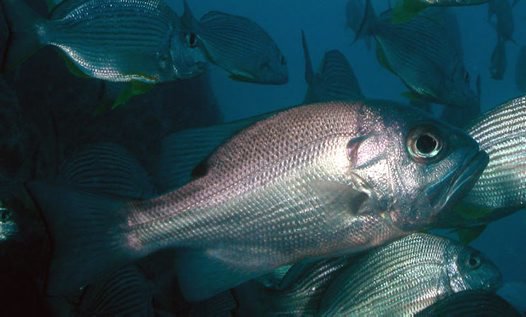
Pearl Perch, Glaucosoma scapulare Macleay, 1881
Bull-eye, Epaulette-fish, Nannygai, Pearly
 Click to enlarge image
© Dave Harasti
Fast Facts
-
Classification
- Genus
- Glaucosoma
- Species
- scapulare
- Family
- Glaucosomatidae
- Order
- Perciformes
- Class
- Actinopterygii
- Subphylum
- Vertebrata
- Phylum
- Chordata
- Kingdom
- Animalia
-
- Size Range
- It grows to 70 cm in length.
Introduction
The Pearl Perch has a blue-black to grey bony shield projecting from under the upper operculum. The species is an excellent table fish that occurs in eastern Australian coastal waters to depths of 90 m.

A 40 cm long Pearl Perch caught on hook and line at a depth of 20 m, North Solitary Island, New South Wales, 1 January 2011.
Image: Justin McKenzie© Justin McKenzie
Identification
The Pearl Perch can be recognised by its supracleithrum, the bone that projects as a blue-black to grey bony shield from under the upper operculum. If the thin layer of skin covering the supracleithrum is removed, the pearly-white bone is revealed. The colouration of the supracleithrum is the origin of the common name of this fish.
The Pearl Perch has a robust body, a large mouth and a second dorsal fin which is higher than the first. The body is silvery to grey, and each scale has a small golden brown spot. There is a dark spot at the base of the last dorsal fin rays. A brown line passes diagonally through the eye of juveniles.
Habitat
The species lives in coastal waters to depths of 90 m.
Distribution
It is endemic to Australia, occurring from the central coast of Queensland to the central New South Wales coast.
The map below shows the Australian distribution of the species based on public sightings and specimens in Australian Museums. Source: Atlas of Living Australia.
Economic impacts
The Pearl Perch is a commercial species, which is mostly caught on lines. It is an excellent table fish.
References
- Hoese, D.F., Bray, D.J., Paxton, J.R. & G.R. Allen. 2006. Fishes. In Beesley, P.L. & A. Wells. (eds) Zoological Catalogue of Australia. Volume 35. ABRS & CSIRO Publishing: Australia. parts 1-3, pages 1-2178.
- Hutchins, B. & R. Swainston. 1986. Sea Fishes of Southern Australia. Complete Field Guide for Anglers and Divers. Swainston Publishing. Pp. 180.
- McKay, R.J. 1997. FAO Species Catalogue. Volume 17. Pearl Perches of the World (family Glaucosomatidae). An annotated and illustrated catalogue of the pearl perches known to date. Food and Agriculture Organisation of the United Nations. Rome. Pp. 26.
- Yearsley, G.K., Last, P.R. & R.D. Ward. 1999. Australian Seafood Handbook, an identification guide to domestic species. CSIRO Marine Research. Pp. 461.