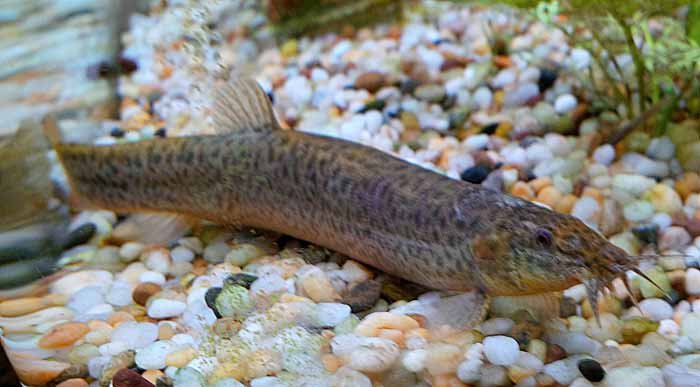
Oriental Weatherloach, Misgurnus anguillicaudatus Cantor, 1842
 Click to enlarge image
© Celia Clifford-Smith
Fast Facts
-
Classification
- Genus
- Misgurnus
- Species
- anguillicaudatus
- Family
- Cobitidae
- Order
- Cypriniformes
- Class
- Actinopterygii
- Subphylum
- Vertebrata
- Phylum
- Chordata
- Kingdom
- Animalia
-
- Size Range
- The Oriental Weatherloach grows to a maximum length of 25 cm, although in Australia it only grows to 20 cm.
Introduction
The Oriental Weatherloach is native to Asia but has been introduced to Australia, probably as a result of release by aquarists or escape from ponds.
Identification
The species can be recognised by its cylindrical body, five pairs of barbels around its mouth and the single short-based dorsal fin. Mature males are easy to identify because the second pectoral ray is long and thick. The pectoral fin is triangular rather than rounded.
Oriental Weatherloach are usually a mottled yellow-brown colour with black spots and a pale undersurface.
Habitat
The species can tolerate a wide range of water conditions, but prefers still waters with a muddy or sandy bottom into which it can burrow. It can survive out of water by swallowing air and absorbing atmospheric oxygen through the hind gut.
Distribution
The Oriental Weatherloach is native to Asia but has been introduced to Australia, probably as a result of release by aquarists or escape from ponds.
This species was first recorded in Australia from the Yarra River, Victoria in 1984. Since then, it has been recorded from numerous freshwater localities in Victoria, Australian Capital Territory, New South Wales and Queensland. There are also unconfirmed reports from Western Australia and South Australia. The 13 cm fish in the images was collected in Tuppal Creek, near Deniliquin, New South Wales in March 1999.
The map below shows the Australian distribution of the species based on public sightings and specimens in Australian Museums. Source: Atlas of Living Australia.
Feeding and diet
It is omnivorous, eating a range of food including insect larvae, crustaceans, algae and detritus.
Other behaviours and adaptations
The standard name refers to this species reportedly becoming restless during changes in barometric pressure.
Economic impacts
The Oriental Weatherloach is not eaten in Australia, but is a food fish in many Asian countries. The lower image shows two barrels of loach for sale in the Tokyo Metropolitan Central Wholesale Market: Tsukiji Market. The loach were sorted for sale by size.
References
- Lintermans, M. & J. Burchmore in McDowall, R.M. 1996. Freshwater Fishes of South-Eastern Australia. Reed Books. Pp. 247.
- Allen, G.R., Midgley, S.H. & M. Allen. 2002. Field Guide to the Freshwater Fishes of Australia. Western Australian Museum. Pp. 394.