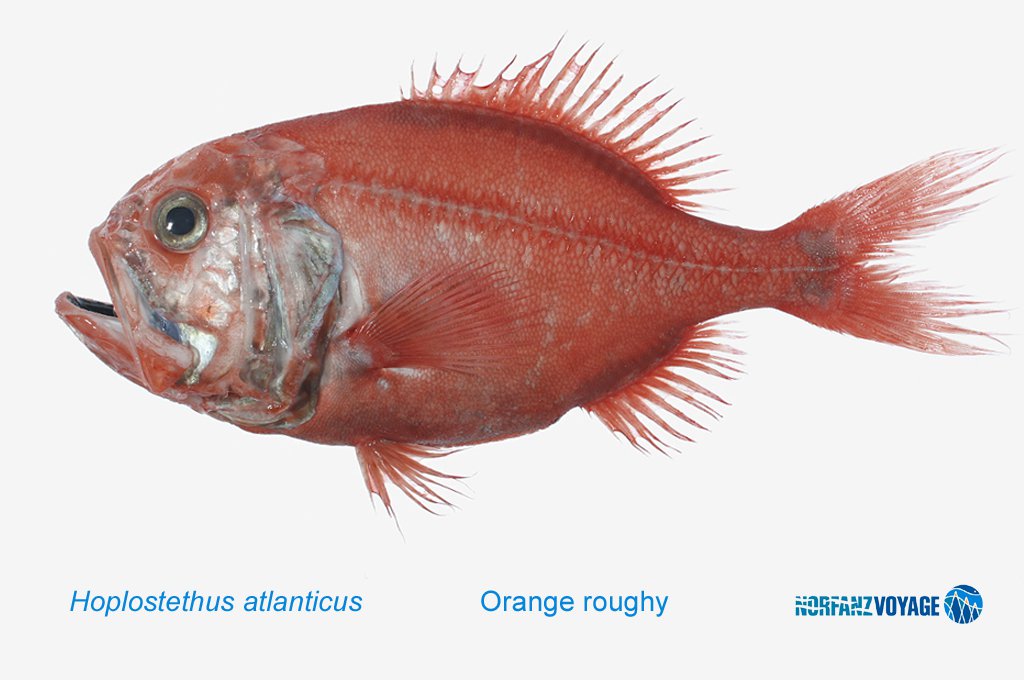
Orange Roughy, Hoplostethus atlanticus Collett, 1889
Deepsea Perch, Orange Ruff, Red Roughy.
 Click to enlarge image
© NORFANZ
Fast Facts
-
Classification
- Genus
- Hoplostethus
- Species
- atlanticus
- Family
- Trachichthyidae
- Order
- Beryciformes
- Class
- Actinopterygii
- Subphylum
- Vertebrata
- Phylum
- Chordata
- Kingdom
- Animalia
-
- Size Range
- It grows to about 50 cm in length in Australia although up to 60 cm elsewhere.
Introduction
The Orange Roughy is a schooling deepwater species that has been heavily overfished in the past. We now know it is a long-lived species that doesn't mature until it is 27 to 32 years of age.
Identification
The Orange Roughy has a moderately deep body that is covered with small ctenoid scales. There are deep mucous cavities on the head and 19 to 25 scutes on the belly. The body colour is orangish red. The fins are pale orange and the inside of the mouth and gill chambers are black.
Habitat
The Orange Roughy is a demersal species that is found in continental slope waters at depths between 500 m and 1000 m.
Distribution
The Orange Roughy occurs in the Eastern Atlantic and the Indo-West Pacific.
In Australia it is known from off the central coast of New South Wales, around the temperate south of the country to south-western Western Australia.
The map below shows the Australian distribution of the species based on public sightings and specimens in Australian Museums. Click on the map for detailed information. Source: Atlas of Living Australia.
Life history cycle
Orange Roughy can live for well over 100 years. The fish doesn't mature until 27 to 32 years of age. In Australia spawning aggregations form between mid-July and late August. These aggregations, which occur near the bottom, can be over 50 m in height.
Economic impacts
Spawning aggregations off Tasmania were targeted by a trawl fishery from the late 1980s. In 1990, over 50,000 tonnes of fish were landed in the South East Trawl Fishery. The extremely slow growth rate combined with aggregating behaviour at spawning makes the Orange Roughy very vulnerable to overfishing. Catches have declined since since 1990, with 4174 tonnes caught in the South East Trawl Fishery during 1998.
The soft white flesh of this species is excellent eating, but the skin contains a substance that can cause diarrhoea.
References
- Gomon, M.F. in Gomon, M.F., Glover, C.J.M. & R.H. Kuiter (Eds). 1994. The Fishes of Australia's South Coast. State Print, Adelaide. Pp. 992.
- Last, P.R., Scott, E.O.G. & F.H. Talbot. 1983. Fishes of Tasmania. Tasmanian Fisheries Development Authority. Pp. 563.
- Pogonoski, J.J., Pollard, D.A. & J.R. Paxton. 2002. Conservation Overview and Action Plan for Australian Threatened and Potentially Threatened Marine and Estuarine Fishes. Canberra: Environment Australia. Pp. 375.
- Yearsley, G.K., Last, P.R. & R.D. Ward. 1999. Australian Seafood Handbook, an identification guide to domestic species. CSIRO Marine Research. Pp. 461.