

Coffin Ray, Hypnos monopterygius (Shaw & Nodder 1795)
Numbfish, Numbray, Crampfish, Numbie, Short-tail Electric Ray, Torpedo
 Click to enlarge image
© Erik Schlögl
Fast Facts
-
Classification
- Genus
- Hypnos
- Species
- monopterygius
- Family
- Hypnidae
- Order
- Torpediniformes
- Class
- Chondrichthyes
- Subphylum
- Vertebrata
- Phylum
- Chordata
- Kingdom
- Animalia
-
- Size Range
- It grows to at 60 cm in length but is uncommon over 40 cm.
Introduction
The Coffin Ray is well known to divers. The fish often hides under the sand from where it can deliver a powerful electric shock to anyone who touches it.
What do Coffin Rays look like?
Identification
The Coffin Ray is shaped like two discs. The head and pectoral fins form a large disc, while a second smaller disc is formed by the pelvic fins. Located on the second disc are two small dorsal fins, immediately followed by a similar-looking caudal fin.
The species can vary from grey or light brown through to black.

© CC BY-NC-ND 4.0
Where do Coffin Rays live?
Habitat
The species is found on sand and mud bottoms in shallow bays and estuaries, but is also known to depths over 200 m. When seen by divers it is usually buried in the sediment where a telltale rounded depression gives away its presence.

© CC-BY 4.0
Distribution
The Coffin Ray is endemic to Australian waters. It is recorded from southern Queensland, around the south of the country and north to the north-western coast of Western Australia. It is rare in Victoria and absent from Tasmania.
The map below shows the Australian distribution of the species based on public sightings and specimens in Australian Museums. Click on the map for detailed information. Source: Atlas of Living Australia.
What do Coffin Rays eat and how have they adapted?

Feeding and diet
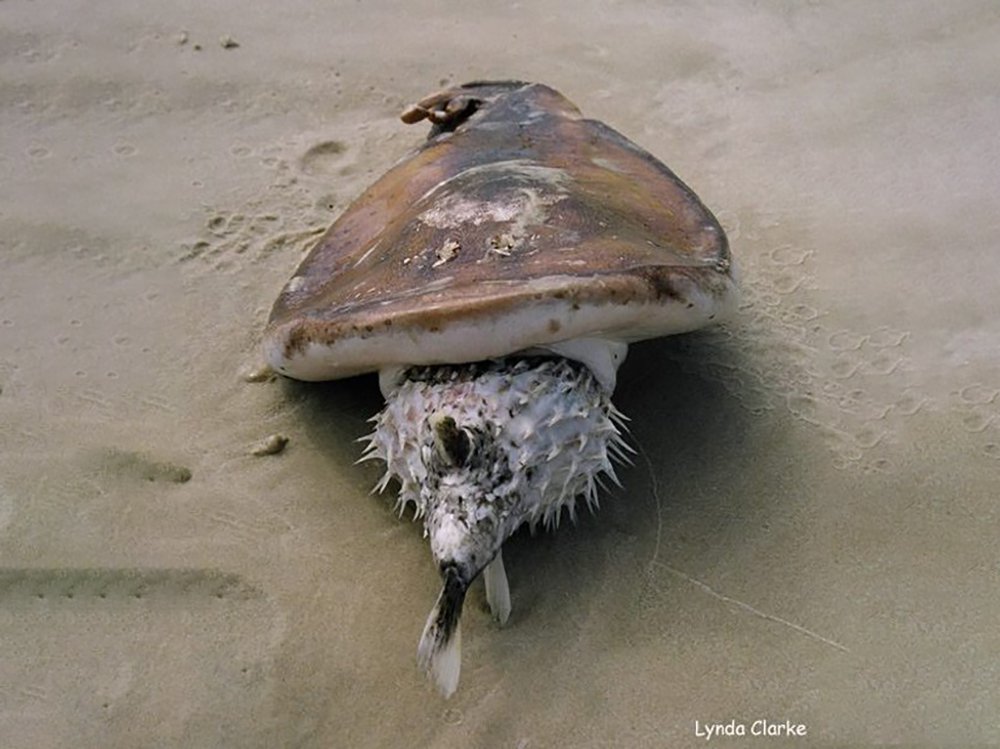
The Coffin Ray can deliver powerful electric shocks with an electric organ located in each pectoral fin. This organ is used to shock crabs, worms and fishes, which make up the Coffin Ray's diet.
To swallow relatively large prey whole, the Coffin Ray is able to greatly expand its mouth.
Craig Henderson, who was the Unit Supervisor of Taronga Zoo Aquarium until its closure in 1992 made the following comments: "I undertook a captive management study of Hypnos monopterygius as the Aquarium had never previously been successful in keeping them in captivity. We found that the rays would only feed on fish (only whole fish initially) that were presented to them on a plastic stick which was 'swum' past their nose. They rays required a soft substrate such as sand or fine shellgrit to bury into. Their attack of the prey was incredibly fast, without any warning, and was always accompanied by an electrical discharge. The prey item (including very large fish) would be swallowed head first, whole, very quickly before the animal would re-bury itself."
© Lynda Clarke
In August 2012, Cary Rogers wrote, "During a night dive, a Coffin Ray was observed feeding at northern Bare Island, Botany Bay, Sydney. I turned off my torch to observe the phosphorescence of the plankton. While observing, I noticed blue-white electric discharges in the water column nearby, similar in appearance to lightening. I then switched on my torch and swam to the area in about 8-10m water depth. When I approached where the flashes had occurred; I observed a large adult Coffin Ray swimming in the mid-water. It was feeding on something which I assume was a fish; I suggest it had stunned this unidentified prey in the water column using its electric organs.
Sean McMahon stated that: "On the weekend I was talking to a family friend who does a lot of beach fishing. He said that in the last ten years he has found a few dead Coffin Ray washed up on the beach. There is a large estuary near Taree (northern NSW) that opens to the sea. He said that once he found a Coffin Ray that had just washed in and was very fat so he cut it open. Inside was a small penguin that had not been digested! He said that he found another Coffin Ray with a penguin in it a few years later as well! I have read the e-mails concerning the 'rat in the Coffin Ray' so I thought this may be of some interest to you."
Sharks online publication
Delve into the world of Sharks and explore the digital publication with videos and extra content from the exhibition. Hear from First Nations peoples, scientists and conservationists as they share their stories about these ancient survivors.
Explore nowBehaviours and adaptations
The electric organs of the torpedo rays (family Torpedinidae) can deliver strong electric shocks (50 amps, with peak of pulses sometimes exceeding 1 kilowatt).

© CC-BY 4.0
References
- Edgar, G.J. 1997. Australian Marine Life: the plants and animals of temperate waters. Reed Books. Pp. 544.
- Hoar, W.W. & D.J. Randall. 1971. Fish Physiology. Sensory systems and electric organs. Academic Press. Volume V. Pp 347.
- Last, P.R. in Gomon, M.F., Glover, C.J.M. & R.H. Kuiter (Eds). 1994. The Fishes of Australia's South Coast. State Print, Adelaide. Pp. 992.
- Hutchins, B. & R. Swainston. 1986. Sea Fishes of Southern Australia. Complete Field Guide for Anglers and Divers. Swainston Publishing. Pp. 180.
- Kuiter, R.H. 1996. Guide to Sea Fishes of Australia. New Holland. Pp. 433.
- Kuiter, R.H. 2000. Coastal Fishes of South-eastern Australia. Gary Allen. Pp. 437.
- Last, PR & J.D. Stevens. 1994 Sharks and Rays of Australia. CSIRO. Pp. 513.
- Randall, J.E., Allen, G.R. & R.C. Steene. 1997. Fishes of the Great Barrier Reef and Coral Sea. Crawford House Press. Pp. 557.

