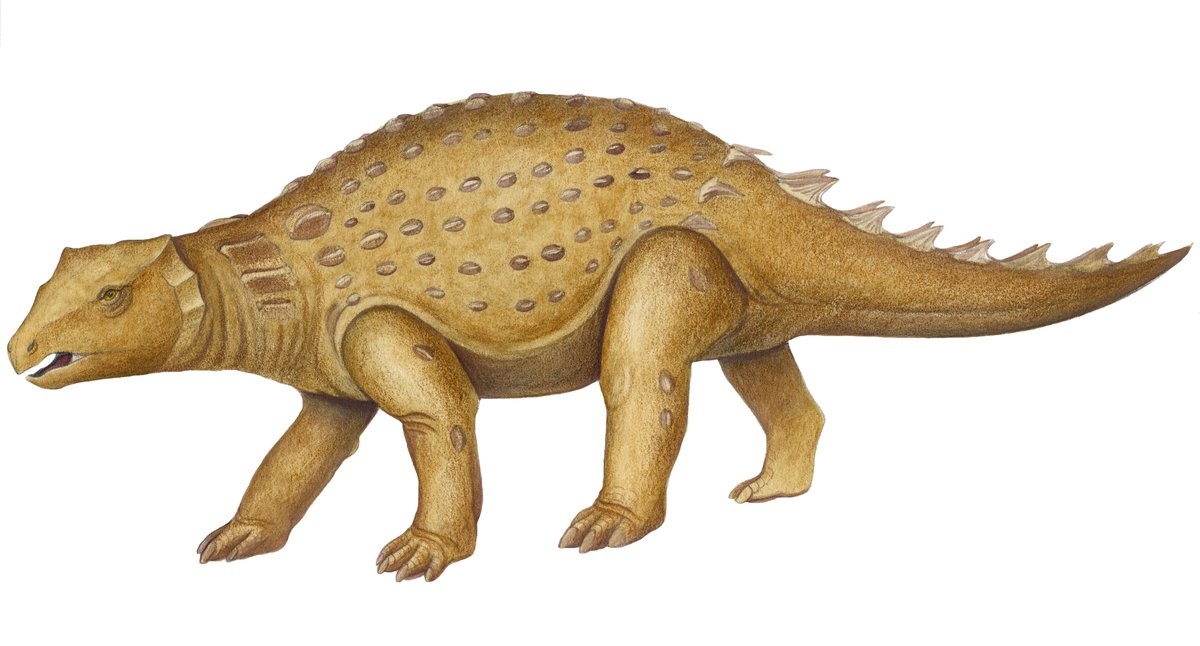
Dinosaur - Minmi paravertebra
 Click to enlarge image
© Anne Musser
Fast Facts
-
Classification
- Genus
- Minmi
- Species
- paravertebra
- Family
- incertae sedis
- Suborder
- Cerapoda
- Infraorder
- Ankylosauria
- Order
- Ornithischia
- Superorder
- Dinosauria
- Subdivision
- Avemetatarsalia
- Division
- Archosauria
- Infraclass
- Archosauromorpha
- Subclass
- Diapsida
- Class
- Sauropsida
- Series
- Amniota
- Super Class
- Tetrapoda
- Subphylum
- Vertebrata
- Phylum
- Chordata
- Kingdom
- Animalia
-
- Size Range
- 3m long
-
View Fossil Record
- Fossil Record
- Cretaceous Period
(141 million years ago - 65 million years ago)
Minmi paravertebra was an ankylosaur, a quadrupedal dinosaur covered in bony armour. It was discovered in 1964 near Minmi Crossing, Queensland, and was the first ankylosaur known from the Southern Hemisphere. Minmi had thin bony rods (ossified tendons, or 'paravertebrae') along its spine that may have been for muscle attachment. This extra muscle power along with its comparatively long legs may have made Minmi a speedy runner. A study of gut contents found that Minmi ate seeds, ferns and other soft plant material.
Identification
Ankylosaurs were heavy-bodied, quadrupedal herbivores. They were armoured for protection against predators. Minmi was unique among ankylosaurs (and other dinosaurs) in having small, backwardly directed bony projections (paravertebrae, or ossified tendons) along the backbone to provide extra attachment for back muscles. These were similar to the bony structures found in crocodiles that strengthen and support the back during the 'high walk'. Along with its unusually long legs, these paravertebrae suggest that Minmi could have outrun at least some predators rather than relying solely on armour for protection.
Minmi had belly armour (absent in most ankylosaurs and related stegosaurs) along with armour (scutes, spikes and dermal ossicles) over the neck and trunk. Minmi did not have a clubbed tail and, unlike almost all other ankylosaurs, had no dermal armour on the skull.
Habitat
During the Early Cretaceous, part of Queensland formed a large island separate from the rest of Australia. The environment is interpreted as a mix of floodplains and woodlands. Although Minmi was found in marine sediments, it was undoubtedly washed out to sea from this nearby terrestrial environment.
Subscribe to our eNewsletter
Keep up to date on events, special offers and scientific discoveries with our What's On eNewsletter. Receive the latest news on school holiday programs and much more!
Sign up nowDistribution
Minmi fossils were found at Minmi Crossing near Roma on the western Darling Downs, southeast Queensland. A second specimen originally thought to belong to Minmi was later found at Marathon Station near Hughenden in north central Queensland, however, it was reassigned to a different genus, Kunbarrasaurus ieversi in 2015. Although ankylosaur fossils have now been found in both New Zealand and Antarctica, these fossils do not appear to belong to Minmi.
Feeding and diet
It is presumed Minmi was a herbivore based on analysis of other ankylosaurs. A study of preserved gut contents (cololites) in Kunbarrasaurus, a closely related species, shows that it ate the seeds and fruiting bodies of flowering plants as well as ferns and other soft-leaved plants. This is the first such study in either ankylosaurs or stegosaurs, and the best evidence yet for the diet of herbivorous dinosaurs. The plant material found in Kunbarrasaurus' abdominal region was finely diced, and it may have cut its food with its serrated cheek teeth after nipping the vegetation off with its beak. The food would then be within the mouth (possibly helped by development of fleshy cheeks).
Fossils description
The type specimen of Minmi includes 11 vertebrae, parts of at least 14 ribs, some armour plating and a partial foot.
Evolutionary relationships
Minmi is placed within the Ankylosauria.
References
- Carpenter, K. 2001. Chapter 21: Phylogenetic analysis of the Ankylosauridae. pp. 455-480 in Carpenter, K. (ed.) The Armored Dinosaurs, Indiana University Press, Bloomington.
- Molnar, R. E. 1980a. An ankylosaur (Ornithischia: Reptilia) from the Lower Cretaceous of southern Queensland. Memoirs of the Queensland Museum 20, 77-87.
- Molnar, R. E. and Frey, E. 1987. The paravertebral elements of the Australian ankylosaur Minmi (Reptilia: Ornithischia, Cretaceous). Neues Jahrbuch für Geologie und Paläontologie, Abhandlungen. 175, 19-37.
- Molnar, R.E. 1996. Preliminary report on a new ankylosaur from the Early Cretaceous of Queensland, Australia. Memoirs of the Queensland Museum 39, 653-668.
- Molnar, R. E. 2001. Chapter 16: Armor of the small ankylosaur, Minmi. pp. 341-362 in Carpenter, K. (ed.) The Armored Dinosaurs, Indiana University Press, Bloomington.
- Molnar, R. E. and Clifford, H. T. 2001. Chapter 19: An ankylosaurian cololite from the Lower Cretaceous of Queensland, Australia. pp. 399-412 in Carpenter, K. (ed.) The Armored Dinosaurs, Indiana University Press, Bloomington.
Further reading
- Carpenter, K. (ed.) The Armored Dinosaurs, Indiana University Press, Bloomington.
- Long, J. A. et al. 2002. Dinosaurs of Australia and New Zealand and Other Animals of the Mesozoic Era. New South Wales University Press, Sydney; 188 pp.