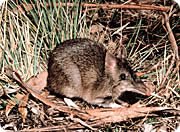
Long-nosed Bandicoot
 Click to enlarge image
© Australian Museum
Fast Facts
-
Classification
- Genus
- Perameles
- Species
- nasuta
- Family
- Peramelidae
- Order
- Peramelemorphia
- Subclass
- Marsupialia
- Class
- Mammalia
- Subphylum
- Vertebrata
- Phylum
- Chordata
- Kingdom
- Animalia
-
- Size Range
- 31 cm - 43 cm
Introduction
The Long-nosed Bandicoot is probably best known for the small, round conical holes it leaves behind as it forages at night.
Identification
About the size of a rabbit, the Long-nosed Bandicoot has pointed ears, a short tail, grey-brown fur and, of course, a long nose.
Habitat
Long-nosed Bandicoots live in forests and woodlands, and heath.
Distribution
Long-nosed Bandicoots are found in eastern Australia, from Queensland, New South Wales and Victoria. They were once widespread and common in Sydney. Today, their range and distribution in the Sydney region is reduced, and isolated populations remain in bushland areas to the north and south of Sydney. A small colony at North Head, Manly is classified as an 'endangered population'.
Feeding and diet
Long-nosed Bandicoots eat insects and other small invertebrate prey.
Other behaviours and adaptations
The Long-nosed Bandicoot is probably best known for the small, round conical holes it leaves behind as it forages at night. These holes are dug with the front feet and are big enough for the animal's long, sensitive snout to reach in and detect insects and other small invertebrate prey. During the day they sleep in nests made from grasses and other plant material.
Life history cycle
Long-nosed Bandicoots are solitary for most of the year. The gestation period of only 12.5 days is one of the shortest known of any mammal.
Support our research
Help us to protect our vital natural and cultural heritage for generations to come. With your support, our scientists, explorers and educators can continue to do their groundbreaking work.
Make a donation