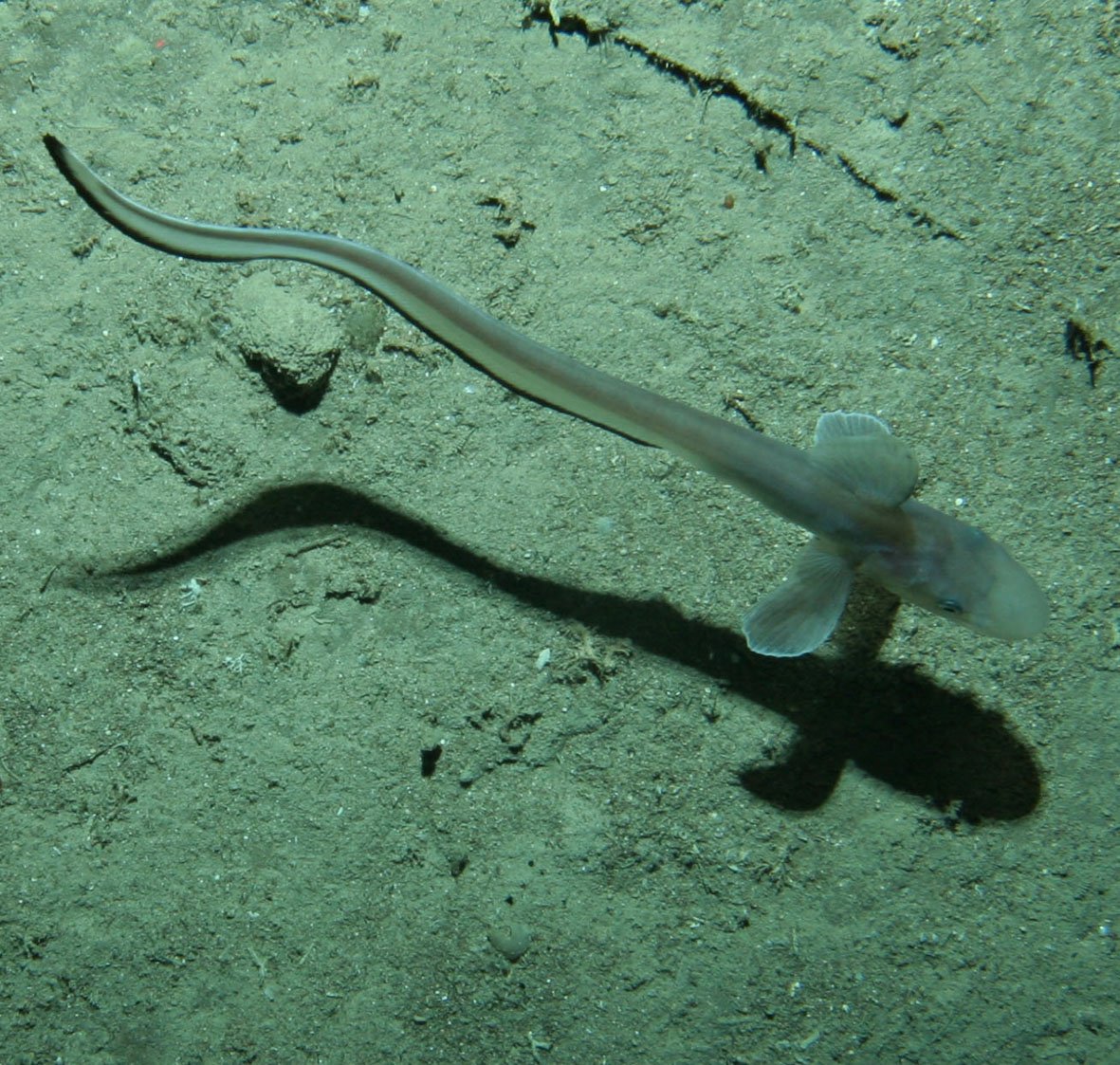
Jellynose Fish, Ateleopus
 Click to enlarge image
© Commonwealth of Australia
Fast Facts
-
Classification
- Genus
- Ateleopus
- Family
- Ateleopodidae
- Class
- Actinopterygii
- Subphylum
- Vertebrata
- Phylum
- Chordata
- Kingdom
- Animalia
-
- Size Range
- The maximum size for fishes in the family is about 2 m in length.
Introduction
Jellynose fishes have a long flabby body, a bulbous snout, and an inferior mouth. They have a short-based dorsal fin and a long-based anal fin that is continuous with the caudal fin. Jellynose fishes are usually dark brown to black.
Identification
Jellynose fishes have a long flabby body, a bulbous snout, and an inferior mouth. They have a short-based dorsal fin and a long-based anal fin that is continuous with the caudal fin.
Jellynose fishes are usually dark brown to black.
The taxonomy of the jellynoses needs research. The family contains about twelve species in four genera Ateleopus, Ijimaia, Parateleopus and Guentherus.
Currently, only one species of jellynose is recorded from Australian waters, the Pacific Jellynose Fish, Ateleopus japonicus.

© C.V. Turner
Distribution
Jellynose fishes occur in tropical and temperate marine waters of the outer continental shelf and slope, down to about 600 m.
The Pacific Jellynose Fish occurs circumglobally in continental slope depths. In Australia, its documented distribution is from off north-western Western Australia and from off southern Queensland to central New South Wales.
The map below shows the Australian distribution of the species based on public sightings and specimens in Australian Museums. Source: Atlas of Living Australia.
References
- Hoese, D.F., Bray, D.J., Paxton, J.R. & G.R. Allen. 2006. Fishes. in Beesley, P.L. & A. Wells. (eds) Zoological Catalogue of Australia. Volume 35. ABRS & CSIRO Publishing: Australia. parts 1-3, Pp. 1-2178.
- Nelson, J.S., 1994. Fishes of the World, third edition. John Wiley & Sons, Inc. Pp: 600.
- Olney, J.E. in Paxton, J.R. & W.N. Eschmeyer (Eds). 1994. Encyclopedia of Fishes. Sydney: New South Wales University Press; San Diego: Academic Press [1995]. Pp. 240.
- Paxton, J.R., D.F. Hoese, G.R. Allen & J.E. Hanley. 1989. Zoological Catalogue of Australia Vol.7 Pisces Petromyzontidae to Carangidae. Canberra: Australian Biological Resources Survey. Pp. i-xii, 1-665.