

Huntsman Spiders
Tarantula, Giant Crab Spider
 Click to enlarge image
© Australian Museum
Fast Facts
-
Classification
- Family
- Sparassidae
- Super Family
- Sparassoidea
- Order
- Araneae
- Class
- Arachnida
- Phylum
- Arthropoda
- Kingdom
- Animalia
-
- Number of Species
- 94 described species.
-
- Size Range
- Body lengths: 2 cm (female), 1.6 cm (male); Leg span: up to 15 cm
-
- Habitats
- peridomestic, tree hole, under bark
-
- Life history mode
- aerial
-
- Feeding Habits
- arthropod-feeder, carnivorous, insectivorous
Introduction
Australian Huntsman spiders belong to the Family Sparassidae (formerly Heteropodidae) and are famed as being the hairy so-called 'tarantulas' on house walls that terrify people by scuttling out from behind curtains.
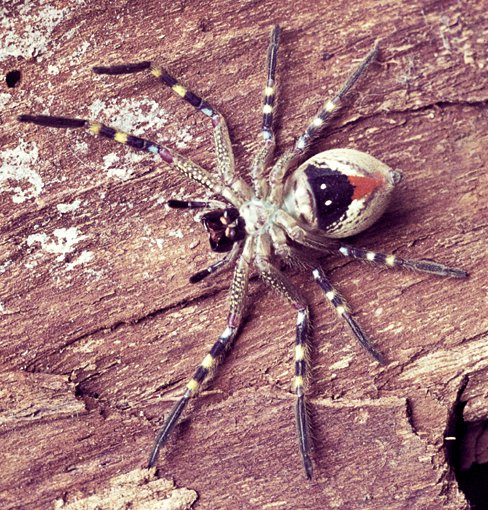
© Ramon Mascord
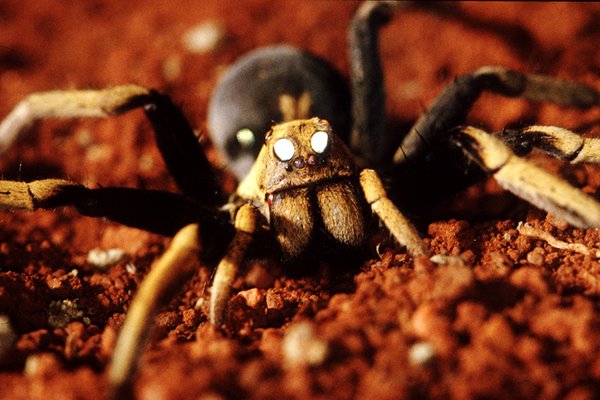
Identification
Huntsman spiders are large, long-legged spiders. They are mostly grey to brown, sometimes with banded legs. Many huntsman spiders, especially Delena (the flattest), and including Isopeda, Isopedella and Holconia, have rather flattened bodies adapted for living in narrow spaces under loose bark or rock crevices. This is aided by their legs which, instead of bending vertically in relation to the body, have the joints twisted so that they spread out forwards and laterally in crab-like fashion ('giant crab spiders'). Both Brown (Heteropoda) and Badge (Neosparassus) Huntsman spiders have less flattened bodies.
Brown Huntsman (Heteropoda species) spiders are patterned in motley brown, white and black.
Stay in the know
Get our monthly emails for amazing animals, research insights and museum events
Sign up todayHabitat
Huntsman Spiders are found living under loose bark on trees, in crevices on rock walls and in logs, under rocks and slabs of bark on the ground, and on foliage. Dozens of the social huntsman species, Delena cancerides, can be seen sitting together under bark on dead trees and stumps (notably wattles) but they can also be found on the ground under rocks and bark slabs.
Huntsman spiders of many species sometimes enter houses. They are also notorious for entering cars, and being found hiding behind sun visors or running across the dashboard.
Distribution
These genera are generally widely distributed throughout Australia, although Heteropoda is absent from most of Southeastern Australia and Tasmania has only a few Huntsman species, notably Delena cancerides and Neosparassus sp.
Feeding and diet
Food consists of insects and other invertebrates.
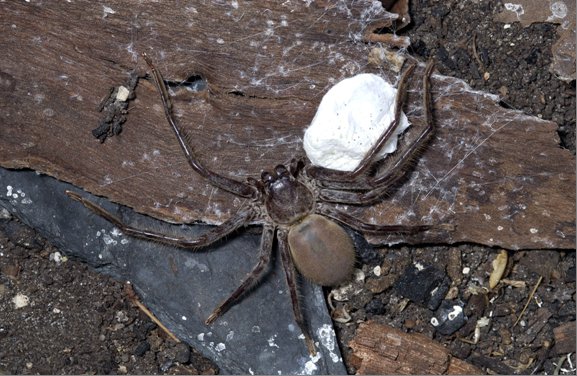
Huntsman Spider with egg sac
Image: Stuart Humphreys© Australian Museum

Life history cycle
The female Huntsman (Isopeda, for example) produces a flat, oval egg sac of white papery silk, and lays up to 200 eggs. She then places it under bark or a rock, and stands guard over it, without eating, for about three weeks. During this period the female can be quite aggressive and will rear up in a defensive display if provoked. Some species will even carry their egg sac under their bodies while moving about. Delena females lay a ground-sheet of silk upon which the egg sac is anchored while the eggs are laid into it. They will then complete her egg sac and pick it up, leaving the silk ground-sheet behind. Incubation periods vary and are probably influenced by climatic conditions.
In some cases (Isopeda), the female may moisten and tear the egg sac open, helping her spiderlings to emerge. The mother stays with them for several weeks. Young Huntsman spiders are pale. They undergo several moults while still with their mother, hardening to a darker brown, and eventually disperse.
Huntsman spiders, like all spiders, moult in order to grow and often their old skin may be mistaken for the original spider when seen suspended on bark or in the house.
The lifespan of most Huntsman species is about two years or more. Discover more about spider survival.

Green Huntsman Spider
Image: Stuart Humphreys© Australian Museum
Breeding behaviours
In the genus Isopoda, the male and female Huntsman spiders have a lengthy courtship, which involves mutual caresses, with the male drumming his palps on the trunk of a tree. He then inserts his palps into the female to fertilise her eggs. The male is rarely attacked, unlike some other species, and in fact many huntsman spiders live peacefully together in large colonies. A silken retreat is often built for egg laying, as well as for moulting.
Predators
Predators of Huntsman Spiders include birds and geckoes, Spider Wasps, nematode worms and egg parasites (wasps and flies).
Danger to humans
A cold pack may relieve local pain. Seek medical attention if symptoms persist.
References
- McKeown, K.C. 1952. Australian Spiders: their lives and habits. Angus and Robertson.
- York Main, B. 1976. Spiders. William Collins Publishers Pty Ltd, Sydney NSW.

