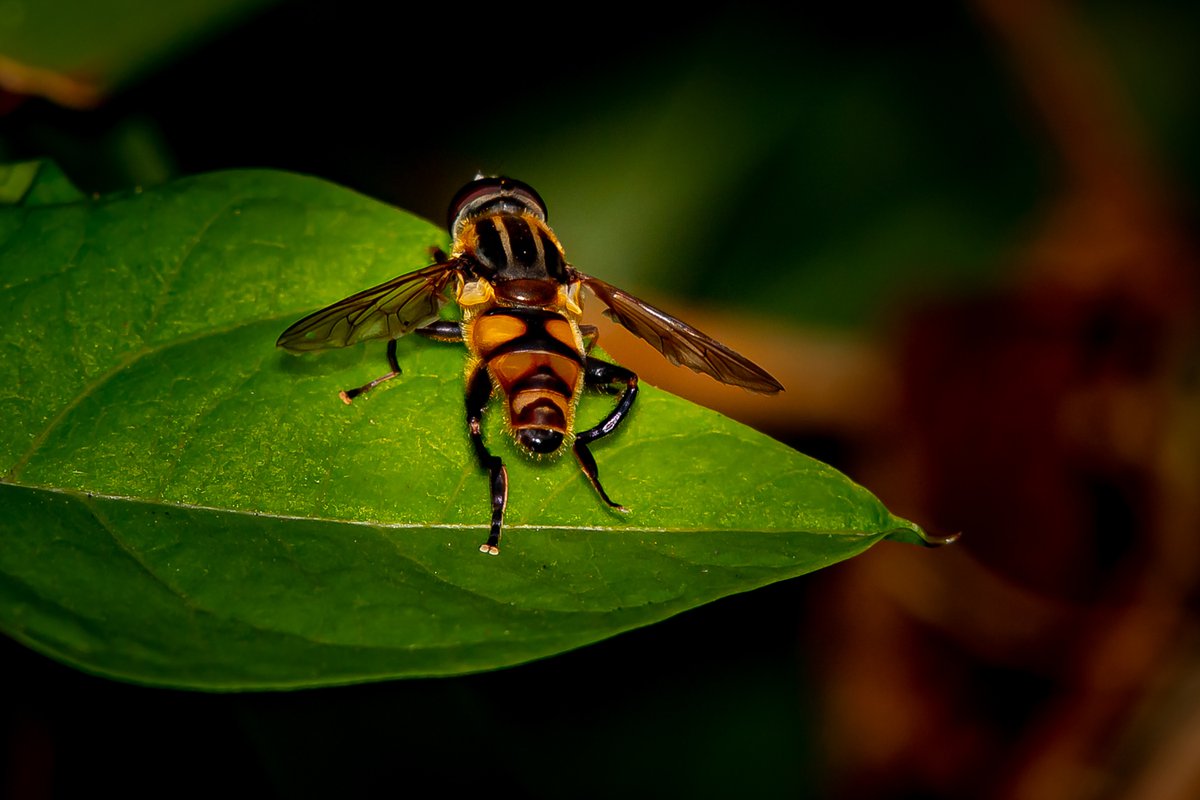
Hover flies
Flower flies
Hover flies are wasp and bee mimics
 Click to enlarge image
© Rob Annesley
Fast Facts
-
Classification
- Family
- Syrphidae
- Super Family
- Syrphoidea
- Order
- Diptera
- Class
- Insecta
- Subphylum
- Uniramia
- Phylum
- Arthopoda
- Kingdom
- Animalia
-
- Size Range
- 8 mm - 20 mm

© Australian Museum
Introduction
Hover flies have a characteristic flight pattern - hovering in one spot, moving suddenly forwards or sideways, then hovering again.
Identification
Hover flies are small to medium sized flies with large heads, large eyes, and small or inconspicuous antennae. Their bodies are medium to slender, with a waist that is not significantly narrow, unless it is a wasp mimicking species. They have one pair of clear wings, and the banded forms have yellow and black bands of equal width.
Hover fly mimicry of wasps can include having a warning coloration of yellow and black, a narrow waist like a wasp and even the ability to mimic the stinging action of a wasp, by pushing the tip of the abdomen into your fingers if they are caught and held. However, they do not sting and are quite harmless.
Aphid-eating hover fly larvae are flattened, legless and maggot-like. Most are green or brown in colour, going largely unnoticed as they crawl over foliage in search of their aphid prey.
Some people mistake hover flies for wasps or bees because of their black and yellow-striped abdomens and also because they can occur in huge numbers. However, they are actually members of a fly family that have evolved as wasp and bee mimics.
Habitat
Hover flies live in urban areas.
Stay in the know
Get our monthly emails for amazing animals, research insights and museum events.
Sign up todayDistribution
Hover flies are found throughout Australia.
Feeding and diet
Hover flies may appear in large numbers during hot weather. They linger in gardens to feed at flowers and to seek shade. Many species perform the useful role of ridding the garden of aphids, as they lay their eggs in aphid colonies and the larvae (maggots) feed on the aphids.
Other behaviours and adaptations
Hover flies are also called flower flies because they are commonly seen during warmer months hovering among flowers, feeding and mating. They pollinate many plants and help keep aphids under control.
They hover in the one spot, move suddenly forwards or sideways, and then hover again.

© Australian Museum
Life history cycle
Some hover fly species (Eristalis sp) lay their eggs in stagnant water. These aquatic larvae have a long thin breathing tube - hence the common name, "rat-tailed maggots". Another hover fly species (Microdon sp) has a larval form that scientists originally classified as a mollusc because it looks rather like a small slug. Microdon larvae survive by scavenging in ant nests, mimicking the ants' chemicals in order to escape detection by their hosts.
References
- CSIRO. 1994. Insects of Australia. CSIRO Publishing: Canberra.
- Hadlington, P. & J. Johnston. 1998. An Introduction to Australian Insects. UNSW Press: Sydney.
- Zbrowski, P. & R. Storey. 1995. A Field Guide to Insects in Australia. Reed Books: Sydney.