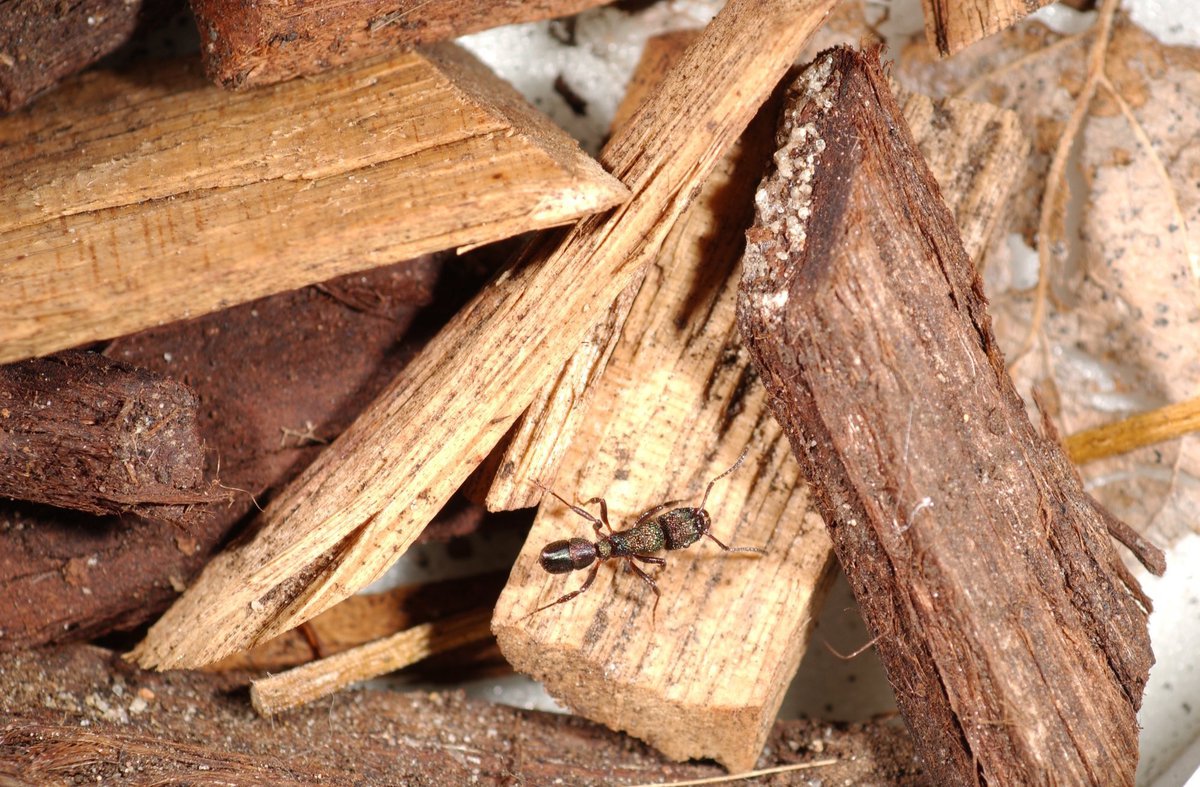
Green-head Ant
Green Ant
 Click to enlarge image
© Australian Museum
Fast Facts
-
Classification
- Genus
- Rhytidoponera
- Species
- metallica
- Subfamily
- Ponerinae
- Family
- Formicidae
- Super Family
- Vespoidea
- Suborder
- Apocrita
- Order
- Hymenoptera
- Class
- Insecta
- Subphylum
- Uniramia
- Phylum
- Arthopoda
- Kingdom
- Animalia
-
- Size Range
- 5 mm - 7 mm
Green-head Ants are one of the most abundant and widespread of Australian insects.
Identification
The metallic colour of Green-head Ants can vary from a green-blue to a green-purple sheen.
Habitat
Green-head Ants live in urban areas, forests and woodlands, heath.
Distribution
Green-head Ants are found throughout Australia.
Feeding and diet
Green-head Ants have a broad-ranging diet, but they generally feed on animal material both as scavengers and predators. They move quickly while foraging, which generally occurs during the day, on the ground and among vegetation.
Other behaviours and adaptations
Green-head Ants are able to colonise disturbed areas quickly and have become common in urban areas. These ants are one of the first insects to forage after bush fires and are sometimes found as soon as the embers have stopped smouldering.
Unlike many ants, rain presents no problem to Green-head Ants, as long as it is only a light shower in continued sunshine. In overcast, cloudy conditions these ants return to their nests, which are usually in soil, under twigs or wood and often at the base of shrubs.
Danger to humans
Green-head Ants can sting. An ice pack or commercially available spray may be used to relieve the pain of the sting. If there is evidence of an allergic reaction, medical attention should be sought.