Golden Orb Weaving Spiders
Golden Orb Weaver
 Click to enlarge image
© Australian Museum
Fast Facts
-
Classification
- Genus
- Nephila
- Family
- Nephilidae
- Order
- Araneae
- Class
- Arachnida
- Phylum
- Arthropoda
- Kingdom
- Animalia
-
- Size Range
- 2 cm - 4 cm (female), 5 mm (male)
The Golden Orb Weaving Spiders build large, strong orb webs with a golden sheen.
Identification
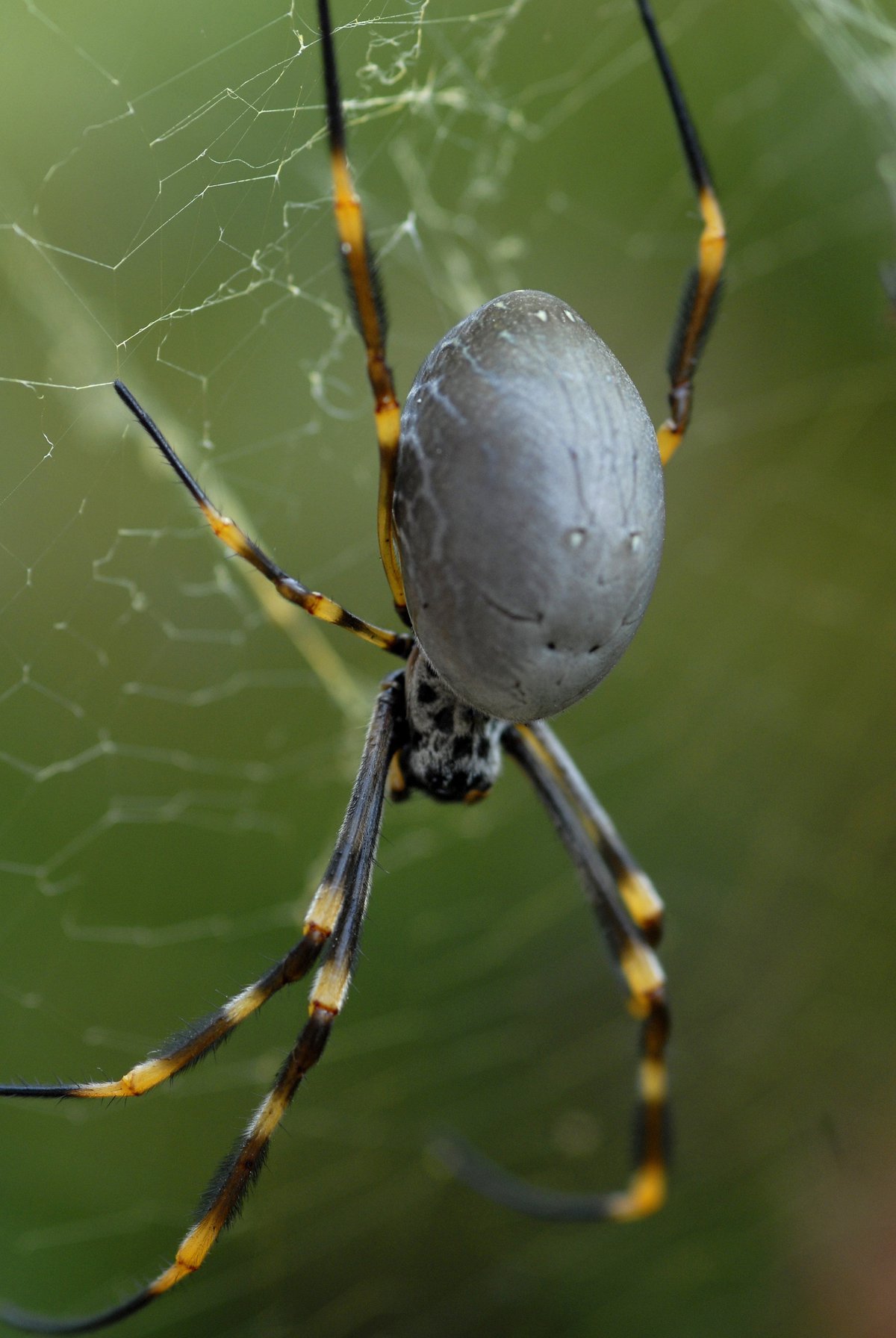
Golden Orb Weaving Spiders are large spiders with silvery-grey to plum coloured bodies and brown-black, often yellow banded legs. The males are tiny and red-brown to brown in colour. The main difference between the common Sydney species, Nephila plumipes and N. edulis (which is commoner in inland regions) is the presence of a 'knob' on the front of the sternum (the heart shaped plate on the underside of the body between the legs) of N. plumipes.

Famale Golden Orb-weaving Spider, Nephila plumipes.
Image: Fritz Hiersche© Fritz Hiersche
Habitat
Golden Orb Weaving Spiders are found in dry open forest and woodlands, coastal sand dune shrubland and mangrove habitats.
All orb weaving spiders make suspended, sticky, wheel-shaped orb webs. Webs are placed in openings between trees and shrubs where insects are likely to fly.
Stay in the know
Get our monthly emails for amazing animals, research insights and museum events
Sign up todayDistribution
Golden Orb Weaving Spiders are found in dry open forest and woodlands, coastal sand dune shrubland and mangrove habitats, with Nephila edulis and N. plumipes being the two species found in the Sydney region.
In Sydney, the bushes and trees of the Royal Botanic Gardens are a good place to see them, as are the mangrove forests of Bicentennial Park and the Homebush Bay area of the city.
Feeding and diet
Golden orb weaving spiders prey items include flies, beetles, locusts, wood moths and cicadas. Sometimes their strong webs manage to trap small birds or bats, and the spider will wrap them and feed upon them.

Juvenile Golden Orb Weaver, Nephila spp.
Image: -© Australian Museum
Other behaviours and adaptations
The Golden Orb Weaving Spiders build large, semi-permanent orb webs. The strong silk has a golden sheen. These spiders remain in their webs day and night and gain some protection from bird attack by the presence of a 'barrier network' of threads on one or both sides of the orb web.
Like the St Andrew's Cross Spider, they will vibrate their webs to distract potential predators. Sometimes aggregations of Golden Orb Weavers are found, with a tangled network of overlapping webs. Their webs are often host to the small kleptoparasitic spiders of the genus Argyrodes (often the Quicksilver Spider, Argyrodes antipodeanus) which inhabit the larger spider's web and eat the smaller insects that become trapped on the web, thereby helping keep the web clear of debris.

Golden Orb Weaving Spider with cicada in web
Image: Bruce Hulbert© Bruce Hulbert
Life history cycle
In the Golden Orb Weaving Spider group, it is common for a number of tiny (6 mm) males to live around the edges of a female's web, waiting for a mating opportunity. After mating, the female Golden Orb Weaving Spider wraps her single egg sac in a mass of golden silk, which is then hidden on foliage away from the web, disguised within a curled leaf or sprig of twigs.
Predators
Predators of orb weavers include several bird species and wasps of the family Sphecidae. The wasps land on the web, lure the spider to the perimeter by imitating a struggling insect's vibrations, and then carry the spider away to be paralysed and stored as live food for their young.
Danger to humans
Orb weavers are reluctant to bite. Symptoms are usually negligible or mild local pain, numbness and swelling. Occasionally nausea and dizziness can occur after a bite.
Seek medical attention if symptoms persist.