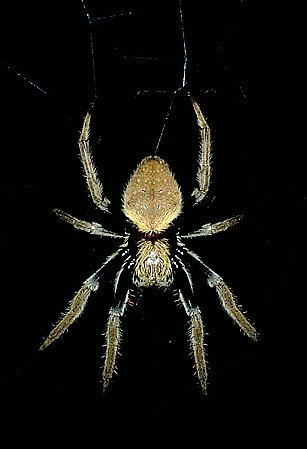
Garden Orb Weaving Spiders
Garden Orb Weavers
 Click to enlarge image
© Australian Museum
Fast Facts
-
Classification
- Genus
- Eriophora
- Species
- sp.
- Family
- Araneidae
- Super Family
- Araneoidea
- Suborder
- Araneomorphae
- Order
- Araneae
- Class
- Arachnida
- Phylum
- Arthropoda
- Kingdom
- Animalia
-
- Number of Species
- 100
-
- Size Range
- 2 cm - 3 cm (female), 1.5 cm - 2 cm (male)
Introduction
The Garden Orb Weaving Spiders are a large group of spiders with over 100 known species in Australia.
Identification
The commonly seen Garden Orb Weavers are stout, reddish-brown or grey spiders with a leaf-shaped pattern on their fat, roughly triangular abdomens, which also have two noticeable humps towards the front. They sometimes have a dorsal stripe which may be white or brown edged with white.
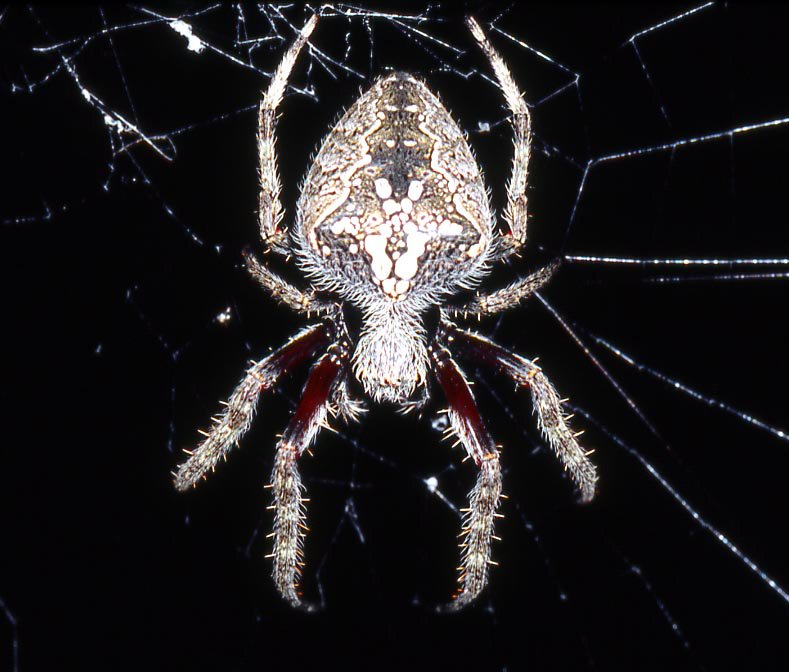
Garden Orb Spider, Eriophora spp.
Image: -© Australian Museum
Habitat
Orb weaving spiders make suspended, sticky, wheel-shaped orb webs. Webs are placed in openings between trees and shrubs where insects are likely to fly.
The Garden Orb Weavers build large, strong, vertical orb webs. Generally, the spider constructs its web in the evenings and takes it down again at dawn. The spider rests head-down in the centre of the web, waiting for prey.
Distribution
Orb weaving spiders are found throughout Australia. Common Garden Orb Weavers are Eriophora biapicata and E. transmarina from eastern and southern Australia.
Feeding and diet
Garden Orb Weaving Spiders make wheel-shaped webs in openings between trees and shrubs where insects are likely to fly. When an insect flies into the web, the spider senses the vibration, rushes out from the web centre and rapidly wraps the victim in silk, rotating it with its shorter middle legs. When the prey is secure the orb-weaver administers a bite and sits back to allow the deadly venom to do its job. Once all movement has stopped, the spider takes the meal to the centre of the web and eats it or hangs it up for later. When food is plentiful these spiders will release large prey rather than risk a fight that may damage their web. Flying insects such as flies, beetles and bugs (including large prey like cicadas), are common prey. Butterflies and day-active moths are sometimes caught but are partially protected from web entrapment by the presence of scales on their wings - these scales can be shed and this may allow the insect to struggle free of the sticky web.
Other behaviours and adaptations
During the day, the spider rests on nearby foliage with its legs drawn under the body.
Life history cycle
The lifespan of a female Garden Orb Weaver is about twelve months. A female lays her eggs in late summer to autumn. The eggs are encased in a fluffy silken cocoon and attached to foliage. During autumn, the spiderlings hatch and disperse by ballooning (floating on the breeze using small silk strands as "balloons"), and build their own tiny orb webs among vegetation and wait out the winter. During spring the spiderlings start to develop more quickly and they mature in summer. The cycle then begins again, the adult females mate and lay their eggs. Adult females usually die off in autumn - early winter. Males and females are similar in size.
Predators
Birds such as honeyeaters are common predators of these spiders.
Danger to humans
Orb weavers are reluctant to bite. Symptoms are usually negligible or mild local pain, numbness and swelling. Occasionally nausea and dizziness can occur after a bite.
Seek medical attention if symptoms persist.
References
- Simon-Brunet, B. 1994. The Silken Web: a natural history of Australian spiders. Reed Books.
- York Main, B. 1976. Spiders. The Australian Naturalist Library, Collins.
- Connell, N.T. 2001. Brood Cell Provisioning By Wasps Of The Family Sphecidae. Entomology 325, Cornell University http://ntc2.home.attbi.com/ent325term.html
- Blackledge, T.A. and Pickett, K.M. 2000. Predatory Interactions Between Mud-Dauber Wasps (Hymenoptera, Sphecidae) and Argiope (Araneae, Araneidae) in Captivity. The Journal of Arachnologyhttp://www.americanarachnology.org/JoA_tocs/JOA_v28n2.html#211
Garden Orb Spider, Eriophora sp.
Image: -© Australian Museum