

Funnel-web Spiders
 Click to enlarge image
© Australian Museum
Fast Facts
-
Classification
- Family
- Atracidae
- Infraorder
- Mygalomorphae
- Order
- Araneae
- Class
- Arachnida
- Subphylum
- Chelicerata
- Phylum
- Arthropoda
- Kingdom
- Animalia
Funnel-web spiders, the most notorious members of our spider fauna, are found in eastern Australia.
There are 36 described species of Australian funnel-web spiders and they are currently placed in three genera: Hadronyche, Atrax and Illawarra. They are medium to large spiders, varying from 1 cm-5 cm body length. Males are more lightly built than females. Body colour can vary from black to brown but the hard carapace covering the front part of the body is always sparsely haired and glossy. The lateral pair of spinning organs (spinnerets) at the end of the abdomen are longer and easily visible in Atrax spp. but often shorter in Hadronyche spp and Illawarra.
Stay in the know
Get our monthly emails for amazing animals, research insights and museum events
Sign up todayNot all species are known to be dangerous, but several are renowned for their highly toxic and fast acting venom. The male of Atrax robustus, the Sydney Funnel-web Spider, is probably responsible for all recorded deaths (13) and many medically serious bites. This remarkable spider has become a part of Sydney's folklore and, although no deaths have been recorded since the introduction of an antivenom in 1981, it remains an icon of fear and fascination for Sydneysiders.

A male Sydney funnel-web spider, Atrax robustus.
Image: Mike Gray© Australian Museum
Identifying funnel-web spiders
- Shiny carapace
- Deeply curved groove (fovea)
- No obvious body pattern
- Eyes closely grouped
- Four spinnerets, largest with last segment longer than wide
- Lower lip (labium) studded with short, blunt spines
- Modified male second leg (a male trapdoor spider has the first leg modified.)
- Male second leg: an obvious, conical projection or 'spur' on the lower side of the middle segment (tibia) of the second leg (about halfway along) is characteristic of the genus Atrax, exemplified by the Sydney Funnel-web Spider, Atrax robustus. Males of all other funnel-web species either have a blunt, spine-covered tibial swelling, or a few spines only, on the second leg. Note also the mating organ on the male palp.

This funnel-web spider (Hadronyche sp) was brought into the Australian Museum to be identified. On closer inspection it was found to be encrusted with phoretic mites (the small brown dots covering the carapace). Phoresy is where an animal attaches to another for transportation only.
Image: Carl Bento© Australian Musuem
Similar species
These spiders are examples of funnel-webs:
- Sydney Funnel-web Spider (Atrax robustus)
- Southern Tree Funnel-web Spider (Hadronyche cerberea)
There are many other spiders that are sometimes mistaken for funnel-webs. Some of the most common in the Sydney area are:
- Sydney Brown Trapdoor Spider (Arbanitis villosus)
- Mouse Spider (Missulena sp) female
- Black House Spider (Badumna insignis).
Elsewhere in Eastern Australia other kinds of trapdoor spiders and wishbone spiders can have a dark and glossy carapace.
Where Australian funnel-web spiders live
Funnel-web spiders live in the moist forest regions of the east coast and highlands of Australia from Tasmania to north Queensland. They are also found in the drier open forests of the Western Slopes of the Great Dividing Range and South Australia's Gulf region. Funnel-webs of the genus Atrax have a much smaller distribution than do the more diverse members of the genus Hadronyche. The Sydney Funnel-web Spider, Atrax robustus, is found from Newcastle to Nowra and west as far as Lithgow in New South Wales.
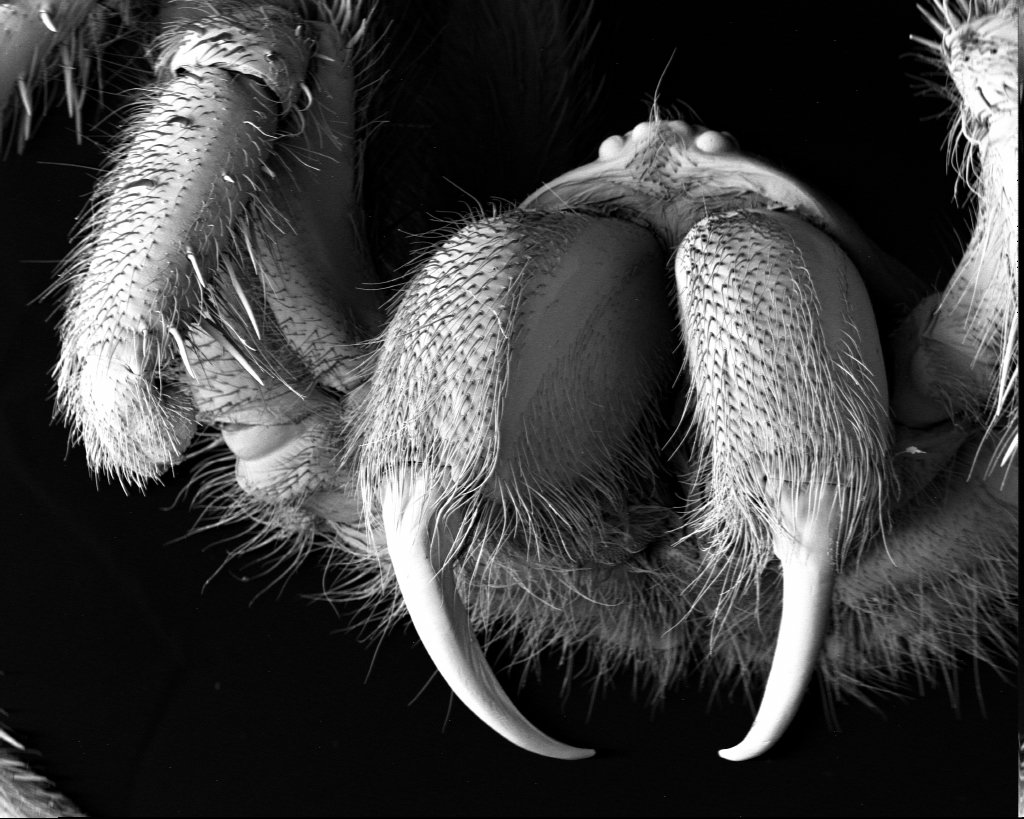
Male Sydney Funnel-web Spider (Atrax robustus) close up using Scanning Electron Microscopy (SEM).
Image: Sue Lindsay© Australian Museum
In Sydney suburbia, funnel-web spiders mostly live in the moist upland forest areas of the Hornsby Plateau to the north and the Woronora Plateau to the south, where sheltered burrow habitats abound in both bushland and gardens. The dry, flatter areas of Western Sydney and the Cumberland Plain have fewer funnel-webs, their numbers picking up again in the foothills of the Blue Mountains. Two funnel-web species are common in the Sydney region – the Sydney Funnel-web Spider (Atrax robustus) and the Southern Tree-dwelling Funnel-web Spider (Hadronyche cerberea). The Blue Mountains Funnel-web Spider (Hadronyche versuta) also occurs here but is only common to the west and south of Greater Sydney.
While Sydney Funnel-webs were never restricted to the leafy north shore region as some would have it, Sydney real estate does give a rough guide to funnel-web density – the more expensive the area the greater the funnel-web population (the dry, sandy eastern suburbs excepted).
Within Hadronyche several groups of related species are currently recognised. These species groups are:
- cerberea group, found entirely south of the Hunter River into Tasmania, except for a single species, the Northern Tree-dwelling Funnel-web Spider, Hadronyche formidabilis, the largest funnel-web spider (body length up to 5 cm)
- infensa group, found north of the Hunter River region into south-east Queensland
- adelaidensis group, isolated in the dry forests of the Gulf Region of South Australia; the only trap-door building funnel-web spiders
- 'lamington' group, several species confined to discrete rainforest areas in New South Wales and Queensland
- anzes group, a single, far northern outlier species in rainforests north of Cairns, north Queensland.
Illawarra wisharti is a single species in its own genus, isolated in the wet forests of the Illawarra region of New South Wales.
Sheltered retreats
Funnel-webs burrow in moist, cool, sheltered habitats – under rocks, in and under rotting logs, crevices, rot and borer holes in rough-barked trees. In gardens, they prefer rockeries and dense shrubberies, and are rarely found in more open situations like lawns.
Rain may flood burrows and the temporary retreats of male funnel-webs, causing an increase in their activity. Funnel-webs are very vulnerable to drying out, so high humidity is more favourable to activity outside the burrow than dry conditions. Most activity is nocturnal. Gardeners and people digging in soil may encounter funnel-webs in burrows at any time of the year.
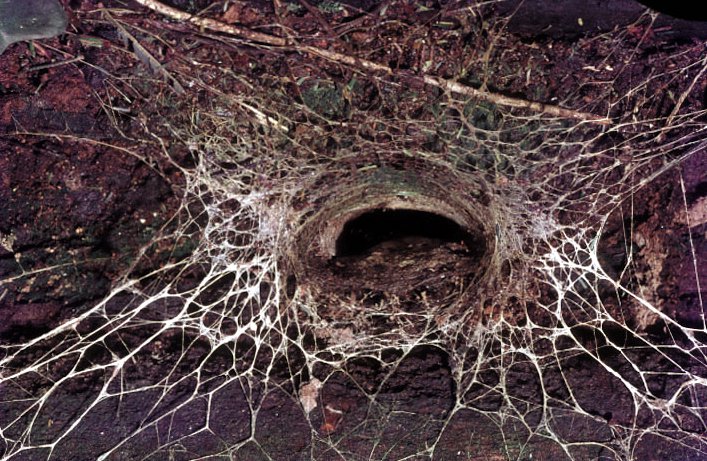
Blue Mountains Funnel-web Spider burrow entrance (Hadronyche versuta), clearly showing silk triplines radiating out from entrance.
Image: Ramon Mascord© Australian Museum
Early warning system
The most characteristic sign of a funnel-web's burrow is the irregular silk trip-lines that radiate out from the burrow entrance of most species. These trip-lines alert the spider to possible prey, mates or danger.
Indeed if a spider burrow has obvious silk trip-lines around its rim, you can be fairly certain that it belongs to a funnel-web spider.
The silk entrance to the burrow of a Sydney Funnel-web Spider has a more or less well-defined funnel-like silk entrance 'vestibule' within which is a collapsed, tunnel-like structure with one or two slit-like openings. The tunnel leads back into a short surface chamber from which the burrow descends. The burrow is often weakly silk-lined and rarely more than 30 cm deep. The spider (hunting mostly at night) sits just inside the entrance with its front legs on the trip-lines. When a beetle, cockroach, or small skink, typical items of funnel-web food, walks across the lines, the spider senses the vibrations and races out to grab its meal. The prey is quickly subdued by an injection of venom from the spider's large fangs. Funnel-web spiders may also forage on the surface in the vicinity of the burrow.
Holes are normally found in moist, shaded areas like rockeries, dense shrubs, logs and leaf litter. A small, neat hole lined with a collar of silk which does not extend more than a centimetre from the rim could belong to a trapdoor spider (the common Brown Trapdoor Spider does not build a 'door' for its burrow). Other possible hole owners include mouse spiders, wolf spiders or insects (most commonly cicadas or ants).
The tree dwellers
Most funnel-webs are ground dwellers but a few live in trees. The largest of all funnel-webs is the Northern Tree Funnel-web Spider, Hadronyche formidabilis, reaching 4 cm-5 cm body length. These spiders live in the wet forests of northern New South Wales and southern Queensland and have been found over 30 m above ground. While many have their retreats in surface-opening branch rot-holes, some spiders appear to live and feed entirely inside the deadwood pipe of large forest trees like Tallow-wood, feeding on beetles and other insects inside this rotting wood habitat. The smaller Southern Tree Funnel-web Spider, H. cerberea, is common in the Sydney and Central Coast regions, but ranges all over eastern New South Wales south of the Hunter River. The abdomen sometimes has a light plum colouration. They make silk-lined retreats in holes and rot-crevices in a variety of rough-barked trees, including Melaleuca (paperbarks), Banksia, Alloasuarina (she-oaks) and eucalypts. The exposed web surface tunnel is disguised by a covering of bark or wood particles. There are often two entrances, each with trip-lines running out across the bark. Prey ranging from beetles to tree frogs are taken by these spiders.

Male Southern Tree Funnel-web Spider (Hadronyche cerberea).
Image: Mike Gray© Australian Museum
Wandering and mating
After they mature, male spiders leave their burrows and become wanderers, especially during the summer/autumn months, looking for females in their burrows. Chemicals called pheromones in the female's tripline silk help the male locate and identify her burrow. Well before mating, the male spins a small silk sperm web, onto which he deposits a droplet of sperm from his abdominal genital pore. The sperm it is then taken up and stored in the mating organs at the ends of the male's palps.
The spur and/or spines on the male's second legs are used to hold the female during mating. During mating, considerable sparring occurs until the female accepts the male. Both spiders rear up with first legs raised against each other, while the male engages his mating spurs across the bases of the female's second legs. The male then inseminates the female by inserting the tips of his palpal organs into the female's genital opening on the underside of her abdomen.
The male factor
Only male spiders have been responsible for all recorded funnel-web envenomation deaths – why? The answer lies in a combination of spider behaviour, venom chemistry, and even colonial history.
During the warmer months of the year (November-April) male funnel-webs wander about at night looking for females in their burrows. Males wandering in suburban gardens may sometimes become trapped inside houses or garages, especially those with concrete slab foundations where entry points under doors are easily reached.
The venom of the male Sydney Funnel-web Spider is very toxic. This is because male spider venom contains a unique component called Robustoxin (δ-Atracotoxin-Ar1) that severely and similarly affects the nervous systems of humans and monkeys, but not of other mammals. The absence of this chemical from female Sydney Funnel-web Spider venom probably explains why bites by these females have not caused any deaths. However, it should not be assumed that bites from females or any funnel-web bites are relatively 'safe' since not all funnel-web species show this gender-based difference in venom toxicity. Over four million people live in the Sydney metropolitan area, the centre of the distribution of the Sydney Funnel-web Spider. This makes the likelihood of human encounters with this spider much greater than in less populous areas like the Blue Mountains and other parts of New South Wales. This is an unforeseen consequence of the 1786 decision to establish a British colony in this region. So now the most populous region in Oceania overlaps strongly with the distribution of one of the world’s most dangerous spider species.

Funnel-web spider antivenom
An antivenom for the Sydney Funnel-web Spider was first developed for clinical use in 1981 by Dr Struan Sutherland and his team at the Commonwealth Serum Laboratories. No deaths have occurred since its introduction. At the same time Sutherland experimentally established the effectiveness of the compression/immobilisation first aid technique for funnel-web bite. Much of the venom for this research was supplied through a funnel-web venom milking program at the Australian Reptile Park near Gosford, NSW. This antivenom has also been effective against other dangerous funnel-web spider species. As well, it has been successfully used in cases of mouse spider envenomation. Antivenom is held at major city and regional hospitals.
Other dangerous funnel-web species
All suspected bites by any funnel-web spider should be regarded as potentially dangerous and treated accordingly. Besides Atrax robustus several other species have been sporadically involved in life threatening envenomations. They include the Blue Mountains Funnel-web Spider (Hadronyche versuta) and the Southern and Northern Tree Funnel-web Spiders (H. cerberea and H. formidabilis).
First aid for funnel-web spider bites – why and how
Despite the availability of an effective antivenom, correct and immediate first aid is still an essential requirement for any Funnel-web Spider (or mouse spider) envenomation. The recommended first aid technique is pressure/immobilisation (as for snake bite) and this must be done as quickly as possible. The pressure/immobilisation technique compresses surface tissues and reduces muscle movement, greatly slowing the lymphatic flow.
Spider bites usually take place on a limb. A pressure bandage should be applied as soon as possible after a bite has occurred. This should be applied as tightly as for a sprained ankle, starting from the bitten area and binding the entire limb above the bite. A rigid splint should be bound onto the limb to prevent limb movement. The patient should be kept as quiet as possible and medical attention must always be sought even if symptoms are not immediately apparent. Severe envenomation is always a medical emergency. If safe to do so, keep the spider for positive identification.
Funnel-web spider FAQs
Can funnel-webs jump?
Despite some popular beliefs , funnel-webs can' t jump. However they can move quickly, and they will rear up when feeling threatened and make sudden lunges when striking. Householders have been surprised by the agility of male funnel-webs, and their sometimes quick escapes from smooth-sided containers (e.g. when the tips of their long legs are able to reach the rim!)
Can funnel-webs swim?
Wandering funnel-webs spiders often fall into backyard swimming pools and they can stay alive for at least 30 hours underwater. They can't swim but they can trap a small bubble of air in hairs around the abdomen, which aids both breathing and floating. As they gradually get waterlogged, their buoyancy decreases and they sink. Eventually they drown but this is a slow process. It should not be assumed that a non-moving spider at the bottom of a pool is dead as they often recover.

This specimen of the notorious Sydney Funnel-web Spider was responsible for the first recorded human death by this species. On 5 February 1927, a toddler sitting on the laundry steps of a house in Thornleigh was bitten on the little finger. It is suspected that the child tried to crush the spider in his hand, which is why the specimen is somewhat squashed. Funnel-web spiders grow up to 3.5 cm in length. They live in cool and humid burrows beneath logs and rocks, across which they spin silken trip lines to alert them to the presence of prey. Although they are one of the most venomous species of spider in the world, there have been no fatalities from Sydney Funnel-web Spider bites since the introduction of antivenom.
Image: Carl Bento© Australian Museum

