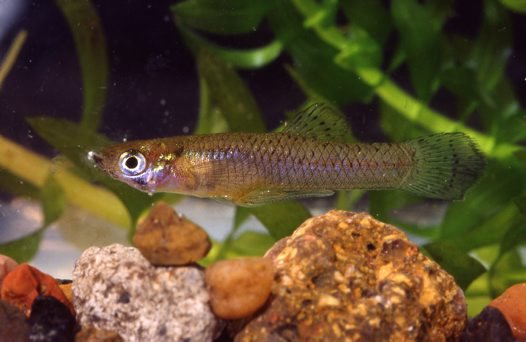
Eastern Gambusia, Gambusia holbrooki Girard, 1859
The Eastern Gambusia has also been called the Mosquitofish.
 Click to enlarge image
© Australian Museum
Fast Facts
-
Classification
- Genus
- Gambusia
- Species
- holbrooki
- Family
- Poeciliidae
- Order
- Atheriniformes
- Class
- Actinopterygii
- Subphylum
- Vertebrata
- Phylum
- Chordata
- Kingdom
- Animalia
-
- Size Range
- Adult females are much larger than males. Females grow to 6 cm in length and males grow to 3.5 cm.
Introduction
The Eastern Gambusia is a major pest species in Australia. Introduced into Australia in the 1920s based on its reputation as a mosquito predator, the species, however, is no more effective at eliminating mosquitos than native fishes.
Identification
The Eastern Gambusia can be recognised by its dorsally flattened head, small, upturned mouth, large eyes, rounded caudal fin and single dorsal fin.
It is green to brown on the above, grey with a bluish sheen on the sides and silvery-white on the belly.
Adult females often have a black mark on the side of the belly above the vent. Males have a large gonopodium. This structure (clearly visible in both images) is formed by the thickened anal fin rays, and is used for sperm transfer to the female.
Habitat
It prefers warm water that is still or gently flowing. In many streams it greatly outnumbers native species. It can tolerate a wide range of temperatures (under ice to 44oC) and water conditions, such as salinities from freshwater to marine.
Distribution
The Eastern Gambusia is native to the rivers of south-eastern America.
The species is now widespread in fresh coastal and inland waters of New South Wales, Victoria, and South Australia. It is also recorded from coastal drainages of Queensland and parts of the Northern Territory, Tasmania and Western Australia.
The map below shows the Australian distribution of the species based on public sightings and specimens in AustralianMuseums. Source: Atlas of Living Australia.
Feeding and diet
Its wide range of food items include ants, flies, aquatic bugs and beetles.
Other behaviours and adaptations
The species shows aggressive fin-nipping behaviour and often outcompetes small native fishes.
Life history cycle
It has a high reproductive rate, producing an average of 50 young per brood although up to 300 have been recorded. The species has up to nine broods per year primarily in the warmer months. Fertilized eggs develop for 3 to 4 weeks inside the female then larvae of a few millimetres in length are born. Young fish mature in under two months. Females can store sperm and self-fertilize in the next season (Ellis, pers comm. ASFB 2011 Conference presentation).
Economic impacts
The Eastern Gambusia was introduced into Australia in the 1920s. Its reputation as a mosquito eater is responsible for one of its common names, Mosquitofish. In Australia, however the Eastern Gambusia appears no more effective at controlling mosquito populations than native fishes.
The species is now a major pest in the freshwaters of eastern New South Wales.
References
- Allen, G.R. 1989. Freshwater Fishes of Australia. T.F.H. Publications. Pp. 240.
- Gill, H.S., Hambleton, S.J., & D.L. Morgan. 1999. Is the Mosquitofish, Gambusia holbrooki (Poeciliidae), a major threat to the native freshwater Fishes of south-western Australia? Proc. 5th Indo-Pac. Fish Conf., Noumea. Seéret, B. & j.-Y. Sire. eds. Paris: Soc. Fr. Ichtyol: 393-403.
- McDowall, R.M. 1996. Freshwater Fishes of South-Eastern Australia. Reed Books. Pp. 247.
- Merrick, J.R. & G.E. Schmida. 1984. Australian Freshwater Fishes. Biology and Management. John R. Merrick. Pp. 409.