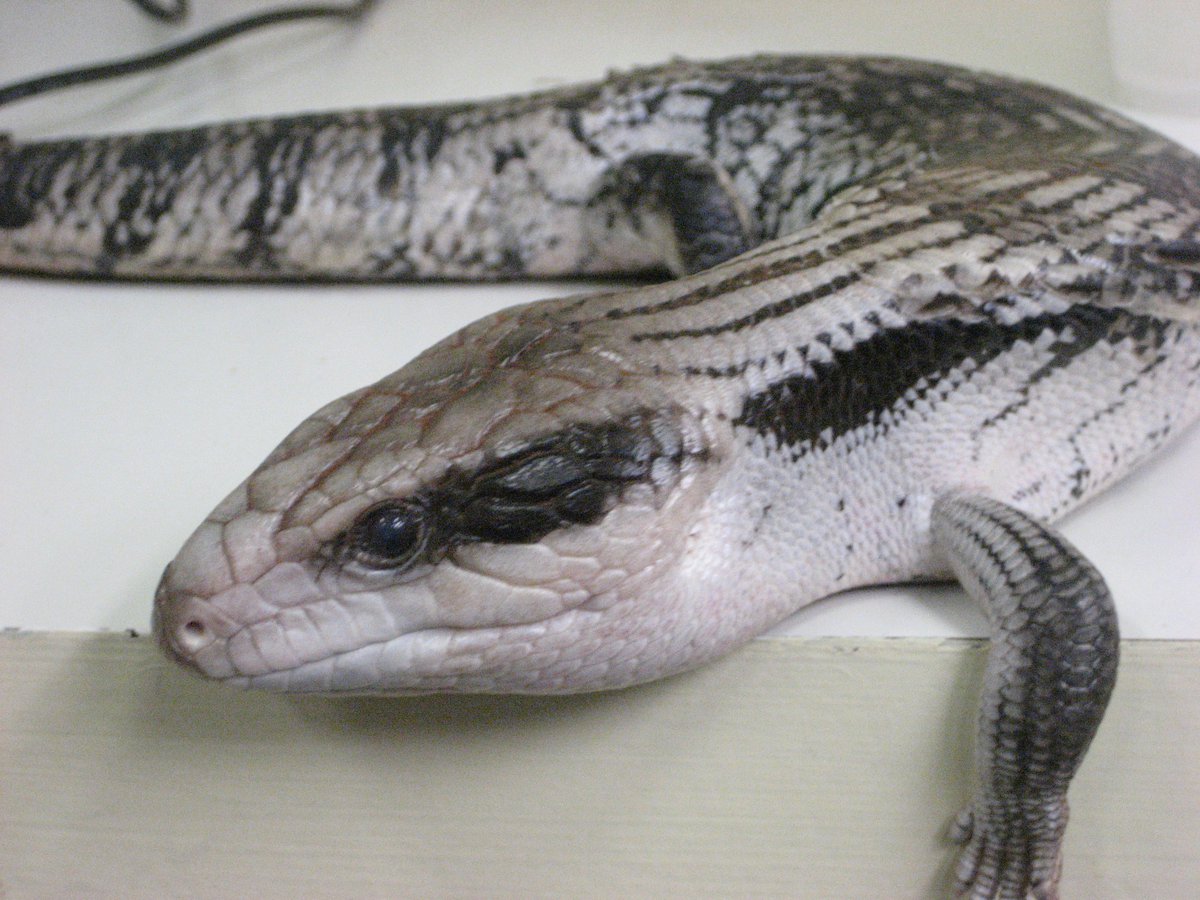
Eastern Blue-tongue Lizard
 Click to enlarge image
© Australian Museum
Fast Facts
-
Classification
- Genus
- Tiliqua
- Species
- scincoides
- Family
- Scincidae
- Order
- Squamata
- Subclass
- Lepidosauria
- Class
- Reptilia
- Phylum
- Chordata
- Kingdom
- Animalia
Introduction
Blue-tongued lizards are the largest members of the skink family. Skink lizards have overlapping scales that are usually smooth and contain small plates of bone.
Identification
The Eastern Blue-tongue is silvery-grey with broad dark brown or blackish bands across the back and tail. Individuals on the coast usually have a black stripe between the eye and the ear which may extend along the side of the neck. The Blotched Blue-tongue is dark chocolate brown to black with large pink, cream or yellow blotches on the back, and a tail banded in the same colours.
The Eastern Blue-tongue can grow to almost 600 mm in total length, of which about 360 mm is head and body.

Eastern Blue-tongue - Tiliqua scincoides
Image: Stephen Mahony© Stephen Mahony
Habitat
Blue-tongues usually live in open country with lots of ground cover such as tussocky grasses or leaf litter. They shelter at night among leaf litter or under large objects on the ground such as rocks and logs. Early in the morning blue-tongues emerge to bask in sunny areas before foraging for food during the warmer parts of the day. Like all lizards, blue-tongues do not produce their own body heat, and rely on the warmth of their surroundings to raise their body temperature. Blue-tongues maintain a body temperature of about 30°C - 35°C when active. During cold weather they remain inactive, buried deep in their shelter sites, but on sunny days they may emerge to bask.
Distribution
The Eastern Blue-tongue occurs throughout much of New South Wales, west to about Cobar. In the Sydney region, the Eastern Blue-tongue occurs on the coastal plain and in the lower Blue Mountains.
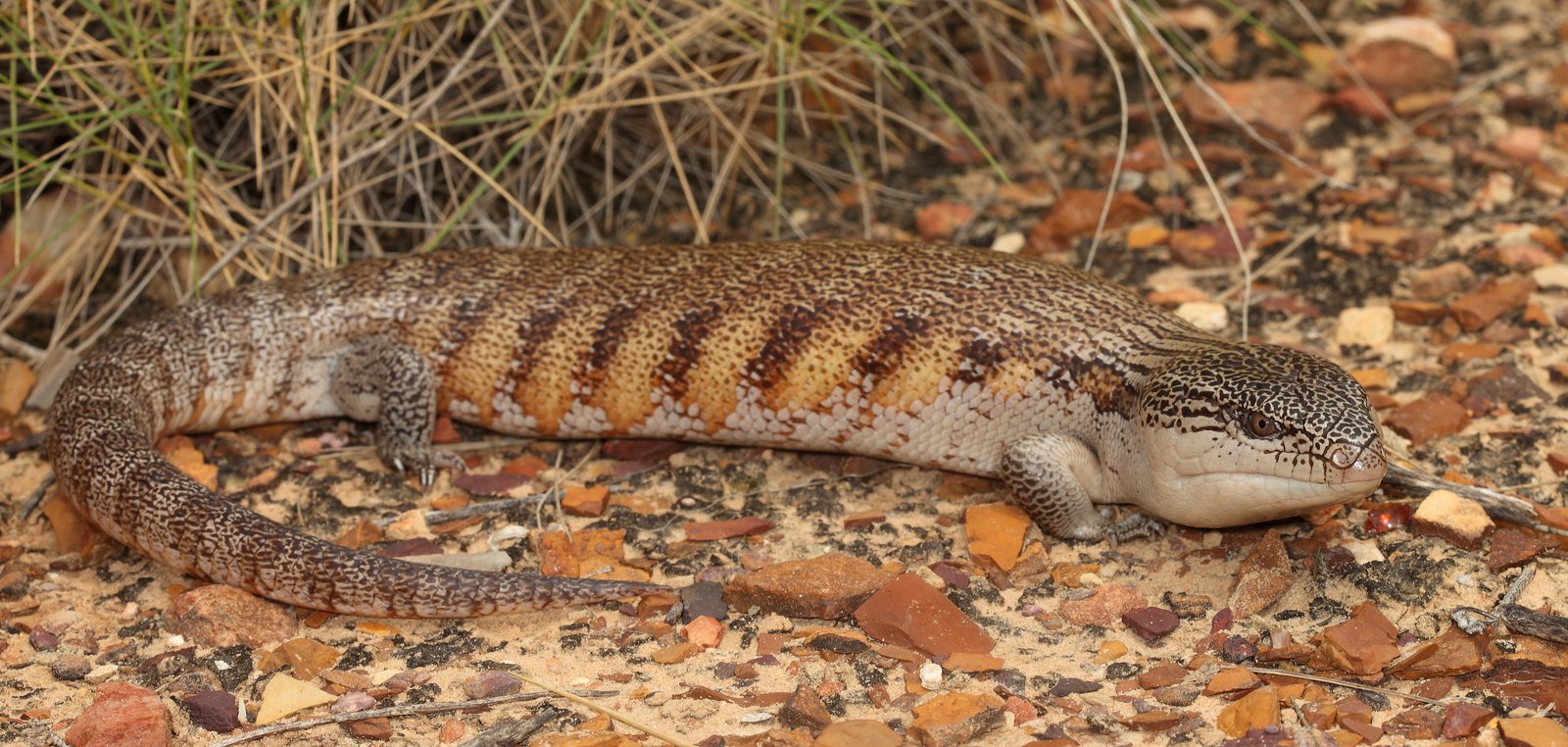
A Northern Blue-tongue Skink (Tiliqua scincoides). Common Blue-tongues from the north of their range are larger and have different body pattern than in the east.
Image: Stephen Mahony© Stephen Mahony
Feeding and diet
Blue-tongues eat a wide variety of both plants and animals. Blue-tongues are not very agile and the animals they eat are mostly slow-moving. Their teeth are large and they have strong jaw muscles so they can crush snail shells and beetles.
Other behaviours and adaptations
When threatened, blue-tongues turn towards the threat, open their mouth wide and stick out their broad blue tongue that contrasts vividly with the pink mouth. This display, together with the large size of the head, may frighten off predators. If the threat does not go away, blue-tongues may hiss and flatten out the body, making themselves look bigger. A frightened blue-tongue may bite if it is picked up.
If handled roughly by their tail, Eastern Blue-tongues, particularly young ones, may drop the tail. The tail stump rapidly heals and a shorter regenerated tail grows back after a while.
Life history cycle
Female blue-tongues give birth three to five months after mating, between December and April. The Eastern Blue-tongue usually gives birth between December and January. The Eastern Blue-tongue is able to breed every year if it has sufficient food but other species of blue-tongue may often skip a year.
The embryos develop in the female's oviduct with the help of a placenta, which is as well-developed as that of many mammals. At birth, the young eat the placental membranes, and within a few days shed their skin for the first time. The young are ready to look after themselves straight after birth, and disperse within a few days.
Of all the blue-tongues, the Eastern Blue-tongue has the largest litters and the smallest young; up to 19 (but usually about 10) young are born, each measuring 130-140 mm in total length and weighing 10-20 g.
Eastern Blue-tongues probably become adults at about three years of age when they have a total length of about 400 mm. Blue-tongues are long-lived. Several captive animals have lived for 20 years, and they may live much longer.
Breeding behaviours
Blue-tongues live alone for most of the year, but between September and November males pursue females and mating occurs. At this time, males may fight aggressively among themselves. Mating may be rough, with females carrying scrape marks from the male's teeth.
Conservation status
Unfortunately, blue-tongues will eat snails and slugs poisoned by snail baits and can be poisoned themselves. Care should be taken in using snail baits and insecticides when blue-tongues are living in a garden. Blue-tongues can squeeze through small holes in and under fences, and garden pests can also cross fences, so chemicals used by neighbours can also affect your blue-tongue.
Look out for blue-tongues when mowing long grass! They will try to escape the lawn mower by hiding in the grass rather than running away. Blue-tongues like to bask on warm surfaces, and black tar roads which warm up quickly in the sun "lure" many to their deaths.
Economic impacts
Adult blue-tongues adapt well to suburbs where there are large backyards with plenty of shelter. They rapidly become used to human activity, and may live in the same place for many years. Rockeries, horizontal pipes and the cavities under houses are favourite hiding places; sunny paths and lawns provide basking sites. Plenty of food such as snails, slugs and caterpillars is usually available in gardens, and a blue-tongue in the garden will help to keep down the number of snails and plant-eating insects.
Predators
Reptile ticks are commonly found on blue-tongues; they attach under the scales and in the ear canal. They do not normally attach to mammals, and are not known to cause paralysis. A number of nematode worms parasitise blue-tongues, and may sometimes be seen in faecal pellets. Again, these worms normally only parasitise reptiles.
In the bush the major predators of blue-tongues are large predatory birds (such as Brown Falcons and Laughing Kookaburras) and large snakes (including the Eastern Brown Snake, Red-bellied Black Snake and Mulga Snake). Feral cats and dogs also eat blue-tongues.
Young blue-tongues are easy prey for suburban dogs and cats, as well as predatory birds like kookaburras. Most young blue-tongues in suburban gardens probably do not reach adulthood. A few adult blue-tongues are also killed by large dogs, although the thick bony scales of the adults protect them from many animal bites.
Danger to humans
A bite from an adult blue-tongue can cause pain, break the skin and leave a bruise but there is no venom and hence no long-term ill effect. However the bite site should be cleaned with a mild disinfectant, as with any animal bite.
References
- Cogger, H.G. 1994. Reptiles & Amphibians of Australia. Reed Books, Sydney.
- Ehmann, H. 1992. Encyclopedia of Australian Animals. Reptiles. Australian Museum and Angus & Robertson, Sydney.
- Greer, A.E. 1989. The Biology and Evolution of Australian Lizards. Surrey Beatty & Sons, Sydney.
- Weigel, J. 1988. Care of Australian Reptiles in Captivity. Reptile Keepers' Association, Gosford.
- Wilson, S.K. & Knowles, D.G. 1988. Australia's Reptiles: A Photographic Reference to the Terrestrial Reptiles of Australia. William Collins, Sydney.