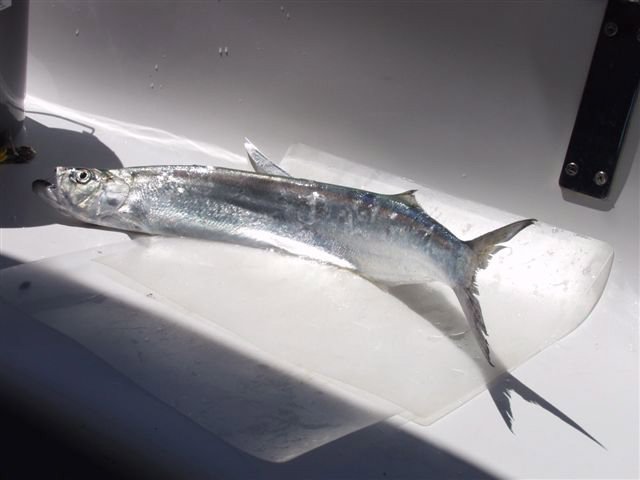
Dorab Wolf Herring, Chirocentrus dorab (Forsskal, 1775)
 Click to enlarge image
© M. Edwards
Fast Facts
-
Classification
- Genus
- Chirocentrus
- Species
- dorab
- Family
- Chirocentridae
- Order
- Clupeiformes
- Class
- Actinopterygii
- Subphylum
- Vertebrata
- Phylum
- Chordata
- Kingdom
- Animalia
-
- Size Range
- It grows to about 1 m in length although rarely exceeds 80 cm.
Introduction
The Dorab Wolf Herring occurs in tropical and subtropical marine waters and is usually found in inshore waters. It feeds on primarily on fishes although crustaceans, squids and other invertebrates are also eaten.
Identification
The Dorab Wolf Herring has an elongate, compressed body with a sharp belly. The body is covered with small cycloid scales. The single dorsal fin and anal fin are positioned in the posterior half of the body. The upward-directed mouth has large canine teeth in both jaws. There are two forward-pointing canine teeth on the premaxillae.
The fish is blue-green above, often with a tinge of violet, and silvery on the sides and belly.

© M. Edwards
Habitat
It is usually found in inshore waters at depths between the surface and 120 m.
Distribution
The species occurs in tropical and subtropical marine waters of the Indo-west Pacific. In Australia it is known from the central coast of Western Australia, around the tropical north of the country and south on the east coast to southern Queensland.
The map below shows the Australian distribution of the species based on public sightings and specimens in Australian Museums. Click on the map for detailed information. Source: Atlas of Living Australia.
Feeding and diet
The Dorab Wolf Herring feeds on primarily on fishes (mainly clupeids and engraulids) although crustaceans, squids and other invertebrates are also eaten.
References
- Munroe, T.A., Nizinski, M.S. & T. Wongratana. 1999. Chirocentridae. in Carpenter, K.E. & V.H. Niem (Eds). FAO Species Identification Guide for Fishery Purposes. The Living Marine Resources of the Western Central Pacific. Volume 3. Batoid fishes, chimaeras and bony fishes part 1 (Elopidae to Linophrynidae). FAO, Rome. Pp. iii-vi, 1398-2068.
- Randall, J.E. 2005. Reef and Shore Fishes of the South Pacific: New Caledonia to Tahiti and the Pitcairn Islands. University of Hawai’i Press. Pp. 584.