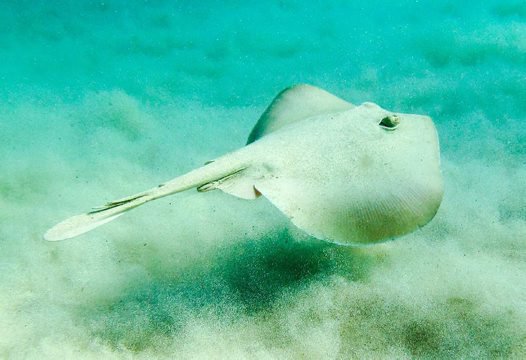
Common Stingaree, Trygonoptera testacea Müller & Henle, 1841
 Click to enlarge image
© Stephen Coulter
Fast Facts
-
Classification
- Genus
- Trygonoptera
- Species
- testacea
- Family
- Urolophidae
- Order
- Myliobatiformes
- Class
- Chondrichthyes
- Subphylum
- Vertebrata
- Phylum
- Chordata
- Kingdom
- Animalia
-
- Size Range
- This species grows to 47cm in length.
Introduction
The Common Stingaree occurs from southern Queensland to southern New South Wales where it is commonly observed in shallow coastal estuaries and reefs. At least six species of stingarees are known to live along the New South Wales coast making it often very difficult to identify an individual in the wild.
Identification
The Common Stingaree is dark brown to grey above and white below. It has a small dorsal fin or a narrow ridge of skin in front of one or two strong, venomous spines on the tail, and a leaf-shaped caudal fin. The shape of the caudal fin is one of the characteristics which separate the stingarees (family Urolophidae) from the other rays including the stingrays (family Dasyatididae) and the skates (family Rajidae).
At least six species of stingarees are known to live along the New South Wales coast. They can be very difficult to identify.
Habitat
The Common Stingaree is most often observed in shallow coastal estuaries and reefs.
Distribution
The Common Stingaree occurs from southern Queensland to southern New South Wales.
References
- Hoese, D.F., Bray, D.J., Paxton, J.R. & G.R. Allen. 2006. Fishes. In Beesley, P.L. & A. Wells. (eds) Zoological Catalogue of Australia. Volume 35. ABRS & CSIRO Publishing: Australia. parts 1-3, pages 1-2178.
- Kuiter, R.H. 1996. Guide to Sea Fishes of Australia. New Holland. Pp. 433.
- Kuiter, R.H. 2000. Coastal Fishes of South-eastern Australia. Gary Allen. Pp. 437. Last, P.R. & ; J.D. Stevens. 1994 Sharks and Rays of Australia. CSIRO. Pp. 513.
- Last, P.R. & J.D. Stevens. 2009. Sharks and Rays of Australia. Edition 2. CSIRO. Pp. 644, Pl. 1-91.