

Burial - Toraja, Sulawesi
On this page...
The Toraja live in the mountainous southern region of the Indonesian island of Sulawesi. Most are now Christian. However, elements of the traditional religion, aluk to dolo ('the law of the ancestors'), are still followed, especially in rural areas.


There is a belief in Toraja that when you die you won't be separated directly from the family - you are expected to bring them good luck and so the family must respect you. When we think of our ancestors, we respect them as individuals, rather than as a group. When a small baby dies, one who hasn't grown teeth yet, they used to be buried in a tree. It had to be a living tree, so that as the tree grew it continued the baby's life. Nicolaus Pasassung, 41, Linguist. Sa'dan, Rantepao, Toraja.
Ancestor spirits can be harmful or protective depending on how they died. People who have died an unnatural death, such as through suicide, accidents or in childbirth, will not go easily to puya, the land of the dead. Ancestors must be treated with appropriate esteem or they will become unhappy, impoverished spirits.
The most important ceremony in a person's life cycle is the funeral. For this reason, there is often a lengthy interval between a person's death and their burial. Time is needed to ensure that all family members can attend and to save money to buy buffalo. In some cases, the deceased may be kept in the house for years, injected with formalin and placed in a temporary wooden coffin. In the past, the body would be laid on a mat in a special room, with bamboo pipes under the floor to catch and divert body fluids.
Death is a gradual process rather than an abrupt event. The deceased is referred to as to mamma (sleeping person) or to masaki (sick person) until the commencement of funeral rites when they are called to membali puang (person who has become one of the gods) or to mate (dead person).
tau tau
Wooden human figures called tau tau accompany the deceased on their journey from the funeral house to the burial ground, where they watch over both the living and the dead. Once carved only for wealthy families, they are now status symbols used by a range of families.
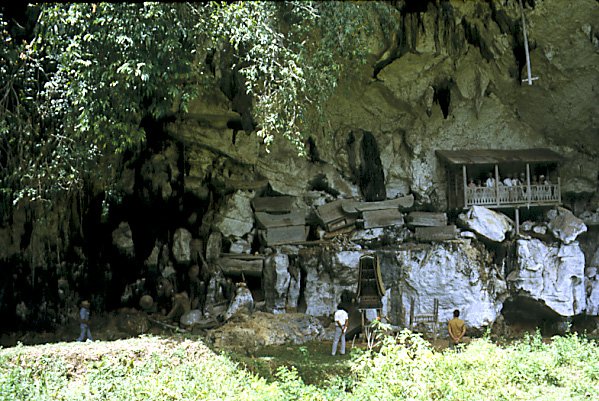
Prior to the 17th century, Torajans were buried in elaborate, boat-shaped wooden coffins stored at the base of cliffs. After heirlooms were extensively plundered, Torajans began burying their dead in high cliff-face vaults. It is now common for people to be buried in family vaults.
Ceremonial Knife
Torajans call knives la'bo' to dolo (knife of the ancestors). They are rare heirlooms, believed to possess magical powers. During the funeral, precious items such as sarita textiles and ceremonial knives are displayed in front of the funeral houses, emphasising the social position of the deceased's family.
The widow of a wealthy deceased man wears black clothing and a poté (widow's hood) until the close of funeral rites, a few days after burial. The hood and other articles of clothing are dyed black using crushed Homolanthus populneas leaves and mud.
Warrior Dance

© Australian Museum
The duration of the funeral, and the number of buffalo killed, depends on the deceased's status. The funeral for a member of the nobility lasts up to seven days and may involve the slaughtering of between 50 and 100 buffalo. At a large funeral for a higher-caste person, a warrior dance called ma'randing is performed, to welcome the guests. The dancers' outfits are based on traditional warrior dress and weaponry.
