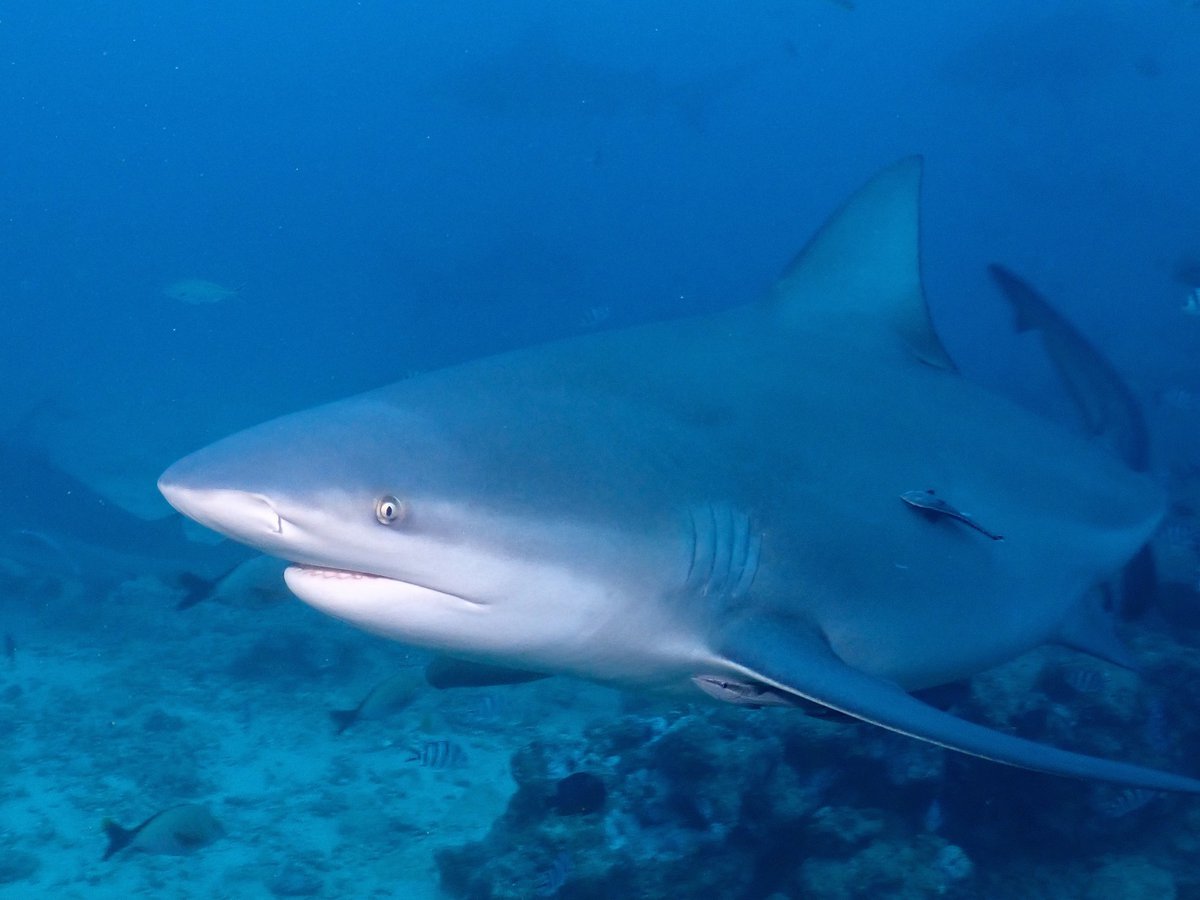
Bull Shark, Carcharhinus leucas Valenciennes, 1839
The Bull Shark has also been called the River Shark, Freshwater Whaler, Estuary Whaler and Swan River Whaler.
 Click to enlarge image
© CC BY-NC 4.0
Fast Facts
-
Classification
- Genus
- Carcharhinus
- Species
- leucas
- Family
- Carcharhinidae
- Class
- Chondrichthyes
- Subphylum
- Vertebrata
- Phylum
- Chordata
- Kingdom
- Animalia
-
- Size Range
- The species grows to a length of 3.4 m.
Introduction
The Bull Shark is one of the few sharks that are potentially dangerous to people and is probably responsible for most of the shark attacks in and around Sydney Harbour.
The species is also the only widely distributed shark that stays in fresh water for long periods of time to feed and breed. Females sometimes give birth in river mouths where the young will live for up to 5 years.
3D interactive model of Bull Shark
3D model made by cdmstudio.com.au
What do Bull Sharks look like?
Identification
The Bull Shark can be recognised by a combination of characters including a stout body, short blunt snout, triangular serrated teeth in the upper jaw and no fin markings as an adult. The species has a second dorsal fin about one third the height of the first, a small eye, and no skin ridge between the two dorsal fins. It is grey above and pale below, sometimes with a pale stripe on the flank.
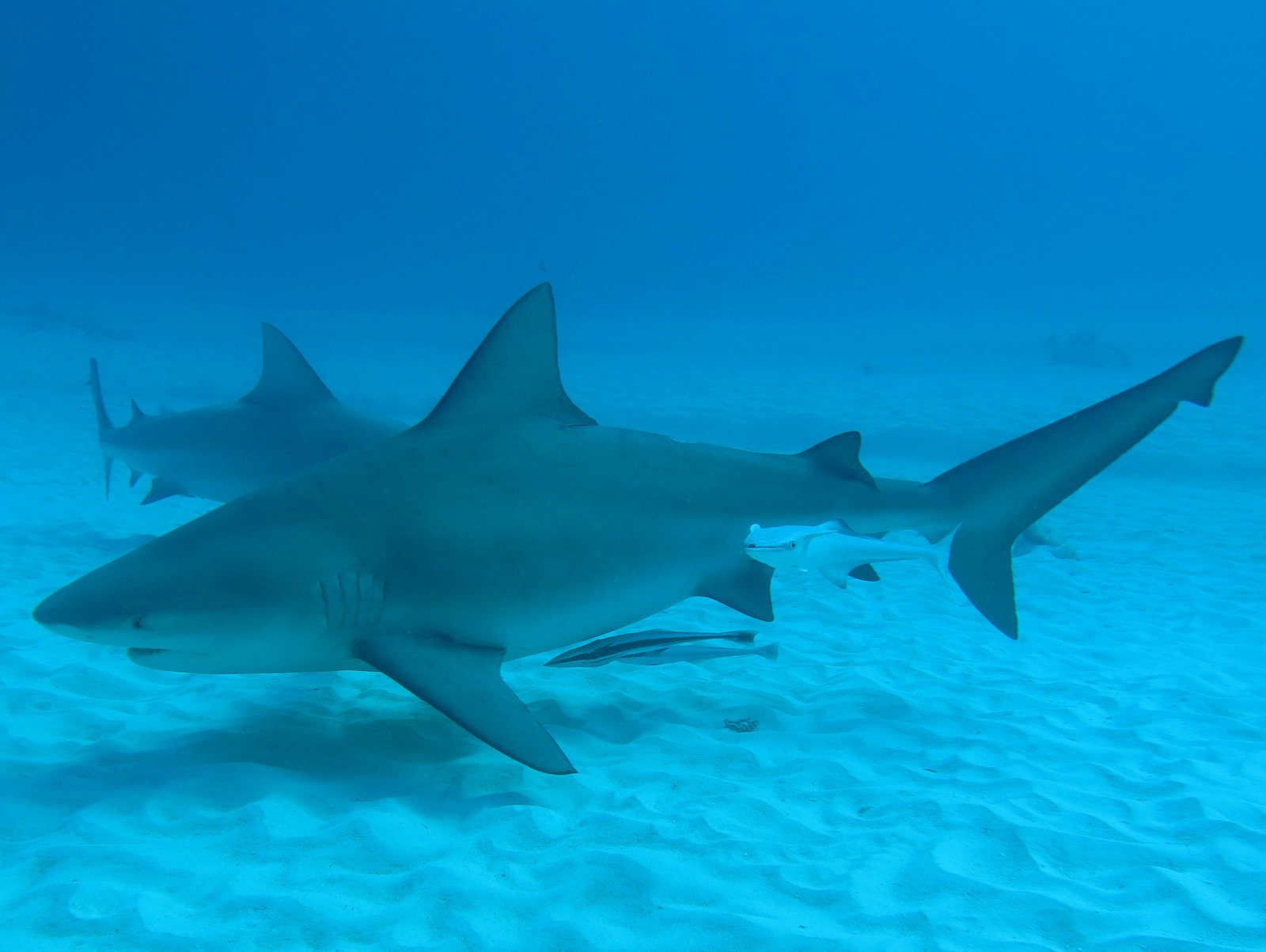
© CC BY-NC 4.0
Where do Bull Sharks live?
Habitat
The Bull Shark can live in a wide range of habitats from coastal marine and estuarine, to freshwater. It has been recorded from the surf zone down to a depth of at least 150 m. It is the only species of shark that is known to stay for extended periods in freshwater. It has been reported nearly 4000 km from the sea in the Amazon River system, and is known to breed in Lake Nicaragua, Central America.
Distribution
This species has a widespread distribution in tropical and warm temperate waters worldwide. In Australia the Bull Shark occurs from south-western, Western Australia, around the northern coastline and down the east coast to the central coast of New South Wales.
The map below shows the Australian distribution of the species based on public sightings and specimens in Australian Museums.
What do Bull Sharks eat and what is their life cycle?
Feeding and diet
Bull Sharks have an omnivorous diet which includes fishes (including other sharks), dolphins, turtles, birds, molluscs, echinoderms and even terrestrial mammals including 'antelope, cattle, people, tree sloths, dogs and rats’ (Compagno, 1984; 480).

© CC BY-NC 4.0
Life History
Bull sharks are born at between 55-80 cm and grow to ~340 cm TL. Female and males mature at about 220-230 cm TL at around 20 years of age, living for approximately 50 years.
Females generally give birth to litters of between 1-13 pups in estuaries and river mouths where the young stay for about 5 years before spending time in their preferred environment of close inshore lagoons, bays, coastal channels and river mouths.
Sharks online publication
Delve into the world of Sharks and explore the digital publication with videos and extra content from the exhibition. Hear from First Nations peoples, scientists and conservationists as they share their stories about these ancient survivors.
Explore nowAre Bull Sharks dangerous?
Danger to humans
The Bull Shark is an aggressive species that is considered dangerous to humans. Some authors consider that the Bull Shark may be more dangerous than the White Shark and the Tiger Shark. This is because of the Bull Shark's omnivorous diet and habitat preferences. The species may be found in murky water, where the splashing of a swimmer could be mistaken for a struggling fish.

A male Bull Shark caught in Middle Harbour, Sydney, New South Wales, February 1999.
Image: Stuart Humphreys© Australian Museum
The 2.8 m long fish in the images was caught on 18 February 1999, in a commercial fishing net near Grotto Point, Middle Harbour (Sydney Harbour) by T. and V. Depasquale and S. Virtu. This catch was a most unusual occurrence which attracted significant media interest. The specimen was on display at the Sydney Fish Markets for a week (where the images were taken) before it was donated to the Australian Museum by G. Costi (De Costi Seafoods). The specimen is now registered in the Australian Museum Fish Collection (AMS I.39432-001).
References
- Compagno, L. 1984. FAO species catalogue. Vol. 4. Sharks of the world. An annotated and illustrated catalogue of shark species known to date. Part 2. Carcharhiniformes. FAO Fish.Synop., (125) Vol.4, Pt.2: 251-655.Last, P.R. & J.D. Stevens. 1994. Sharks and Rays of Australia. CSIRO. Pp. 513, Pl. 1-84.
- Hutchins, B. & R. Swainston. 1986. Sea Fishes of Southern Australia. Complete Field Guide for Anglers and Divers. Swainston Publishing. Pp. 180.
- Last, P.R. & J.D. Stevens. 2009. Sharks and Rays of Australia. Edition 2. CSIRO. Pp. 644, Pl. 1-91.
- Paxton, J.R. 2003. Shark nets in the spotlight. Nature Australia. Spring. 27 (10): 84.