

Broadgilled Hagfish, Eptatretus cirrhatus (Forster, 1801)
The Broadgilled Hagfish is also known as the New Zealand Hagfish.
 Click to enlarge image
© Museum of New Zealand Te Papa Tongarewa
Fast Facts
-
Classification
- Genus
- Eptatretus
- Species
- cirrhatus (Forster, 1801)
- Family
- Myxinidae
- Order
- Myxiniformes
- Class
- Myxini
-
- Size Range
- The Broadgilled Hagfish grows to 83 cm in length.
Introduction
Hagfishes eat mostly dead fishes and worms. They use their rasping teeth to burrow through the body wall or enter through the mouth, gills or anus of larger animals.
Hagfishes are able to produce large quantities of slime. These fishes can tie their bodies in a knot and then run the knot down the length of the body to remove slime.
Identification
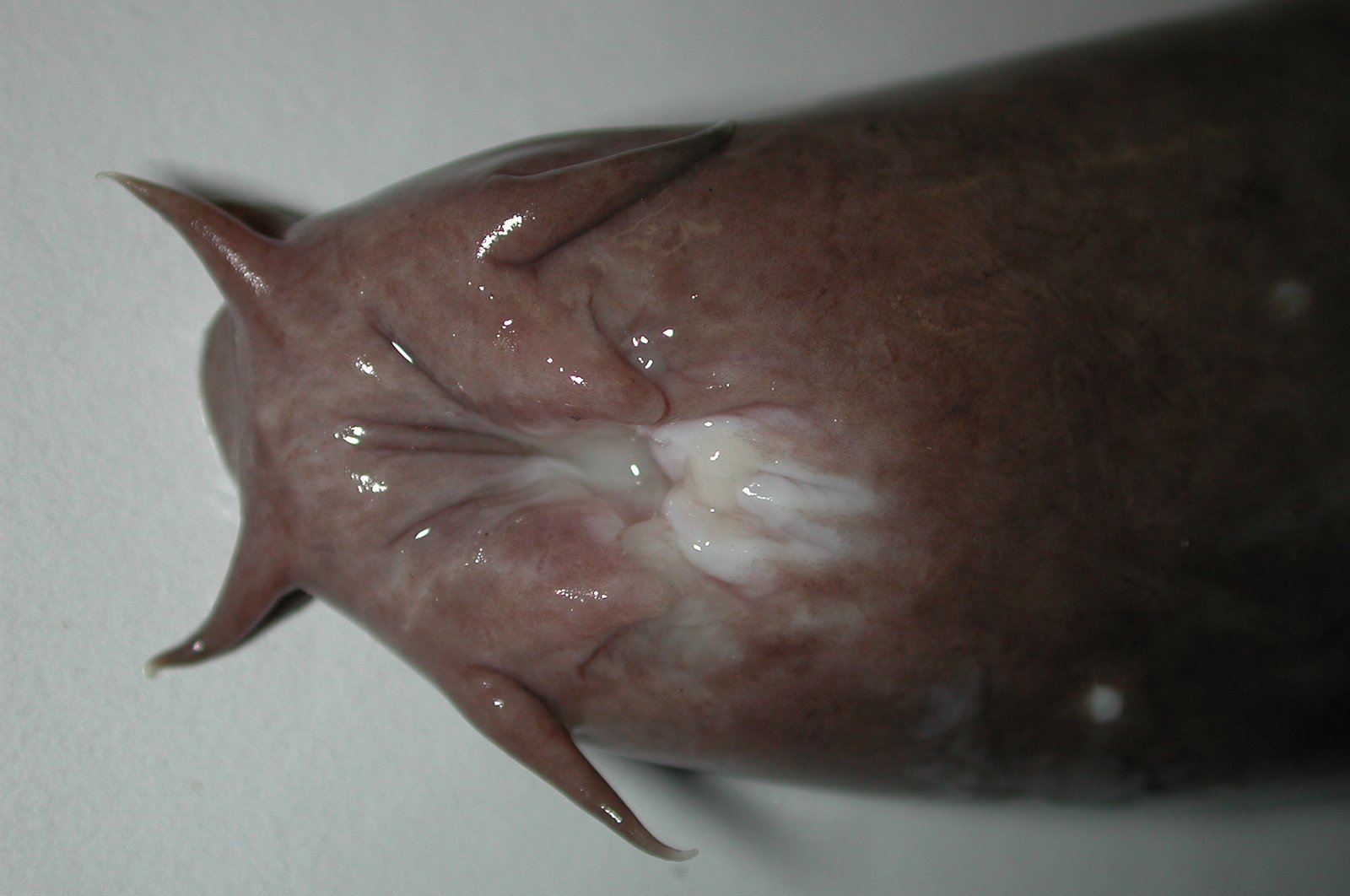
The Broadgilled Hagfish has an eel-like body that lacks scales. It has vestigial eyes, six barbels around the mouth and six or seven gill openings on the lower sides. The tail is paddle-like. There are rows of slime glands on the lower sides. Like other hagfishes, it lacks jaws but has a mouth lined with horny teeth.
It is grey to brown above and sometimes paler below. The gill openings have white borders.


Habitat
It is known from depths of 300 m to 700 m,
Distribution
The species occurs in temperate marine waters of southern and eastern Australia and New Zealand.
In Australia it occurs off southern Queensland to southern New South Wales.
The map below shows the Australian distribution of the species based on public sightings and specimens in Australian Museums. Source: Atlas of Living Australia.
Feeding and diet
Hagfishes eat mostly dead fishes and worms. They use their rasping teeth to burrow through the body wall or enter through the mouth, gills or anus of larger animals.
From the article "Thin-Skinned" by Kim Tingley on the onearth website:
"Glover and colleagues recently discovered another way hagfish are both incredibly efficient and incredibly unsavory eaters. Noticing their proclivity for burrowing into the decaying carcasses to dine on them -- and realizing that a "soup of nutrients" like proteins and carbohydrates was likely forming inside the rotting animals -- they ran tests on hagfish skin. Turns out the scavengers were absorbing nutrients across the entire surface of their bodies while at the same time munching with their mouths."
Other behaviours and adaptations
Hagfishes are able to produce large quantities of slime. When the concentrated slime solution is ejected from the slime glands it mixes with seawater and expands to several hundred times its initial volume. A bucket of water can be turned into slime in a matter of minutes after the inclusion of a hagfish. These fishes can tie their bodies in a knot and then run the knot down the length of the body to remove slime.
Predators
Hagfishes are preyed upon by marine mammals and octopuses (Zintzen et.al, 2011). Hagfishes are not generally eaten by fishes. Zintzen and colleagues used underwater video cameras to record footage of sharks and bony fishes attempting to eat hagfish. When the would-be predator attacked a hagfish, it ended up with a mouthful of slime and immediately spat out the hagfish. Marine mammals and octopuses do not have gills that can be clogged by slime.
References
- Fernholm, B. & Paxton, J.R. 1998. Hagfishes. in Carpenter, K.E. & V.H. Niem (Eds). FAO Species Identification Guide for Fishery Purposes. The Living Marine Resources of the Western Central Pacific. Volume 2. Cephalopods, crustaceans, holothurians and sharks. FAO, Rome. Pp. iii-vi, 688-1396.
- Fudge, D. 2001. Hagfishes: Champions of Slime. Nature Australia. 27(2): 61-69.
- May, J.L. & Maxwell, J.G.H. 1986. Field Guide to Trawl Fish from Temperate Waters of Australia. CSIRO Division of Marine Research. Pp. 492.
- Zintzen, V., Roberts, C.D., Anderson, M. J., Stewart, A.L., Struthers, C.D, & E.S. Harvey. 2011. Hagfish predatory behaviour and slime defence mechanism. Nature. Scientific Reports. Volume: 1, Article number: 131, DOI: 10.1038/srep00131.

